

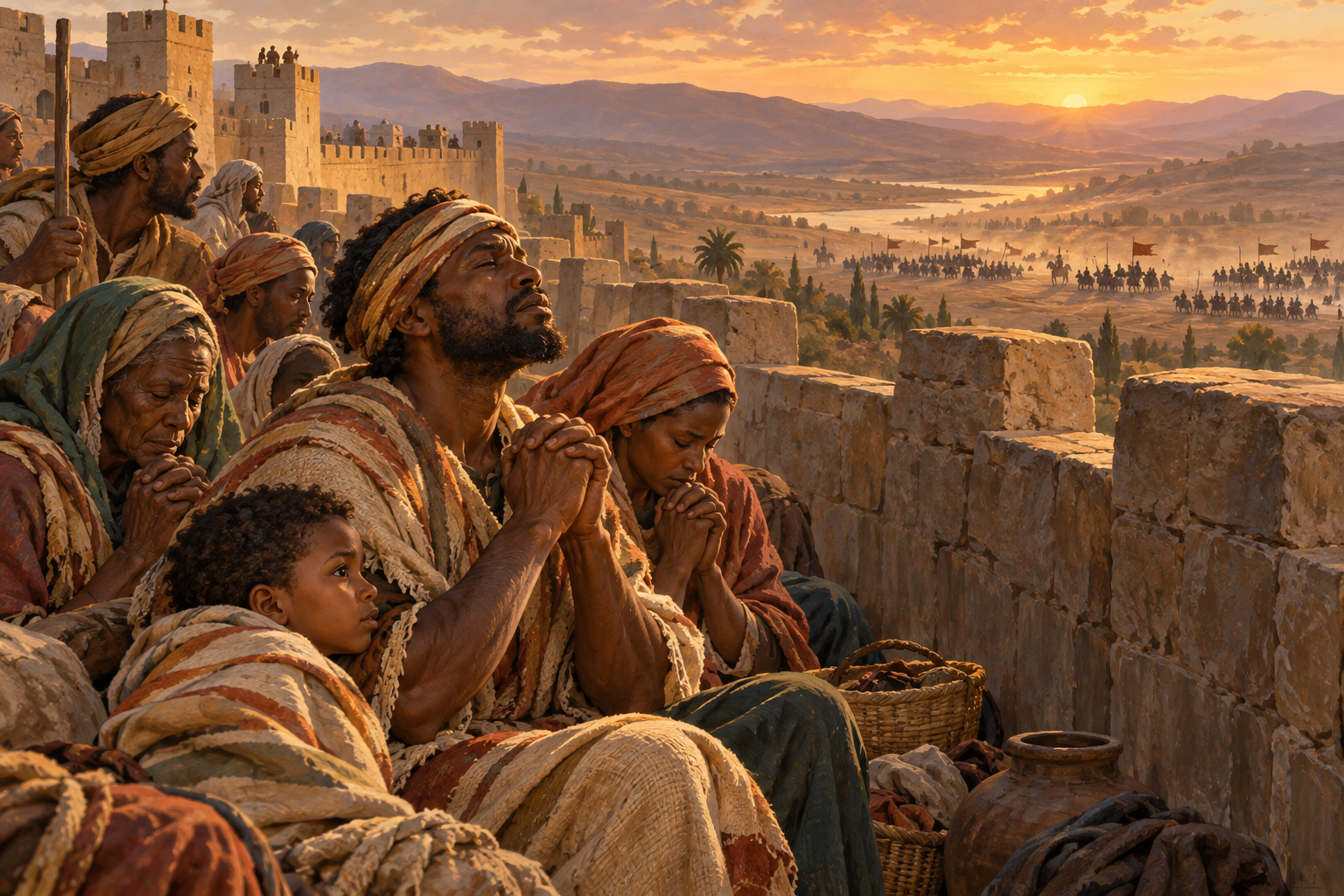
How can an endangered community pray for protection without being ruled by revenge?
01
Overview
An endangered community calls upon the God of all the earth to break the power of aggression—and make his name known
Key text — Psalm 83:1, 16–18 (summary of the passage): The psalm asks God not to remain silent while enemies plot to destroy his people. Its closing petition asks that the attackers be brought to acknowledge the LORD as the Most High over all the earth. This is a summary, not a verbatim quotation from a particular Bible translation.
A community hears plans being made about its future—but it has not been invited into the room. The plans are not for negotiation or peaceful coexistence. They are for its disappearance. Around it stand peoples with different histories and interests, united for one dreadful purpose.
The community has little control over what those powers decide. So the singer looks beyond the gathering of enemies and addresses another throne: God, do not keep silent.
02
1.0 Introduction
What do you pray when you are surrounded by hostility? Not merely criticized or misunderstood, but threatened by people who want your community to vanish? How do you entrust the longing for safety and justice to God without letting fear turn into an appetite for revenge?
Psalm 83 refuses to make these questions comfortable. It speaks of a plot to remove Israel from the family of nations, asks God to repeat severe judgments from Israel's history, and summons images of storm and consuming fire. Yet near its conclusion comes a startling request: let the enemies seek God's name and recognize that the LORD alone is Most High over the entire earth (vv. 16–18).
This is the last psalm in the principal Asaph collection, Psalms 73–83. Its placement matters. Psalm 82 called God to rise and judge the earth because the powerful were failing the vulnerable. Psalm 83 shows a particular people fearing the consequences when collective power is organized for destruction. Together, the two psalms ask what becomes of the weak when authorities fail—and whether God's reign will finally be recognized by every nation.
Central message: When a community faces the threat of annihilation, it may take its fear and demand for justice to God. But the horizon of prayer must remain larger than its own survival: the world's powers are accountable to the LORD, whose rule is intended to be known throughout the earth.
03
2.0 Historical and Literary Context
The heading calls this a song and psalm of Asaph. It concludes the Asaph sequence in Book Three (Psalms 73–83), a collection preoccupied with failed justice, national vulnerability, threatened worship, and God's apparently delayed action. The precise date, authorial setting, and military crisis behind Psalm 83 cannot be established.
Its enemy list includes Edom, the Ishmaelites, Moab, the Hagrites, Gebal, Ammon, Amalek, Philistia, Tyre, and Assyria (vv. 6–8). Several were neighboring peoples related to Israel through biblical family histories; others were coastal powers or an imperial force. Gebal may refer to a region south of the Dead Sea or to the northern coastal city known as Byblos. The catalog's geographical sweep makes the community's sense of encirclement vivid, but no securely documented episode matches this entire coalition (Goldingay 2007, 573–79).
Derek Kidner points to the crisis in the reign of Jehoshaphat (2 Chronicles 20), when Moab, Ammon, and forces associated with Edom threatened Judah. This offers a suggestive parallel, especially because an Asaphite minister speaks in that narrative. But Kidner notes that the psalm names far more peoples than the narrative does and that the singers in the story are not identified as Asaphites. He therefore allows that Psalm 83 evokes the recurring experience of threats against Israel rather than recording that particular battle (Kidner 2014, 330–31).
John Goldingay likewise cautions against reading the list as a dated military intelligence report. Several periods could explain its anxiety, and the psalm describes a conspiracy being planned, not the aftermath of a completed invasion. The resemblance to Psalm 2, where nations devise plans against God's rule, may be more important than a precise reconstruction of a battlefield (Goldingay 2007, 572–75).
The poem's movement is clear:
1. Verse 1 — The opening appeal: God must not remain silent. 2. Verses 2–8 — The reason for alarm: enemies threaten God's people and form a hostile alliance. 3. Verses 9–12 — An appeal to remembered history: the singer recalls the defeat of oppressive powers in the days of the judges. 4. Verses 13–15 — A prayer using nature's violence: wind, fire, and storm picture the destruction of aggression. 5. Verses 16–18 — The difficult final aim: shame, judgment, and the acknowledgment of the LORD.
Unlike many lament psalms, Psalm 83 contains no extended confession of sin, no narrative of the people's previous fidelity, and no clear announcement that the answer has come. It is an urgent petition. Significantly, the people speak largely of your enemies and your people: the singer grounds the appeal in God's relationship with Israel rather than in claims of national innocence.
A caution for contemporary readers is essential. These are names of ancient peoples in an ancient poetic setting. They are not a scriptural license to identify today's ethnic communities, religions, or nation-states as permanent objects of divine hatred. The psalm requires careful historical reading, not the transfer of an ancient enemy list onto living neighbors.
04
3.0 Walking Through the Text
3.1 When God seems silent, prayer becomes a protest
Psalm 83:1
The opening piles up three related requests: do not be silent, do not hold back your voice, do not stay quiet. Repetition conveys urgency. The singer does not think that a loud prayer can manipulate God; the point is that silence feels unbearable when danger is approaching.
The plea stands near others in which Israel asks God to speak and act (Psalm 28:1; 74:10–11). The language also recalls the prophetic picture of God ceasing to hold back and rising to deliver his people (Isaiah 42:13–14). What the singer seeks is not merely reassurance but intervention.
Notice the direction of the protest: the speaker addresses God, not a crowd to be stirred into retaliatory violence. Bringing a grievance before God does not remove the need for responsible action, but it refuses to let human rage appoint itself the supreme judge.
3.2 The threat is not defeat alone but erasure
Psalm 83:2–4
The enemies are noisy while God seems silent. They roar, lift their heads, and deliberate against a people described as belonging to God and sheltered by him. Their intention is then made explicit: Israel must cease to be a nation, and its name must no longer be remembered.
This is more severe than an ordinary quarrel over borders or influence. The enemies aim at collective extinction and the destruction of a people's memory. In biblical language, a name represents recognition, identity, and a place within the human story. The plot seeks to make an entire community disappear from that story (compare Esther 3:6–9).
The contrast is sharp: those whom God protects are precisely those the aggressors intend to eliminate. That does not mean Israel's people are morally flawless; other psalms and prophets regularly confront their sins. The immediate issue here, however, is the wickedness of the threat itself. No community's failures make a plan for its annihilation righteous.
The text provides language for those who face organized exclusion, persecution, or violence. They need not make their grief polite before God. They may name the threat truthfully.
3.3 An alliance can be powerful and still be wrong
Psalm 83:5–8
The plans become a solemn agreement: diverse peoples act together “against you,” meaning against the God to whom the threatened people belong. The list moves around Israel's world: Edom and Moab, peoples linked to the families of Esau and Lot; groups associated with Ishmael and Hagar; Ammon and Amalek; Philistia and Tyre; and finally Assyria, the great imperial name (Genesis 25:12–18; 36:1–9; 19:36–38; 1 Chronicles 5:10; Exodus 17:8–16).
The names communicate political isolation. Opposition is not coming from one direction. The singer looks around and sees few safe borders. Even relations among peoples with ancestral links offer no guarantee of peace.
But numbers do not establish moral legitimacy. A coalition can coordinate trade, care, or peace—or organize dispossession and harm. Agreement about a violent objective does not make the objective just.
The passage must be read with historical precision. The list does not prove that these peoples always behaved with identical motives or that every member of each group shared the hostility. It dramatizes a threatened community's perception of converging powers. Goldingay emphasizes both the breadth of the names and the uncertainty of assigning them to one identifiable campaign (Goldingay 2007, 577–79).
3.4 Memory becomes a plea: you delivered the weak before
Psalm 83:9–12
The psalm turns from contemporary names to the Book of Judges. Midian was defeated despite Gideon's tiny force (Judges 7–8). Sisera and Jabin were defeated in the story of Deborah and Barak, culminating around the Kishon River (Judges 4–5). Oreb, Zeeb, Zebah, and Zalmunna recall leaders whose apparent power did not secure their victory (Judges 7:25; 8:10–21).
The singer is not recounting this history for historical interest alone. The memories become arguments in prayer: God, the enemies confronting us are not stronger than the enemies you once overcame.
The quoted ambition in verse 12 is to seize God's dwelling places or pastures. The precise reference may include the land and its sacred associations. The deeper claim is that the land is not simply a prize to be distributed by whichever army has the strongest weapons. The singer regards it as entrusted by God.
Yet the psalm is asking for acts of violent judgment like those in the Judges narratives. Readers should neither censor this difficulty nor assume that every biblical description of ancient warfare is a standing instruction for believers to imitate. The text is a prayer spoken from peril, and the remembered stories supply its imagery. Ethical Christian application requires reading it within Scripture's fuller account of justice, enemies, and God's kingdom.
3.5 Wind, fire, and storm express the demand that aggression be stopped
Psalm 83:13–15
The psalm's images intensify: make them like something driven and scattered by the wind; pursue them like a fire spreading through woodland; overwhelm them like a tempest. Nothing in these images suggests slow negotiation. The prayer is for violent plans to collapse decisively.
The imagery also exposes the fragility of apparent strength. Armies and political alliances that seem immovable may prove as transient as chaff before a storm (compare Psalm 1:4; Isaiah 17:12–14). Their confidence is real, but it is not ultimate.
These lines are unsettling because they ask God to terrorize the threatening powers. That difficulty should be felt, particularly by readers whose families have experienced violence. Psalm 83 lets threatened people bring terrifying emotions into prayer, but it does not authorize them to terrorize civilians, seek communal vengeance, or treat cruelty as worship.
A responsible response to actual threats can include protecting victims, obtaining help, documenting wrongdoing, demanding just intervention, and working to stop violence. None of those actions requires turning the psalm into a celebration of destruction for its own sake.
3.6 The last prayer reaches toward God's name—and retains a painful tension
Psalm 83:16–18
Verse 16 introduces a purpose we might not expect: let the enemies be humiliated so that they may seek the LORD's name. The singer appears to desire more than their disappearance. Their pride must give way to the recognition that they cannot oppose God's purposes with impunity.
Then verse 17 asks for enduring shame, terror, and death. That sounds incompatible with a call to turn and seek God. Verse 18 nevertheless renews the larger purpose: they are to know that the LORD alone is the Most High over all the earth.
It would be convenient to explain every detail as if the singer were simply asking for conversion. It would be equally misleading to read the psalm as though it only wanted enemies killed. Both desires appear in the poem, and they stand in genuine tension. Goldingay calls attention to the unresolved wish for punishment, humiliation, and positive acknowledgment within the same prayer. Kidner stresses that even a threatened community retains a horizon wider than its immediate triumph: the divine name is to be recognized throughout the world (Goldingay 2007, 582–85; Kidner 2014, 331–33).
The ending offers a profound reversal. The enemies wanted Israel's name erased (v. 4). The singer wants God's name known (vv. 16, 18). The poem moves from a plan to obliterate a people to the confession that the world's final sovereignty does not belong to any people, empire, or military alliance.
Recognition of God's greatness is not automatically identical with willing repentance; one may acknowledge a truth reluctantly. The passage does not promise that all aggressors will be reconciled. But it refuses to let the horizon stop at national survival alone.
05
4.0 Theological Reflection
4.1 God is not indifferent to threats against human life
The opening demand for God to speak is born from fear that destruction will proceed unchecked. Throughout Scripture, the cries of endangered people matter to God (Exodus 3:7–10; Psalm 10:12–18). Prayer does not trivialize their suffering by demanding that they speak without anger. It gives them a place to say, “This is wrong; act in your justice.”
4.2 God's cause must not be confused with every national cause
The psalm speaks from Israel's covenant story, in which God's purposes for the nations unfold through a particular people (Genesis 12:1–3). It does not imply that every political choice made by that people—or by a later church or state—automatically expresses God's will. Psalm 82 has just condemned authorities who fail to defend the weak. The moral claim in Psalm 83 cannot be detached from that prior demand for justice.
4.3 The Bible gives us difficult prayers rather than denying difficult emotions
Threatened people often experience both the desire to survive and the desire to see their enemies punished. Psalm 83 does not sanitize this experience. Its place in Scripture invites worshipers to bring even harsh speech before God for examination, instead of making private vengeance a sacred obligation (compare Psalm 79:6–9; Romans 12:17–21).
4.4 The knowledge of God is larger than the defeat of an enemy
The psalm's last word is not a location on a battlefield but the identity of the Most High. Verse 16's call for enemies to seek God makes it impossible to reduce the poem to a tribal anthem. Even so, verse 17 stops us from pretending that the text has already resolved every question about justice and reconciliation. The broader biblical witness holds God's judgment and his invitation to turn together (Ezekiel 18:23, 32; Jonah 3–4).
06
5.0 Canonical and Christological Horizon
Psalm 83's opening resembles Psalm 2: nations organize against the rule of God. Its last verse answers the prayer of Psalm 82:8 that God rise to govern the earth. The book of Esther gives a later narrative of a plot to destroy a people; Psalm 83 provides poetic language for such existential fear (Esther 3:6–9; 9:1–2).
Yet the Bible's story never ends with the safety of one people alone. God's promise to Abraham envisages blessing for all families of the earth (Genesis 12:3). The prophets can imagine former enemies turning to worship the LORD (Isaiah 19:19–25; Zechariah 8:20–23). These texts do not erase the experience of persecution; they widen the hoped-for outcome beyond perpetual enmity.
In the Gospels, Jesus stands within Israel's story and encounters hostility, conspiracy, and violence. He does not teach his followers to deny wrongdoing or abandon victims. Yet he commands love and prayer for enemies, rejects retaliation as the character of his kingdom, and prays for forgiveness amid the violence of his crucifixion (Matthew 5:43–48; Luke 23:34; John 18:36). His resurrection declares that violence and death do not hold the final authority (Acts 2:23–24; 1 Corinthians 15:20–26).
This is not a claim that Psalm 83 secretly describes the crucifixion in detail. It is a canonical Christian reading that asks how the psalm's cry for justice is reshaped by the crucified and risen Messiah. The cross exposes the depth of human hostility while opening the possibility that enemies can become reconciled neighbors (Ephesians 2:13–18). At the same time, the New Testament continues to anticipate God's judgment of evil (Acts 17:30–31; Revelation 21:3–8).
The most faithful Christian response therefore neither celebrates violence nor erases justice. It seeks protection for people under threat, accountability for oppressors, repentance where possible, and the eventual reconciliation of peoples under the Lordship of Christ. The goal is not to transfer Psalm 83's catalog of enemies onto today's populations. It is to testify that no power may claim ultimate lordship over human lives.
07
6.0 Life Application
- Name threats honestly. If you or others face intimidation or violence, do not minimize it in the name of spirituality. Seek safety, trustworthy support, and appropriate intervention. Prayer can accompany concrete protection.
- Do not confuse a powerful coalition with a just cause. Before joining a campaign, ask who is being harmed, whether its claims are truthful, and whether it protects the dignity of people who disagree.
- Bring anger to God before acting from it. Psalm 83 shows the intensity of fear and outrage. Let prayer slow impulsive retaliation and redirect your energy toward justice and responsible action.
- Resist turning ancient peoples into modern enemies. Refuse preaching or rhetoric that uses biblical ethnic labels to demonize living communities. Evaluate actions and policies on their merits rather than assigning collective guilt by ancestry.
- Pray for a wider victory. Seek not only the end of threatening behavior but, wherever possible, truth-telling, accountability, repentance, and peace. If reconciliation is unsafe or impossible now, wise boundaries remain necessary.
08
7.0 Reflection Questions
- What difference does it make that Psalm 83 begins by speaking to God rather than mobilizing retaliation?
- How does the desire to erase Israel's name in verse 4 deepen the moral seriousness of the threat?
- Why is it dangerous to apply the psalm's ancient list of peoples directly to contemporary ethnic or political groups?
- What do the differing prayers of verses 16 and 17 reveal about the tension between justice, punishment, and the hope of repentance?
- How might our church or community oppose harm while still seeking a future in which former enemies can acknowledge God and live in peace?
09
8.0 Response Prayer
God Most High, when threatening voices become louder than our prayers, when decisions are made to erase the dignity and future of others, do not let us mistake your patience for indifference.
Hear those who are afraid. Guard people exposed to violence, protect the weak, and uncover plans that rely on cruelty and lies.
Keep us from using your name to baptize revenge. Where we have joined unjust alliances, give us courage to withdraw and make things right. Where anger burns in us, let it become truthful action, not hatred.
Break the arrogance that destroys life. Bring wrongdoers to accountability. Where repentance is possible, open a way toward it; where danger persists, give the vulnerable refuge and wise protection.
Let your name be known, not through our pride but through your justice and mercy. In Jesus Christ, the crucified and risen King, teach us to await your judgment while living as people of peace.
Amen.
10
9.0 Window into What Comes Next
Psalm 83 finishes the Asaph collection with the sound of threatening nations and a plea that all the earth recognize the Most High. Psalm 84 opens a different scene: a worshiper longs for the dwelling place of the LORD. One psalm fears the destruction of a people; the next yearns for the place where God's presence is encountered.
The connection is more than a change of mood. Psalm 83 asks for safety in the face of enemies; Psalm 84 explores the blessedness of trusting God while still on a difficult journey. The God whose name is to be known across the earth is also the God whose presence becomes home for the pilgrim. We move from encirclement to longing, from threatened belonging to the joy of finding refuge with God.
11
10.0 Bibliography
Scripture: Psalm 83; Psalms 2, 79, 82, 84; Genesis 12; Exodus 3 and 17; Judges 4–8; 2 Chronicles 20; Esther 3 and 9; Isaiah 19 and 42; Matthew 5; Luke 23; John 18; Ephesians 2; Romans 12; Revelation 21. Biblical phrases are summarized or discussed rather than presented as verbatim quotations from an unverified translation.
BibleProject. n.d. The Book of Psalms: Study Notes. Especially pp. 14–15, on the literary shape and theology of Book Three. Project study resource.
Goldingay, John. 2007. Psalms, Volume 2: Psalms 42–89. Baker Commentary on the Old Testament Wisdom and Psalms. Grand Rapids, MI: Baker Academic, 571–85 (Psalm 83).
Kidner, Derek. 2014. Psalms 73–150. Kidner Classic Commentaries. Downers Grove, IL: InterVarsity Press, 330–33 (Psalm 83; originally published 1975).

Be the first to leave a comment.