

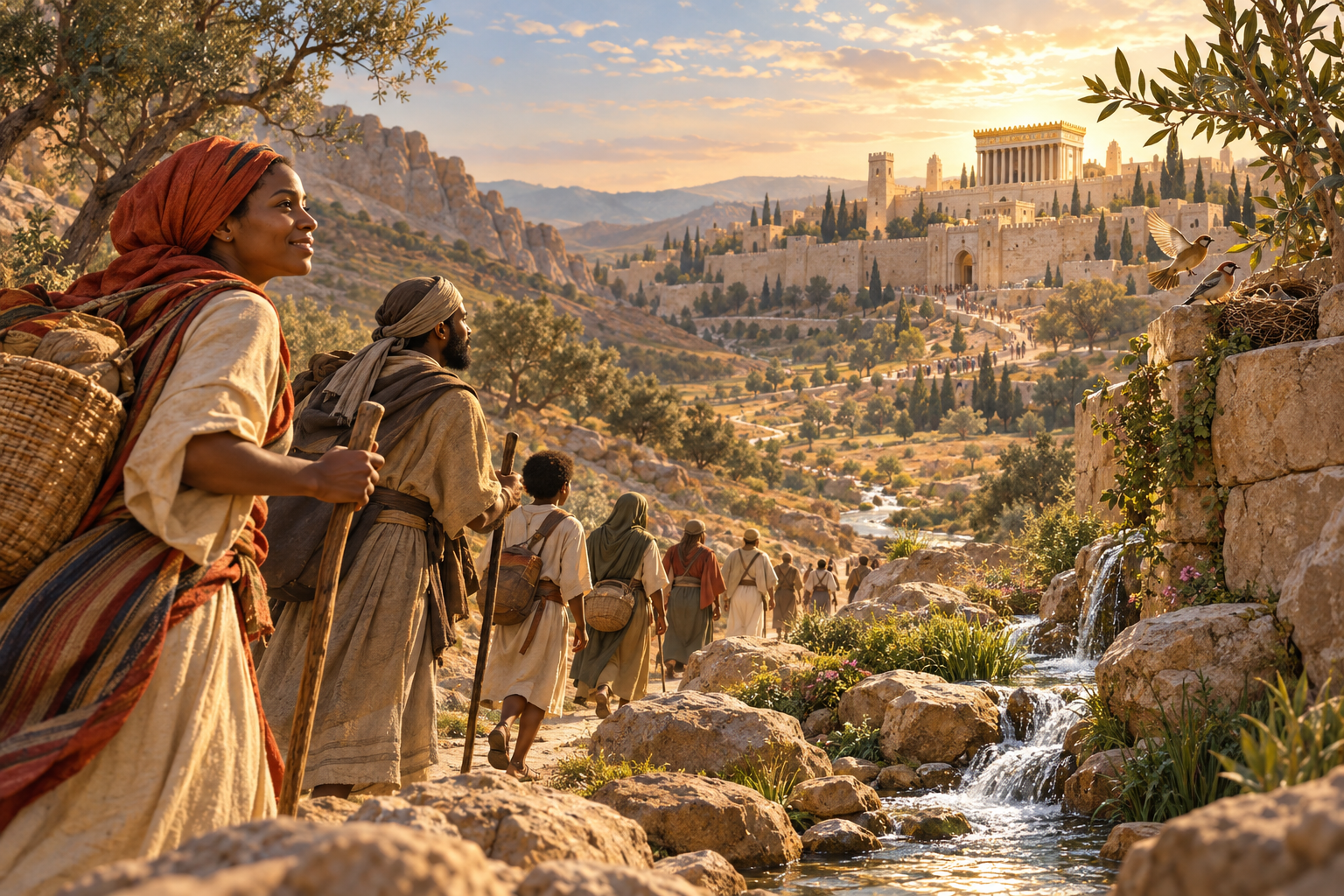
How can a thirsty valley become a path of hope as we seek God?
01
Overview
The beloved dwelling, the thirsty valley, and the blessedness of trusting the living God
Key text — Psalm 84:5–6, 12 (summary): Blessed are those who find their strength in God and carry the pilgrim road in their hearts. Even a difficult valley becomes associated with springs and rain. The final blessing belongs to the person who trusts in the LORD. This is a thematic summary, not a verbatim quotation from a Bible translation.
A small bird finds somewhere to build its nest. Travelers follow a road that passes through a dry valley. A worshiper stands at a doorway and would rather stay there than enjoy splendid accommodations elsewhere. These ordinary pictures lead us toward the heart of Psalm 84: the deepest security is not having an easy journey but belonging to the living God.
02
1.0 Introduction
Where do you most deeply want to be? Perhaps the answer is a familiar home, the company of loved ones, or a place where you can finally rest without defending yourself. For the singer of Psalm 84, the answer is the dwelling place of the LORD. Yet the psalm is not simply about a building. Its true subject is a relationship: the delight of being near the God whose presence gives strength for the road and hope for ordinary life.
Psalm 84 begins with affection, moves through pilgrimage, pauses to pray for God's anointed king, and ends with a decision about what really makes life good. Three blessings shape its movement: the blessedness of those who praise God in his house (v. 4), of those who find strength in him on the road (v. 5), and of anyone who trusts in him (v. 12).
Its place in the Psalter is significant. Psalm 83 ended the Asaph collection (Psalms 73–83) with the fear of hostile nations and a prayer for God's intervention. Psalm 84 begins a collection associated with the sons of Korah (Psalms 84–85, 87–88), returning to the language of yearning for God's presence familiar from Psalms 42–43. The mood changes, but the underlying question remains: How can God's people live securely in a world where safety and belonging are uncertain?
Central message: God's presence is worth more than status, luxury, or a trouble-free life. Those who love him learn to seek his face, draw strength from him while traveling through difficulty, and carry the integrity of worship into everyday life.
03
2.0 Historical and Literary Context
The heading attributes Psalm 84 to the sons of Korah and includes a musical direction often rendered according to the Gittith. The Korahites were associated with worship and music in Israel (1 Chronicles 6:31–38; 2 Chronicles 20:19). The superscription associates the psalm with this worshiping tradition, but it does not tell us the name of an individual composer or a precise date.
The references to the LORD's courts, altars, house, and anointed king make Jerusalem's sanctuary and Israel's royal life central to the poem. A pilgrimage to one of the great festivals is a plausible setting. John Goldingay argues that the speaker may already be enjoying a visit to Jerusalem and reflecting on the journey, whereas Derek Kidner hears a worshiper painfully conscious of distance from the sanctuary and envisioning the joy of reaching it. Both readings have something to commend them: the poem contains real longing, but also remarkably confident delight (Goldingay 2007, 586–89; Kidner 2014, 334–35). It would be too confident to assign the psalm to a particular exile, festival, or royal crisis.
The Valley of Baca in verse 6 is also uncertain. The Hebrew name resembles a word for a balsam-like tree, perhaps associated with dry country, and sounds like the verb to weep. Ancient interpretation therefore connected it with a “valley of tears.” No location can be identified with certainty. Its literary force is clearer than its geography: pilgrims press onward through a place of difficulty and need, with springs and the gift of rain entering the description (Goldingay 2007, 592–94; Kidner 2014, 335–36).
We can follow four large movements:
1. Verses 1–4 — The beloved dwelling: longing for God's courts, the bird's nest, and the first blessing. 2. Verses 5–7 — Strength for the journey: the roads to Zion, the Valley of Baca, and the second blessing. 3. Verses 8–9 — A prayer for the anointed: the individual's longing embraces the welfare of the community. 4. Verses 10–12 — The decisive preference: God's courts over deceptive security, God's generosity, and the final blessing of trust.
The musical pauses marked Selah after verses 4 and 8 reinforce the poem's shifts. The repeated title “LORD of hosts” or “LORD Almighty” (vv. 1, 3, 8, 12) connects the singer's intimate desire to God's sovereign strength. The beloved God is no powerless object of religious sentiment.
BibleProject highlights Psalm 84's place within the second Korahite group (Psalms 84–89), which echoes themes introduced in Psalms 42–49: longing for God's presence, trust amid apparent absence, and hope tied to Zion and God's kingship (The Book of Psalms: Study Notes, 14–15).
04
3.0 Walking Through the Text
3.1 The sanctuary is loved because the living God meets his people there
Psalm 84:1–2
The opening expression often translated “How lovely are your dwelling places” means more personally, how beloved they are. The singer is speaking the language of attachment and desire, not giving an architectural review. The courts of the LORD are precious because they belong to the one the worshiper loves (Kidner 2014, 334; Goldingay 2007, 589).
The language becomes bodily. The singer's whole being longs and nearly faints; heart and flesh cry out to the living God. This is not a detachable spiritual appetite, as though the body were irrelevant to worship. The worshiper desires God's nearness with the whole self. The declaration echoes the thirst for God in Psalm 42:1–2, but Psalm 84 carries more immediate warmth.
There is a small interpretive question here. Is the psalmist still absent and crying in longing, as Kidner stresses, or remembering that longing while presently exulting in God's courts, as Goldingay argues? The verb forms allow discussion. The more important point survives either reading: the temple matters because the living God is encountered there. God is neither a stone building nor a religious mood; the sanctuary serves the relationship, not the other way around.
This distinction is vital wherever sacred spaces become objects of pride or competition. A beautiful church, historic shrine, or cherished worship venue may help us attend to God, but the place is not a substitute for knowing him.
3.2 A bird's nest becomes a picture of belonging
Psalm 84:3–4
The image moves from the grandeur of God's dwelling to the smallest creature. The bird has found a home; the swallow, or another small bird represented by the uncertain Hebrew term, has a nest for its young. The poem imagines that humble life can flourish in the vicinity of God's altars.
Kidner sees the worshiper almost envying the birds' access to the sanctuary: they can stay where the pilgrim longs to be. Goldingay gives more weight to the possibility that the bird itself becomes a metaphor for the worshiper finding refuge. The precise species and the idea of nests at the altars should not be pressed too literally: the temple courts and adjacent structures are a more plausible setting than the surfaces of altars used for sacrifice (Kidner 2014, 334–35; Goldingay 2007, 590–91).
What gives the image its power is the contrast between the God of hosts and a small, fragile bird. The Lord whose name evokes immense power can be addressed as “my King and my God,” while the smallest creatures picture the welcome associated with his dwelling.
Verse 4 introduces the first blessing: happy are those who remain near God's house and continue praising him. This may especially evoke temple servants, who enjoyed frequent access, though a visiting pilgrim could also stay there for a time. The point is not that the privileged have no troubles. It is that their greatest privilege is the opportunity to turn toward God again and again.
3.3 The road itself can become a place of strength
Psalm 84:5
The second blessing changes the focus. Some worshipers are close enough to attend the sanctuary frequently; others have miles to travel. The psalm blesses those whose strength is in God, and whose hearts hold the highways—probably the routes associated with pilgrimage.
Notice that God's presence is not limited to arrival. The Lord worshiped in Zion is already the source of the traveler's strength on the road. A person need not wait until every obstacle has passed before turning toward him.
The “highways in their hearts” also joins an outward action to an inward orientation. Pilgrimage is more than movement on a map. It involves intention, longing, perseverance, and hope. The road matters because it leads toward communion with God; the person is already shaped by the destination while still far away.
This does not make literal pilgrimage a command for every believer today. We can recognize the importance of Israel's historical worship journeys while receiving the psalm's enduring insight: what we set our hearts on changes how we travel through the present.
3.4 The Valley of Baca is difficult, but it is not the journey's destination
Psalm 84:6–7
The pilgrims pass through the Valley of Baca. That single preposition matters: they are passing through, not establishing their final home there. The phrase may suggest a dry valley marked by balsam-like trees, or carry a wordplay on weeping. Neither explanation lets us identify it securely on a modern map.
The valley becomes associated with a place of springs; early rain covers it with pools or blessings, depending on how a difficult Hebrew expression is understood. The picture contains both human participation and divine provision. Pilgrims move onward, perhaps taking practical steps to find or make use of water; rain is not under their control. Kidner emphasizes courageous transformation of hardship; Goldingay connects the imagery with the hoped-for autumn rains and the sustenance people need beyond the festival (Kidner 2014, 336; Goldingay 2007, 593–95).
This is not a formula promising that every painful experience will quickly become pleasant. The text describes the transformation of the route through hope, strength, and provision. It does not deny aridity or imply that we should celebrate suffering.
The travelers go “from strength to strength,” a phrase rendered differently in some textual proposals. The ordinary reading suggests renewed capacity to keep going, until the worshipers appear before God in Zion. The final goal is not a heroic reputation for enduring hard travel. It is encounter with God.
For someone traveling through grief, uncertainty, chronic hardship, or delayed hopes, the image can become a prayer: Give me enough strength for the next part of the road. Let me notice the springs without pretending the valley is easy.
3.5 Personal delight widens into a prayer for the community
Psalm 84:8–9
The psalm unexpectedly pauses its description of pilgrimage to ask the LORD Almighty, the God of Jacob, to hear. The request is then directed toward “our shield” and God's “anointed.”
The most natural reading in the psalm's historical context takes these expressions together as referring to the anointed king, who was meant to protect the people. The word anointed comes from the same Hebrew background as messiah, but here it first refers to Israel's ruler, not automatically to a direct prediction of Jesus. The image of God as a “shield” appears again in verse 11, so the poem keeps the distinction between God's ultimate protection and the king's delegated responsibility. Some ancient translations interpret “our shield” differently; the poetic parallelism favors the royal reading (Goldingay 2007, 595–97; Kidner 2014, 336–37).
Why pray for the king in a song about loving the sanctuary? Because worship and public life cannot be wholly separated. A community's ability to travel safely, gather, worship, and flourish is affected by the justice and stability of its leadership. The singer does not care merely about a private religious experience; the wellbeing of the people is at stake.
Theologically, the prayer reminds us that power entrusted to leaders ought to be exercised as protection, never as domination. To pray for leaders is not to declare them morally untouchable. It is to bring their responsibilities under God's gaze.
3.6 One day with God is better than the apparent security of another home
Psalm 84:10–12
Now the singer makes a deliberately extravagant comparison: one day in God's courts is better than a thousand elsewhere. The psalmist would rather stand at the threshold of God's house than settle comfortably in the tents of wickedness.
The Hebrew verb behind the familiar “doorkeeper” phrase does not necessarily describe the official position of a temple gatekeeper. It may simply mean staying at the threshold. The point is a choice of belonging, even without prestige: proximity to God is worth more than a secure-looking life in company that rejects his ways (Kidner 2014, 337–38; Goldingay 2007, 597–99).
The next description explains that choice: the LORD is “sun and shield.” The paired images speak of life-giving warmth and light on one hand, protection on the other. Goldingay also observes that sunlight exposes what is hidden; the image may carry implications of justice as well as comfort. Unlike the anointed king of verse 9, God is the ultimate source of security.
He gives favor and honor and withholds no good thing from those who walk with integrity. This is not a guarantee that believers will never face poverty, illness, death, or unanswered prayer. The Psalter itself contains too many faithful sufferers for that reading (see Psalms 44, 74, 77, 88). The claim concerns God's good character and the life-giving relationship available to those whose path is directed toward him, even when the form or timing of his gifts differs from their wishes.
“Integrity” does not mean flawless moral performance by which we purchase God's favor. It means a whole-hearted direction of life—a refusal to divide public worship from private conduct. Goldingay points out the fruitful connection between two kinds of walking: the pilgrim walks toward Zion and then walks through ordinary life in integrity. Each journey should shape the other (Goldingay 2007, 599–600).
The third blessing closes the poem: happy is the one who trusts in the LORD Almighty. It does not say that the most blessed person is the one with the shortest trip, the finest lodging, or uninterrupted attendance at a sacred site. The final word is trust.
05
4.0 Theological Reflection
4.1 The place matters because the living God matters more
Israel did not regard the sanctuary as interchangeable with any other space: God's presence and covenant history gave it a special significance. Yet Psalm 84's very movement from courts to highways teaches that God cannot be confined inside its walls. Worship spaces are gifts when they draw people into real fellowship with God and one another; they become distortions when they replace that fellowship.
4.2 Worship is meant to supply strength for the road
The pilgrim does not acquire strength only upon reaching the destination. God's strength accompanies the journey. A Christian congregation should therefore not measure worship solely by the beauty of its music or the emotion of a gathering. An equally serious question is whether worship prepares people to face work, conflict, suffering, and responsibility with courage and fidelity.
4.3 Blessing includes both delight and endurance
The psalm's three blessings embrace those who praise, those who persevere, and those who trust. None is limited to wealthy, powerful, or continuously cheerful people. Happiness here is not shallow pleasure. It is the profound good fortune of being held in a relationship with God that can persist through changing circumstances.
4.4 The God who welcomes also calls for integrity
Psalm 84:11 refuses to separate comfort from character. The God who gives light and protection is also the God before whom our daily conduct matters. This guards against two errors: thinking that grace is earned through moral achievement, and thinking that closeness to God has no bearing on how we treat other people.
06
5.0 Canonical and Christological Horizon
Psalm 84 joins a wide biblical story about God dwelling with humanity. In the wilderness God directed Israel to construct a sanctuary so that he might dwell among them (Exodus 25:8), and Solomon later prayed in the temple while acknowledging that even the highest heavens could not contain God (1 Kings 8:27–30). The tension is already there: God's presence is truly encountered in a place, but God is greater than any place.
Other psalms help us hear Psalm 84 accurately. Psalms 42–43 long for the living God when the worshiper is separated from the sanctuary; Psalm 63 desires God in a dry land; Psalm 27 seeks to dwell in God's house. Psalm 84 adds the picture of a road on which strength is found before the journey ends. These texts do not deny one another's different circumstances.
For Christians, the Gospel of John says that God's Word became flesh and made his dwelling among us (John 1:14), while Jesus speaks of his own body as the temple that would be raised (John 2:19–22). Through his death and resurrection, access to God is described not as a return to Jerusalem's temple courts but as confidence to approach God through Christ (Hebrews 10:19–25). The Christian community also becomes a dwelling of God through the Spirit (Ephesians 2:19–22; 1 Corinthians 3:16–17). None of this erases the historical meaning of Israel's sanctuary; rather, the New Testament extends the story of divine presence in a new way.
The prayer for God's anointed in verse 9 likewise belongs first to the world of Israel's kings. It can then be read within the Bible's developing hope for the faithful king from David's line, which Christians see fulfilled in Jesus (2 Samuel 7:12–16; Luke 1:32–33). Jesus is not merely the answer to a word puzzle about “anointed.” He is the king whose authority is given for the life of others, and whose resurrection opens a future larger than the security of one kingdom.
At the Bible's conclusion, the new Jerusalem has no temple building, because God and the Lamb are its temple (Revelation 21:22). God's servants see his face, and the curse is gone (Revelation 22:3–5). Psalm 84's longing is therefore not finally answered by endless travel toward one earthly address. It points us toward the promised world in which God's presence is no longer distant, interrupted, or threatened.
07
6.0 Life Application
- Ask what you truly love about worship. Is it chiefly familiar surroundings, an impressive program, or an encounter with the living God? Choose one practice this week—attentive prayer, Scripture reading, or unhurried fellowship—that puts relationship before performance.
- Name your Valley of Baca without romanticizing it. Acknowledge a real difficulty. Ask what practical help, trustworthy companionship, or daily provision may sustain you while you pass through it. Seeking support is not a failure of faith.
- Carry the road in your heart. Set aside a regular time for gathering with other believers, but also take the posture of worship into work, family life, and public responsibility. The journey is not confined to a church service.
- Pray for leaders without excusing misconduct. Pray that those entrusted with authority will protect the vulnerable, act justly, and permit communities to live and worship in peace. Match that prayer with responsible civic and communal action.
- Choose integrity over attractive compromise. Identify a setting where status, money, influence, or acceptance tempts you to abandon what is right. Take one concrete step to keep your worship and ordinary conduct aligned.
08
7.0 Reflection Questions
- What makes God's presence desirable to me, beyond the comforts or traditions of a familiar worship place?
- In what sense am I presently traveling through a Valley of Baca, and what would it mean to find strength in God along the way?
- How do the three blessings in verses 4, 5, and 12 correct my assumptions about who has a good life?
- What might the prayer for God's anointed teach my church about public responsibility and leadership?
- Where do I need to exchange the promise of status or comfort for the costly freedom of walking with integrity?
09
8.0 Response Prayer
Living God, LORD of hosts, our hearts seek more than a beautiful place; they seek you.
When we feel far from home, remind us that your care reaches the road. When the valley is dry, give us courage for another step and eyes to recognize the springs you provide.
Teach us to love your presence without making a possession of holy places. Make our worship honest, our leadership just, and our daily walk whole-hearted.
Where prestige invites compromise, give us the freedom to stand at your threshold. Where we fear what lies ahead, be our light and shield.
Through Jesus Christ, our risen King, keep us on the way of faith, until the longing of your people becomes joy in the presence that never ends.
Amen.
10
9.0 Window into What Comes Next
Psalm 84 rejoices that God is the pilgrim's strength and protection. Its last word is trust. But Psalm 85 soon reminds us that a community may trust God while still needing to ask him to turn its fortunes around. The next psalm remembers acts of divine forgiveness in the past, then pleads for renewed mercy and listens for the promise of peace.
That sequence matters. Love for God's dwelling is not an escape from the wounds of communal life. It prepares people to seek restored relationships, truth, justice, and peace. The person who has found a home with God can join the wider prayer that God's people and their land might live again. Psalm 84 gives us a road of trust; Psalm 85 asks what God's shalom will look like when it reaches a wounded community.
11
10.0 Bibliography
Scripture: Psalm 84; Psalms 27, 42–43, 63, 74, 77, 83, 85, 88; Exodus 25; 1 Kings 8; 1 Chronicles 6; 2 Chronicles 20; 2 Samuel 7; Isaiah 35; Luke 1; John 1–2; 1 Corinthians 3; Ephesians 2; Hebrews 10; Revelation 21–22. Biblical language is summarized or discussed rather than offered as a verbatim quotation from an unverified English translation.
BibleProject. n.d. The Book of Psalms: Study Notes. Especially pp. 14–15, on the literary connections between the Asaph and Korahite collections in Books Two and Three. Project study resource.
Goldingay, John. 2007. Psalms, Volume 2: Psalms 42–89. Baker Commentary on the Old Testament Wisdom and Psalms. Grand Rapids, MI: Baker Academic, 586–601 (Psalm 84).
Kidner, Derek. 2014. Psalms 73–150. Kidner Classic Commentaries. Downers Grove, IL: InterVarsity Press, 333–39 (Psalm 84; originally published 1975).
Be the first to leave a comment.