

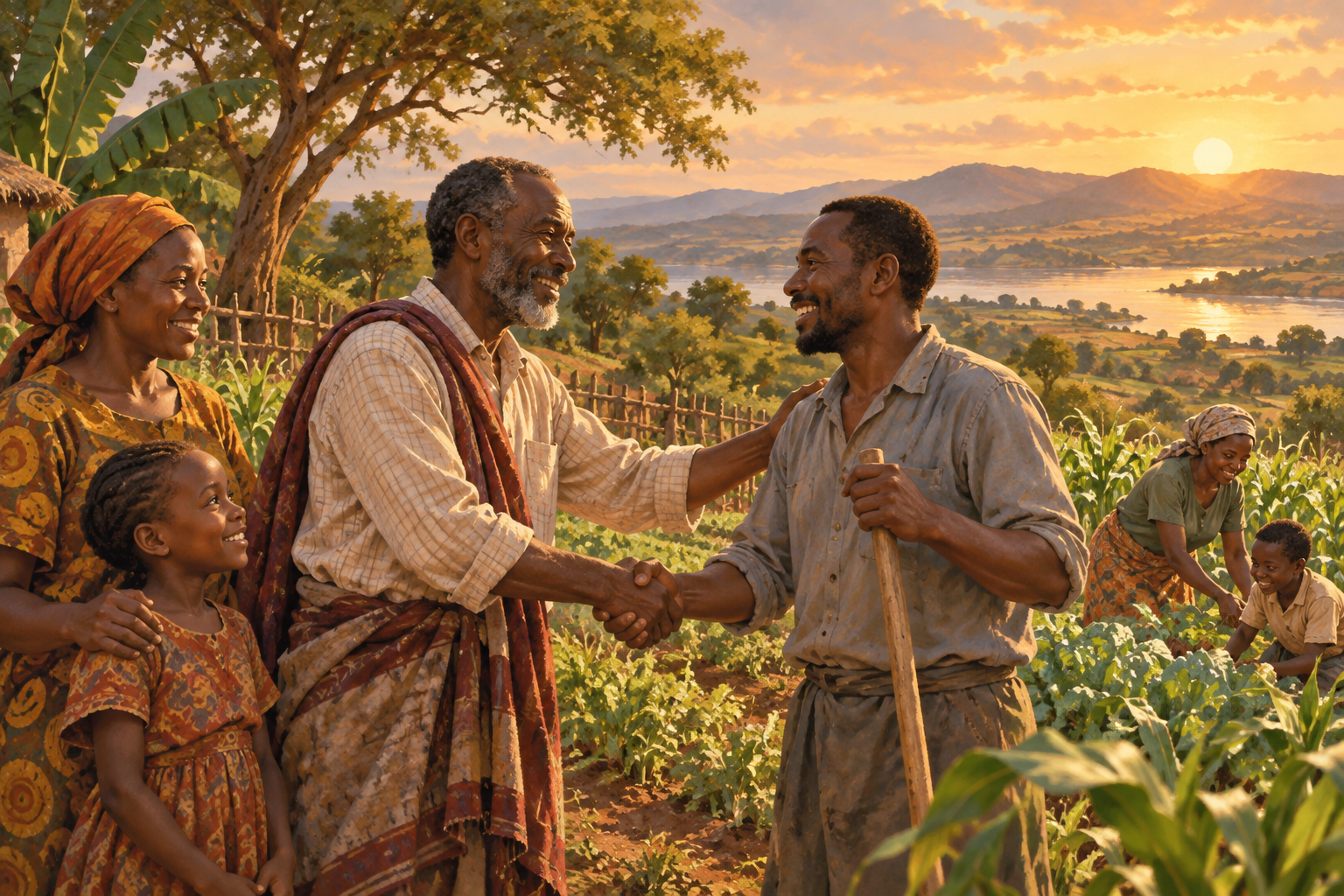
When mercy and truth meet, how can justice and peace take root in our community?
01
Overview
Remembered forgiveness, a prayer for renewed life, and the promise of peace taking root in the land
Key text — Psalm 85:10–12 (thematic summary): Steadfast love and faithfulness meet; righteousness and peace embrace. Faithfulness rises from the earth, righteousness looks down from heaven, and the Lord gives what is good so that the land bears fruit. This is a summary of the imagery, not a verbatim quotation from a Bible translation.
A community remembers a better season. God had forgiven; the burden had lifted; life had begun again. Yet the ground now feels hard, and hope has grown thin. What do people do when yesterday's restoration has not removed today's distress? Psalm 85 teaches them to remember without pretending, to pray without despair, and then to become quiet enough to listen for the God who speaks shalom—peace that reaches from the human heart into the life of the land.
02
1.0 Introduction
We often imagine restoration as a single turning point. An apology is accepted, a family returns home, a community survives a crisis, and we expect everything to be well from that day onward. But healing frequently happens in stages. Forgiveness can be real while trust is still being rebuilt. People may return to their land while harvests remain uncertain. A congregation may thank God for yesterday's mercy yet urgently need his help today.
Psalm 85 speaks from that unfinished place. Its singers begin in gratitude: God has favored the land, restored Jacob, forgiven the people's sin, and turned from anger (vv. 1–3). Then comes an unsettling prayer: “Restore us again” (v. 4). This is not ingratitude. It is the realism of faith that knows the difference between a past gift and a present need.
The poem changes direction when a voice declares, “I will listen” (v. 8). It then unfolds a vision in which steadfast love, faithfulness, righteousness, and peace belong together; heaven and earth respond to one another; and the land becomes fruitful again. What began with the memory of mercy ends with a vision of renewed life.
Central message: The God who restored his people in the past is invited to renew them again—not merely by ending trouble, but by creating a shared life marked by faithful love, truthful living, justice, peace, and fruitfulness.
The sequence of the Psalms makes the movement even richer. Psalm 84 desires the joy of God's dwelling; Psalm 85 asks what life under God's favor looks like when the worshipers return to an unsettled world. The answer is larger than an inspiring worship service. God's shalom must take root in the places where people live.
03
2.0 Historical and Literary Context
The heading associates Psalm 85 with the sons of Korah, the group connected with temple worship and other songs in the Psalter (compare Psalms 42–49; 84; 87–88). It does not name an individual author or provide a firm date. The psalm's language concerns both the people and their land, making it a communal prayer rather than only the private reflections of one sufferer.
Some interpreters associate it with the difficult decades after Judah's return from Babylonian exile: a great restoration had happened, but disappointment and hardship remained. Derek Kidner points to the possible resonance with Haggai's account of meager conditions after the return (Kidner 2014, 339–41; Haggai 1:5–11; 2:7–9). John Goldingay cautions that the Hebrew expression in verse 1 means to bring about restoration and does not necessarily refer to a reversal of exile. The situation may instead involve another period of trouble, perhaps disappointing harvests (Goldingay 2007, 604–5, 614–16). The exile-and-return setting is plausible, but neither the text nor the commentaries establish it as certain.
The poem can be heard in four movements:
1. Verses 1–3 — Remembered mercy: God restored, forgave, and withdrew anger. 2. Verses 4–7 — The present appeal: the community asks for restoration, revived joy, steadfast love, and salvation. 3. Verses 8–9 — Listening for peace: a singular voice listens, and salvation is declared near to those who fear God. 4. Verses 10–13 — The landscape of renewal: love and faithfulness meet; righteousness and peace embrace; heaven and earth participate in fruitfulness.
The movement of speakers is important. The first part addresses God as “you.” Verse 8 introduces an “I”, perhaps a priest, Levite, or worship leader. The final verses speak in the voice of shared confidence. Goldingay proposes a congregational prayer, a leader's listening response, and the congregation's answer; Kidner likewise sees a possible solo voice at verse 8 (Goldingay 2007, 604, 610–11; Kidner 2014, 340).
Another key is the Hebrew root shuv, “turn” or “return.” God once turned the people's fortunes and turned from anger; now the people ask him to restore them and revive them again. They are also warned not to turn back to folly (vv. 1, 3–4, 6, 8). The repeated word binds divine restoration and human response together. The longing for renewal is not permission to return unchanged to the habits that damage life.
04
3.0 Walking Through the Text
3.1 The community remembers what God has already done
Psalm 85:1–3
The prayer begins with testimony, not complaint. God was favorable toward his land; he restored Jacob. The singers then identify the deeper mercy beneath that restoration: God forgave the people's wrongdoing, covered their sin, and turned away from burning anger.
In Hebrew, the language of forgiveness is tangible. Wrongdoing is pictured as a weight God chooses to carry, while sin is “covered,” deprived of its destructive power over the relationship. This resembles Psalm 32:1–2 and God's self-description in Exodus 34:6–7. Goldingay underlines that such forgiveness does not mean pretending no wrong was done; it means that God's commitment opens the possibility of restored relationship (Goldingay 2007, 606–8).
The expression “your land” matters. The psalm is not offering an escape from the earth into a more spiritual realm. Land, people, livelihood, worship, and covenant relationship belong together in Israel's experience of blessing. The God who forgives is concerned with the lives his people inhabit.
Yet these opening verses use the language of past mercy. The people are not claiming that every problem has already vanished. Kidner observes that memory is not nostalgia for supposedly flawless old days; it is recollection of a God who has acted graciously before (Kidner 2014, 339). Remembering becomes the ground of the petition that follows.
3.2 “Restore us again”: forgiveness does not remove every unfinished need
Psalm 85:4–5
Suddenly the community asks the God of its salvation to restore it. If God had already restored Jacob in verse 1, why is restoration needed again?
Because history does not always move in one uninterrupted line from trouble to ease. A crisis can end while its wounds remain. A community may have experienced genuine divine mercy and still face spiritual confusion, insecurity, or hardship. The psalm refuses to deny either part of its story.
The following question intensifies the plea: will God remain angry forever? Will his anger extend through every generation? These are not clever attempts to manipulate God. They are the language of people who take God's covenant character seriously and cannot reconcile their present experience with the mercy they remember.
The question resembles the communal distress of Psalm 80, where Israel repeatedly asks God to restore his people and let his face shine. Here, too, asking is an act of relationship. The worshipers bring their uncertainty to the one they believe can change the situation.
An important pastoral distinction follows. We should not assume that every contemporary hardship is a direct punishment from God for an identifiable sin. Psalm 85's own imagery connects estrangement and restoration, but it does not authorize a preacher to diagnose another person's illness, poverty, crop failure, or grief as evidence of God's anger.
3.3 The desired renewal is life shared with God, not success without God
Psalm 85:6–7
The community asks a tender question: will God not revive them again, so that his people may rejoice in him?
The verb translated “revive” or “bring to life” is stronger than merely feeling cheerful. People experiencing prolonged discouragement can feel as though their communal life has drained away. They need their future opened again. Goldingay draws attention to the connection with Psalm 80:18–19, where restored life and calling on God's name also go together (Goldingay 2007, 608–10).
Notice the purpose of revival: “that your people may rejoice in you.” The goal is not simply improved reputation, prosperous fields, or the return of public confidence. Those gifts may matter, but the psalm hopes for a living relationship with the God who gives them.
Verse 7 makes the request explicit: show us your steadfast love (hesed) and grant salvation. Hesed speaks of faithful, committed love within a relationship, not a passing emotion. The people do not offer impressive achievements as payment. They appeal to the character of the God who has pledged himself to them (Exodus 34:6–7).
The prayer does not say, “Restore our prosperity, and then we will consider whether you deserve worship.” It says, in effect, “Give us life again, so that we may live joyfully with you.” That is the difference between treating God as a means to an end and seeking him as the source of life.
3.4 The turning point is the decision to listen
Psalm 85:8
After the communal plea, one voice says it will listen to what God the LORD will speak. This is the hinge of the poem. Up to this point the singers have been addressing God; now attention turns toward what God might say to them.
The anticipated word is peace, Hebrew shalom. In this setting, peace means more than the silence of weapons or the absence of an argument. It includes safety, wholeness, well-being, restored relations, and conditions in which life can flourish. The final verses will make that broader meaning visible through the imagery of fruitful land and ordered relationships.
But the expectation comes with a warning: God's people must not turn back to folly. Translations vary slightly in how the final clause is linked to the preceding words, but the warning is well grounded in the Hebrew and makes sense of the psalm's recurring language of turning (Kidner 2014, 340–41; Goldingay 2007, 610–11).
Listening is therefore more than asking God to endorse a plan we have already decided upon. It includes readiness to change direction. Israel's story in Psalm 81 has already shown how a joyful act of worship can turn into a summons to listen and obey. Psalm 85 now joins that summons to the hope of renewed peace.
There is a caution here as well. Goldingay notes that announcing peace too easily can become dangerous; Israel's prophets challenged those who promised well-being while ignoring continuing wrongdoing (Jeremiah 6:14; 8:11). The voice in Psalm 85 expresses confident expectation, but it should not be turned into an unconditional guarantee that every present difficulty will end immediately.
3.5 Salvation is near to those who revere God
Psalm 85:9
A confident assurance follows: God's salvation is near to those who fear him, so that glory may dwell in the land.
This is not a formula for earning salvation through a sufficient quantity of religious fear. Reverence describes a people who acknowledge Yahweh as God and orient their lives toward him. The parallel with verse 8 warns against a merely ceremonial identity that leaves everyday practice untouched.
The word translated “glory” can suggest God's manifest presence, honor, or restored splendor. Kidner emphasizes the hope of God's glory dwelling among his people, with a possible resonance with Haggai's vision of a restored sanctuary. Goldingay gives greater weight to the land's renewed honor and flourishing, arguing that the vocabulary does not compel a direct reference to temple glory (Kidner 2014, 340–41; Goldingay 2007, 611–12). Either way, the vision reaches beyond a private feeling of relief: the shared life of the people is to become different.
The promise also creates a responsibility. Reverence and folly point in opposite directions. A community cannot credibly pray for truth and peace while normalizing deception, exploitation, or indifference to those who suffer.
3.6 Steadfast love and faithfulness meet; righteousness and peace embrace
Psalm 85:10
This is one of the most memorable pictures in the Psalter. Four qualities appear like living persons arriving at the same gathering: steadfast love (hesed), faithfulness or truth (emet), righteousness (tsedeq), and peace (shalom). The first pair meets; the second kisses.
The poetry is not describing a courtroom drama in which mercy and justice are sworn enemies and God must somehow choose between them. Kidner stresses that love and faithfulness are natural partners, and righteousness can mean putting things right, not only finding wrongdoing (Kidner 2014, 341–42). Goldingay likewise cautions against making verse 10 a direct explanation of an inner conflict in God supposedly settled by atonement. In its setting, the verse pictures the harmonious conditions of restoration (Goldingay 2007, 612–14).
The four terms enrich each other. Love without truth can become denial. Truth detached from love can become a weapon. Peace divorced from righteousness can leave oppression undisturbed. Righteousness without a vision of peace can become mere retaliation. The psalm does not instruct us to bargain these virtues down into an unhappy compromise. It imagines them flourishing together as God's good world is renewed.
This should reshape the way Christians speak about reconciliation. A family, church, or society may declare that “peace has returned” because no one is raising objections anymore. But if the frightened have been silenced, the wounded ignored, and the truth suppressed, the peace is incomplete. Biblical shalom makes room for truth, faithful commitment, and the repair of what has gone wrong.
3.7 Heaven and earth participate together in renewal
Psalm 85:11–12
The poetry moves outdoors. Faithfulness springs from the earth as though the ground itself were coming alive; righteousness looks down from heaven. Then the LORD gives what is good, and the land yields its produce.
These are not disposable decorations around a purely spiritual message. Israel's life depended on soil, rain, harvests, and shared security. Goldingay argues that the agricultural language may indicate the concrete concern underlying the community's distress: the land has not been productive as it should be (Goldingay 2007, 613–16). The psalm's image of heaven responding to earth expresses the interdependence of God's generosity and the created world's fruitfulness. Compare Leviticus 26:4–6 and Isaiah 45:8.
Kidner describes the same movement as harmony between heaven and earth, where God's gift and the land's response belong together (Kidner 2014, 341–42). The promise is not a blank cheque assuring that every faithful person will enjoy unlimited wealth. It is a picture of life as God intends it to be: grace is received, relationships are healed, and the material conditions of living are not treated as irrelevant.
That matters in communities where an abundant church service may coexist with hunger in nearby homes, or where peace is celebrated while people's livelihoods remain precarious. The psalm does not divide the sacred from the ordinary. A land that yields good things belongs within the horizon of prayer.
3.8 Righteousness goes ahead and prepares a way
Psalm 85:13
The final image has movement. Righteousness goes before God and makes a path associated with his footsteps. The Hebrew wording admits more than one possible arrangement: righteousness may prepare the way for God's arrival, or it may trace the way God walks for his people to follow. Both Kidner and Goldingay recognize the difficulty, while emphasizing that God's coming is bound to faithfulness and rightness (Kidner 2014, 342; Goldingay 2007, 614–15).
This ending changes the posture of the worshiper. The community does not merely sit back enjoying an imagined scene of peace. It watches for God's way and is called to respond. The path ahead is not shaped by a return to folly. It is marked by the faithfulness appropriate to the God whose peace the singers have asked to receive.
The psalm ends with hope, not with a dated report that the harvest arrived or every disagreement was settled. The promise remains large enough to sustain prayer and concrete obedience while fulfillment is awaited.
05
4.0 Theological Reflection
4.1 Memory keeps hope truthful
The people of Psalm 85 neither rewrite the past nor deny the present. They remember genuine forgiveness and admit their ongoing need. Christian hope grows weak when it depends on pretending that yesterday was perfect or that today contains no pain. It grows stronger when honest memory becomes prayer.
4.2 Restoration is relational, communal, and material
Forgiveness matters, but it is not the only image in the psalm. God's people want to live again, rejoice in him, hear his word, experience peace, and see the land bear fruit. The psalm refuses to separate a restored relationship with God from the well-being of neighbors and creation. This is not a promise that faithful believers never face poverty or disease. It is a claim about what God's good future values.
4.3 Peace cannot be purchased by suppressing justice
The embrace of righteousness and peace guards against two distortions: justice without healing and apparent harmony without truth. A biblical pursuit of peace takes wrongdoing seriously, protects the vulnerable, and remains open to mercy, repentance, repair, and restored fellowship.
4.4 To listen is to accept the possibility of repentance
The repeated language of turning culminates in a warning against turning back to folly. It is possible to love the idea of restoration while resisting the changes that restored life requires. Worshiping communities must hear God's call as carefully as they make their requests.
06
5.0 Canonical and Christological Horizon
Psalm 85 belongs first to Israel's covenant story. Its remembered pardon, prayer for restoration, concern for the land, and expectation of shalom should be heard on their own terms before they are connected with Jesus. It does not explicitly predict Jesus' birth or describe a future Christian doctrine of atonement.
Nevertheless, Christians rightly read it within the larger biblical story. Its appeal to faithful love recalls God's revelation to Moses (Exodus 34:6–7). Its longing for revived people and a renewed land echoes the prophetic hope of restoration (Isaiah 52:7–10; 55:10–13; 57:18–19). Its refusal to separate justice from peace also resonates with Isaiah's vision that the fruit of righteousness is peace (Isaiah 32:16–18).
The New Testament presents Jesus as the one in whom God's faithful love and truth become visible in a new way (John 1:14–18). His ministry announces God's reign and gives signs of restored life through healing, forgiveness, welcome, and the breaking of boundaries that keep people apart (Luke 4:16–21; 7:22–23). Through his death and resurrection, reconciliation becomes more than a social ideal: Christ brings peace by dealing with the estrangement of sin and hostility (Romans 5:1–11; Ephesians 2:13–18; Colossians 1:19–20).
This is a canonical connection, not a claim that Psalm 85:10 was originally written as a direct prediction of the cross. The psalm's four partners—love, faithfulness, righteousness, peace—find a wider expression in the saving work of Christ and in the new community called to embody his peace.
Yet the horizon still reaches further. Revelation pictures God dwelling with humanity and removing death, tears, and pain (Revelation 21:1–5). The nations are healed and the tree of life bears fruit (Revelation 22:1–5). The fertile land of Psalm 85 is not abandoned in favor of escape from creation; it contributes to the Bible's longing for creation made whole.
07
6.0 Life Application
- Remember a real mercy before naming a present need. In prayer, recall one specific time you experienced God's kindness. Then speak honestly about what remains unresolved. Gratitude and grief can belong in the same prayer.
- Ask what genuine renewal would restore. If you are praying for your family, church, or community, name not only the return of success but also repaired trust, protection of the vulnerable, honest leadership, and a renewed desire for God.
- Make listening part of prayer. After bringing your requests, attend to Scripture and examine whether there is a destructive pattern you have been tempted to repeat. Do not use silence to avoid necessary decisions or seek an unquestionable private revelation.
- Pursue peace without hiding the truth. Where relationships are broken, make room for acknowledgment of harm, appropriate boundaries, responsible repair, and forgiveness that does not excuse ongoing abuse.
- Treat everyday well-being as a concern of faith. Practical support for struggling households, fair treatment of workers, good stewardship of land, and care for those without reliable food belong beside prayers for spiritual growth.
08
7.0 Reflection Questions
- Where am I living between a past experience of God's mercy and a present need for restoration?
- When I pray “revive us,” what changes do I actually hope will follow in the life of our community?
- What is the difference between pursuing quietness at any cost and working for peace rooted in truth and righteousness?
- Is there a form of folly—an old habit, a dishonest practice, or a misplaced confidence—to which I am tempted to return?
- How could our church or household become a more visible meeting place of steadfast love, faithfulness, righteousness, and peace?
09
8.0 Response Prayer
God who has shown mercy before, we remember the doors you opened and the burdens your forgiveness lifted. We thank you for the good that was real, even as we confess that much is still unfinished.
Restore us again. Where our hearts have grown cold, give renewed life. Where our words have wounded, teach us to speak truth in love. Where we have mistaken silence for peace, give us courage to repair what is broken.
Teach us to listen before we claim to speak for you. Keep us from returning to the follies that destroy trust. Let mercy and faithfulness shape our relationships; let righteousness and peace find room in our homes and communities.
Bless those whose work depends on the land, those whose families lack enough, and those waiting for a future that still seems distant. Through Jesus Christ, our risen Lord, lead us in the way of reconciliation until your whole creation knows your healing peace.
Amen.
10
9.0 Window into What Comes Next
Psalm 85 speaks in the plural: restore us, revive us, grant us salvation. Its final image is a road marked by righteousness as God comes near. But what does this hope look like when one person, rather than the whole congregation, walks into a day of trouble?
Psalm 86 will answer from that more personal angle. Its speaker asks God to listen, seeks mercy, confesses trust, and begs for an undivided heart. The God whose steadfast love filled the shared vision of Psalm 85 becomes the God to whom a solitary servant brings fear, need, and worship.
The transition is deliberate: the peace hoped for in the land must also shape the human heart. The community's plea for restoration leads naturally to a person's prayer: “Teach me your way, LORD.”
11
10.0 Bibliography
Scripture: Psalm 85, with Exodus 34:6–7; Leviticus 26:4–6; Psalms 32; 80–81; Isaiah 32:16–18; 45:8; 52:7–10; 55:10–13; 57:18–19; Haggai 1–2; John 1:14–18; Luke 4:16–21; Romans 5:1–11; Ephesians 2:13–18; Colossians 1:19–20; Revelation 21–22. Interpretive paraphrases are distinguished from verbatim quotations.
BibleProject. n.d. The Book of Psalms: Study Notes. Project reference material, especially pp. 14–15 on the Korahite psalms and the arrangement of Book Three.
Goldingay, John. 2007. Psalms. Volume 2: Psalms 42–89. Baker Commentary on the Old Testament Wisdom and Psalms. Grand Rapids, MI: Baker Academic. Commentary on Psalm 85, pp. 603–16.
Kidner, Derek. 2014. Psalms 73–150. Kidner Classic Commentaries. Downers Grove, IL: InterVarsity Press. Originally published 1975. Commentary on Psalm 85, pp. 339–42.
Be the first to leave a comment.