

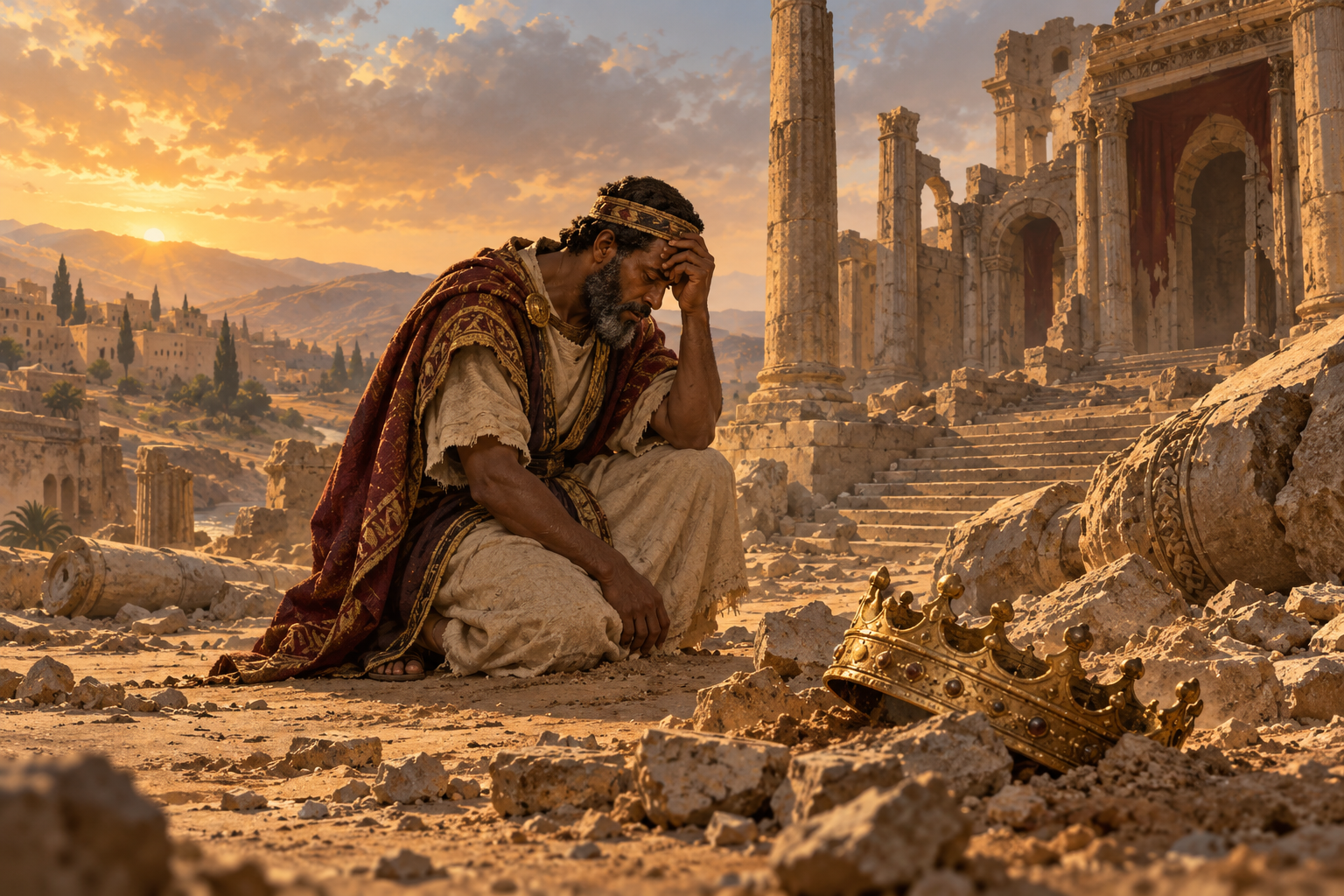
When the crown falls, how do we hold God’s promise without hiding our pain?
01
Overview
The faithfulness of the LORD, the crisis of David's throne, and a prayer that refuses to hide the contradiction
Key verse — Psalm 89:49 (study rendering): “Lord, where are your former acts of steadfast love, which you swore to David in your faithfulness?”
A nation can survive the loss of a building. It can even survive the loss of a ruler. But what happens when a throne falls that people believed God himself had promised to establish forever? The crown is on the ground, the walls are broken, and the songs of celebration sound painfully distant. The deepest question is no longer simply, Who defeated us? It is, What has become of the word God spoke?
Psalm 89 dares to ask that question. It begins by singing of divine faithfulness and ends by challenging God to remember it. Between those two movements lies one of the Bible's most searching reflections on promise, catastrophe, kingship, and hope.
02
1.0 Introduction
Can believers continue to trust God's promises when the world they can see seems to contradict them?
Psalm 88 ends in darkness, without any report of relief. Psalm 89 begins as though daylight has returned: the singer promises to proclaim the LORD's steadfast love from generation to generation (vv. 1–2). Yet this apparently confident psalm will soon become another lament. The trouble is no longer primarily the anguish of one sufferer. It is the collapse of Israel's public hope centered on David's royal house.
The poem recalls God's covenant with David, praises the Creator who rules the sea, and describes a king chosen and sustained by God's own hand (vv. 3–37). Then the devastating word arrives: “But you” (v. 38). The singer describes a rejected anointed king, a disgraced crown, breached defenses, and celebrating enemies. He asks how God's promises and these events can both be true.
The psalm does not solve the difficulty by denying the disaster or by pretending that the covenant words were never spoken. It brings both sets of evidence before God. This makes it a necessary companion for believers whose families, churches, or communities are living with loss that theological formulas cannot explain away.
Central message: Covenant faith is not the refusal to notice contradiction. It is the courage to remember God's pledged faithfulness, name the devastation truthfully, and bring the unresolved question back to the God who made the promise.
03
2.0 Historical and Literary Context
The heading identifies Psalm 89 as a maskil associated with Ethan the Ezrahite. Scripture mentions a wise Ethan (1 Kings 4:31) and musicians bearing the name Ethan (1 Chronicles 15:17–19), but the superscription does not establish which, if either, is intended, or when the complete psalm took shape. Its subject and public voice fit a communal or representative lament over the Davidic monarchy. The king is generally described in the third person while the singer moves between “I” and “we” (Goldingay 2007, 663–65).
The promise behind the poem is 2 Samuel 7:4–17, God's message to David through Nathan. David wants to build God a house; God promises to build David a “house,” meaning a royal lineage. This play on house underlies the psalm's repeated language of establishing and building a throne (Kidner 2014, 351–52). The covenant also finds echoes in Psalm 2, Psalm 72, and the later prophetic expectation of a righteous Davidic ruler.
The catastrophe in verses 38–45 is compatible with Jerusalem's fall in 587/586 BCE and the end of an independent Davidic kingdom. Kidner particularly points to parallels with Lamentations and to Jehoiachin, the young king exiled in 597 BCE (Kidner 2014, 356–57). Goldingay warns against treating this reconstruction as certain: earlier royal reverses and the continued lack of a Davidic king after the exile have also been proposed (Goldingay 2007, 665–66). The text leaves the king unnamed. What matters for its argument is the contrast between the “forever” of the covenant and the visible overthrow of the crown.
Psalm 89 brings Book Three of the Psalter (Psalms 73–89) to a powerful close. Its literary progression is striking:
Verses 1–4: Opening pledge to sing; God's promise to David.
Verses 5–18: The LORD's supremacy in heaven, creation, justice, and Israel's worship.
Verses 19–37: The choice of David and God's enduring covenant, including discipline for disobedient descendants.
Verses 38–45: A sharp accusation: the anointed king has been cast down.
Verses 46–51: Appeals for God to remember human frailty, the covenant, and the people's disgrace.
Verse 52: A blessing with “Amen and Amen,” functioning as the editorial doxology to Book Three, like those closing the other books of Psalms.
The last distinction matters. The song's lament ends in verse 51 without narrated deliverance. Verse 52 affirms praise at the level of the collection; it does not report that the singer's crisis has already been resolved (Kidner 2014, 357–58; Goldingay 2007, 690–94).
04
3.0 Walking Through the Text
3.1 An opening song whose promise will be tested
Psalm 89:1–4
The singer commits himself to celebrating the LORD's steadfast love and faithfulness. Behind these English expressions stand the Hebrew terms ḥesed—loyal love or covenant commitment—and ʾĕmûnâ—faithfulness, reliability, truthfulness. These are not merely feelings God has toward David. They are qualities that make God's word worthy of trust.
The repeated “forever” and “generation after generation” prepare the central problem. The LORD has sworn that David's offspring and throne will endure. By placing this pledge before the account of the disaster, the psalmist makes the promise itself the foundation of his later complaint. He is not accusing God because he has forgotten Scripture. He is asking his question because he remembers it.
This kind of worship is more demanding than singing only what feels easy. It lets God's words remain fully weighty even when circumstances become hard to understand.
3.2 The throne of heaven is higher than every earthly throne
Psalm 89:5–13
The hymn expands into the heavenly assembly. The “holy ones” and the “sons of the mighty” form a poetic picture of celestial beings. None can be compared with the LORD. His majesty is not one competing power among many; all other power is answerable to him.
The sea, often pictured in biblical poetry as threatening and untamable, lies under God's rule. He subdues its raging waves and crushes Rahab (v. 10). Here Rahab is a poetic name or image of monstrous opposition, elsewhere associated with Egypt and the exodus (Isaiah 51:9–10). It is not a reference to Rahab of Jericho (Joshua 2). The imagery links the LORD's sovereignty over creation with his historical deliverance of his people (Goldingay 2007, 670–72; Kidner 2014, 352–53).
Heaven and earth belong to him; north and south are his work; Tabor and Hermon join the praise. The geography widens the scene beyond Jerusalem. If God has mastery over sea, mountains, and the great powers of history, why does the Davidic throne now lie defenseless? That question is not spoken yet. The hymn makes it more urgent.
3.3 God's throne rests on justice, not arbitrary force
Psalm 89:14–18
A theological center appears in verse 14: righteousness and justice are the foundation of God's throne, while steadfast love and faithfulness go before him. His rule is not described merely by how much he can accomplish. It is described by what sort of ruler he is.
The people who recognize his joyful summons walk in the light of his face. They do not manufacture their own security. Their strength and exaltation come from the God to whom their king belongs. The paired words “shield” and “king” in verse 18 underline the relationship between the royal office and God's care for Israel.
This connection sharpens the problem of the psalm's second half. If justice and faithfulness support God's own throne, how should the community understand the public humiliation of the king to whom God made a covenant? The singers cannot be content with saying, “Power has prevailed.” They are asking about justice and faithfulness.
3.4 A chosen servant, not a self-appointed savior
Psalm 89:19–27
God's remembered speech describes his initiative: he chooses David, anoints him, places a supporting hand upon him, and promises protection from enemies. The ruler is called God's servant. Royal authority is therefore a vocation received, not a claim that a human ruler owns the nation or stands above accountability.
The king is given a remarkable family title: he will address God as “my Father,” and God will make him firstborn, highest among earth's kings (vv. 26–27). In the original royal setting, “firstborn” is a title of status and appointment, not an assertion that David literally preceded every other human being in birth. Israel itself had previously been called God's firstborn (Exodus 4:22).
The royal language anticipates later messianic reflection, but we should first hear how extraordinary it is in its own context. The king is sustained by the LORD and called to represent a people under God's rule. The covenant raises expectations because the God who selected him is trustworthy (Kidner 2014, 354–55).
3.5 Discipline is permitted; cancellation is denied
Psalm 89:28–37
The promise reaches its fullest form. God's covenant with David is described as enduring like the heavens. The sun and moon become witnesses of stability; the royal throne is imagined as lasting beyond the life of any one king.
Then comes a necessary qualification. David's descendants may abandon God's law and violate his commandments. They will not be excused. God declares that their transgressions will be visited with discipline (vv. 30–32). Yet the divine speech immediately insists that steadfast love will not be removed, nor will the covenant be broken (vv. 33–34).
The distinction is essential: covenant commitment does not abolish moral accountability. A royal house can be punished for unfaithfulness without God becoming unfaithful. But this distinction also makes the coming protest more searching. If God explicitly promised not to abandon his commitment, what does the community make of an apparently destroyed monarchy?
The poem is not offering a tidy explanation before the pain begins. It is gathering the covenant words that now make the pain harder to bear.
3.6 “But you”: the crown lies on the ground
Psalm 89:38–45
The abrupt opening of verse 38 changes the entire sound of the poem: “But you…” The same God who promised to establish the king is addressed as the one who has rejected and humiliated the anointed. The singer describes a covenant seemingly disowned, a consecrated crown defiled, broken fortifications, exposed borders, successful enemies, and a throne cast down.
Most verbs place responsibility directly before God: you have rejected; you have broken; you have raised the attackers. This is language of covenant protest, not detached historical reporting. It captures the community's experience of God's hand behind a national catastrophe. The psalm does not reveal all of God's reasons or invite later readers to attribute every military defeat or personal disaster directly to divine punishment.
There is no easy escape from the tension between verses 28–37 and 38–45. Kidner understands the latter as a painful appeal made from within covenant faith rather than a simple accusation of bad faith. Goldingay emphasizes that praise and protest are deliberately held together: God's previous commitments make the present situation a scandal requiring an answer (Kidner 2014, 356–57; Goldingay 2007, 664–65).
The psalmist refuses two shortcuts: denying the promise and denying the wound. Both must be brought into the same prayer.
3.7 “How long?”—the covenant crisis becomes a human cry
Psalm 89:46–48
The poem turns from the throne to time. How long will the LORD hide his face? How long will his wrath burn? The singer then asks God to remember how brief human life is. Who can live without seeing death, or deliver himself from the power of Sheol, the realm of the dead?
The question is not a complete biblical doctrine of the afterlife. It is a cry about the shortness of the years in which people must live with broken promises and unrelieved humiliation. If the Davidic future is to be restored, will those suffering now ever see it?
The connection with Psalm 88 is powerful: the individual lament feared the grave; the communal lament fears that generations will die without seeing the covenant vindicated. Here the divine promise and human mortality confront one another.
3.8 “Where are your former acts of love?”
Psalm 89:49–51
At the climax, the singer asks where God's earlier acts of steadfast love have gone—the very covenant commitment sworn to David. He appeals for God to remember the insults carried by his servants and directed against his anointed.
This is more than wounded national pride. In the logic of the psalm, when nations mock the king whom God chose, they also mock the reliability of the God whose name the king was meant to serve. The singer presses God's own reputation into the argument. Still, no account of a fresh royal restoration arrives before the prayer stops (Goldingay 2007, 688–90).
The final plea is remarkably spare: remember. The singer cannot rebuild the throne through words. He can present the memory of God's covenant and the community's shame, and ask the covenant-maker to act.
3.9 “Amen and Amen”: praise at the edge of an unfinished story
Psalm 89:52
The final verse blesses the LORD forever and ends with a double Amen. Yet its placement and formula indicate that it closes Book Three of the Psalter, rather than narrating an answer within the lament. Similar doxologies appear at Psalm 41:13 and 72:18–19, with another at 106:48. The psalmist's prayer ends in verse 51, still awaiting a response.
This does not make the “Amen” meaningless. It places praise beside an unanswered appeal, holding the whole collection before God. The blessing belongs to the larger worshiping community, which continues to confess the LORD's kingship even after the Davidic throne has fallen. It does not erase the cries of the people who cannot yet see what restoration will look like (Goldingay 2007, 693–94).
05
4.0 Theological Reflection
4.1 God's faithfulness must be taken seriously enough to question appearances
Psalm 89's complaint is grounded in the promise, not in indifference to it. The worshiper recites God's sworn commitment with precision and then asks why reality looks otherwise. Biblical trust can include painful questions addressed to God himself. Faithfulness is not protected by editing the experience of suffering out of the story.
4.2 Royal authority is accountable to God's justice
The Davidic promise is never a license for unlimited human power. The king remains God's servant, the law remains binding, and disobedience may bring discipline. Psalm 89:14 anchors legitimate rule in righteousness and justice, not military success. This matters whenever religious language is used to shield leaders from accountability.
4.3 Discipline and covenant commitment must not be confused
Verses 30–34 refuse both permissiveness and despair. Sin has consequences; nevertheless God pledges covenant faithfulness. The poem then refuses to let readers use this truth as a quick answer to the humiliation that follows. It is possible to affirm God's character while still not knowing how to explain a particular crisis.
4.4 The community needs worship that can bear unresolved grief
Psalm 89 could have ended after its joyful opening, but it did not. Its placement beside Psalm 88 ensures that Book Three closes with unanswered personal and public sorrow. Churches should be able to praise God's faithfulness without silencing those who ask where his promised help is. Prayer must have room for both the song and the protest.
06
5.0 Canonical and Christological Horizon
Psalm 89 is rooted in the promise to David (2 Samuel 7:12–16). Other Scriptures do not simply forget that promise when the monarchy collapses. The prophets speak of a future righteous descendant of David (Isaiah 9:6–7; 11:1–5; Jeremiah 23:5–6), while Isaiah 55:3–5 extends the language of David's enduring covenant blessings toward God's renewed work among his people. These developments deepen the question rather than pretending Jerusalem never fell.
The arrangement of the Psalter is itself significant. Book Three ends with the humiliated anointed; Psalm 90, the beginning of Book Four, turns to the God who has been his people's dwelling place across generations. Psalms 93–100 repeatedly celebrate the LORD's reign. The larger collection thus teaches Israel to confess that God's kingship cannot be reduced to the survival of one earthly palace (Goldingay 2007, 690–92).
For Christians, the New Testament identifies Jesus as the promised son of David (Luke 1:32–33; Romans 1:3–4). At his crucifixion, the “King of the Jews” is mocked and apparently defeated (Mark 15:16–32). His resurrection and exaltation become the apostles' announcement that God has acted faithfully on the promise to David in a way the fallen monarchy could not accomplish (Acts 2:29–36; 13:32–39). The true king bears suffering rather than merely imposing power, and his reign opens God's blessing beyond Israel to the nations.
This is a canonical Christian reading, not a claim that the original singer already knew the circumstances of Jesus' death and resurrection. Psalm 89's first horizon is the Davidic covenant crisis. The New Testament supplies a later answer, but it does not authorize us to scold earlier sufferers for asking their question or to suggest that all present injustice has already disappeared (Romans 8:22–25).
The story moves toward the new creation, where justice, healing, and God's dwelling with humanity are finally made visible (Revelation 21:1–5). Until then, the psalm gives worshipers words for the tension between a promised kingdom and a wounded world.
07
6.0 Life Application
- Do not edit out the painful half of the story. In telling a church's or family's history, name both God's gifts and the losses that still demand attention. Truthful remembrance is a form of respect.
- Test every claim to spiritual authority by justice. Ask whether leaders defend the vulnerable, keep their promises, and accept correction. Anointing language must never excuse mistreatment (Psalm 89:14, 30–32).
- Pray God's promises without dictating the timetable. Bring a specific Scripture promise and a specific unresolved burden before God. Avoid promising yourself or others a date or outcome the text does not give.
- Give lament a voice in public worship. Let Scripture's questions—“How long?” and “Where are your former acts of love?”—be heard alongside hymns of praise. Make space for those carrying communal grief.
- Practice faithful hope in the present. Christians awaiting Christ's completed reign can work for fair leadership, reconciliation, truthful speech, and care for neighbors now. Hope is not passivity dressed in religious language.
08
7.0 Reflection Questions
- Which words in Psalm 89 make the gap between God's promise and the community's experience most painful?
- Why does the psalmist spend so long praising God's faithfulness before describing the king's humiliation?
- What is the difference between disciplining an unfaithful leader and abandoning a covenant?
- How does Psalm 89 challenge churches that celebrate authority but avoid accountability or the grief of those who have been hurt?
- How can the resurrection of Jesus sustain our confidence without making us insensitive to people who still cry, “How long?”
09
8.0 Response Prayer
LORD of heaven and earth, you founded your throne on justice and pledged your steadfast love in faithfulness. We thank you for words strong enough to be remembered even after crowns fall.
Yet you see the ruins we cannot explain, the promises that seem distant, and the shame carried by people who trusted. Give us honesty without contempt, and hope without denial.
Remember those who wait for justice. Correct the powerful when they refuse your ways. Lift up those who have been betrayed by leaders, and teach your people to serve rather than dominate.
Through Jesus Christ, the son of David who suffered, rose, and reigns, keep us faithful while creation still groans. Let our praise never silence another person's lament, and let our lament never stop seeking your face.
Amen.
10
9.0 Window into What Comes Next
Psalm 89 closes the third book of Psalms with a question that no human king can answer: Where is God's enduring promise now? The psalm does not report a restored palace or a triumphant new ruler. Its unresolved cry requires the reader to look beyond the visible throne.
Psalm 90 opens Book Four with a prayer attributed to Moses, a leader who lived long before Israel had a king. It begins not with David's palace but with the LORD as the dwelling place of his people in every generation. In that movement, the Psalter does not abandon the Davidic promise; it asks readers to locate their deepest security in the God whose reign precedes every dynasty and outlasts every human life.
The transition from Psalm 89 to Psalm 90 takes us from the fall of a throne to the faithfulness of the eternal God. It is an invitation to mourn honestly, remember wisely, and entrust an unfinished history to the One who remains God from everlasting to everlasting.
11
10.0 Bibliography
Scripture: Psalm 89; Psalms 2; 72; 88; 90; 93–100; 132; 2 Samuel 7:4–17; 2 Kings 24–25; 1 Chronicles 15:17–19; Isaiah 9:6–7; 11:1–5; 51:9–10; 55:3–5; Jeremiah 23:5–6; Luke 1:32–33; Mark 15:16–32; Acts 2:29–36; 13:32–39; Romans 1:3–4; 8:22–25; Revelation 21:1–5. The opening key verse is a study rendering, not a verbatim quotation from a named modern translation.
BibleProject. n.d. The Book of Psalms: Study Notes. Project study resource, especially the overview of Book Three and its transition into Book Four.
Goldingay, John. 2007. Psalms, Volume 2: Psalms 42–89. Baker Commentary on the Old Testament Wisdom and Psalms. Grand Rapids: Baker Academic, 660–94 (including the treatment of the Book Three doxology at Psalm 89:52).
Kidner, Derek. 2014. Psalms 73–150. Kidner Classic Commentaries. Downers Grove, IL: InterVarsity Press, 351–58. Originally published 1975.
Be the first to leave a comment.