

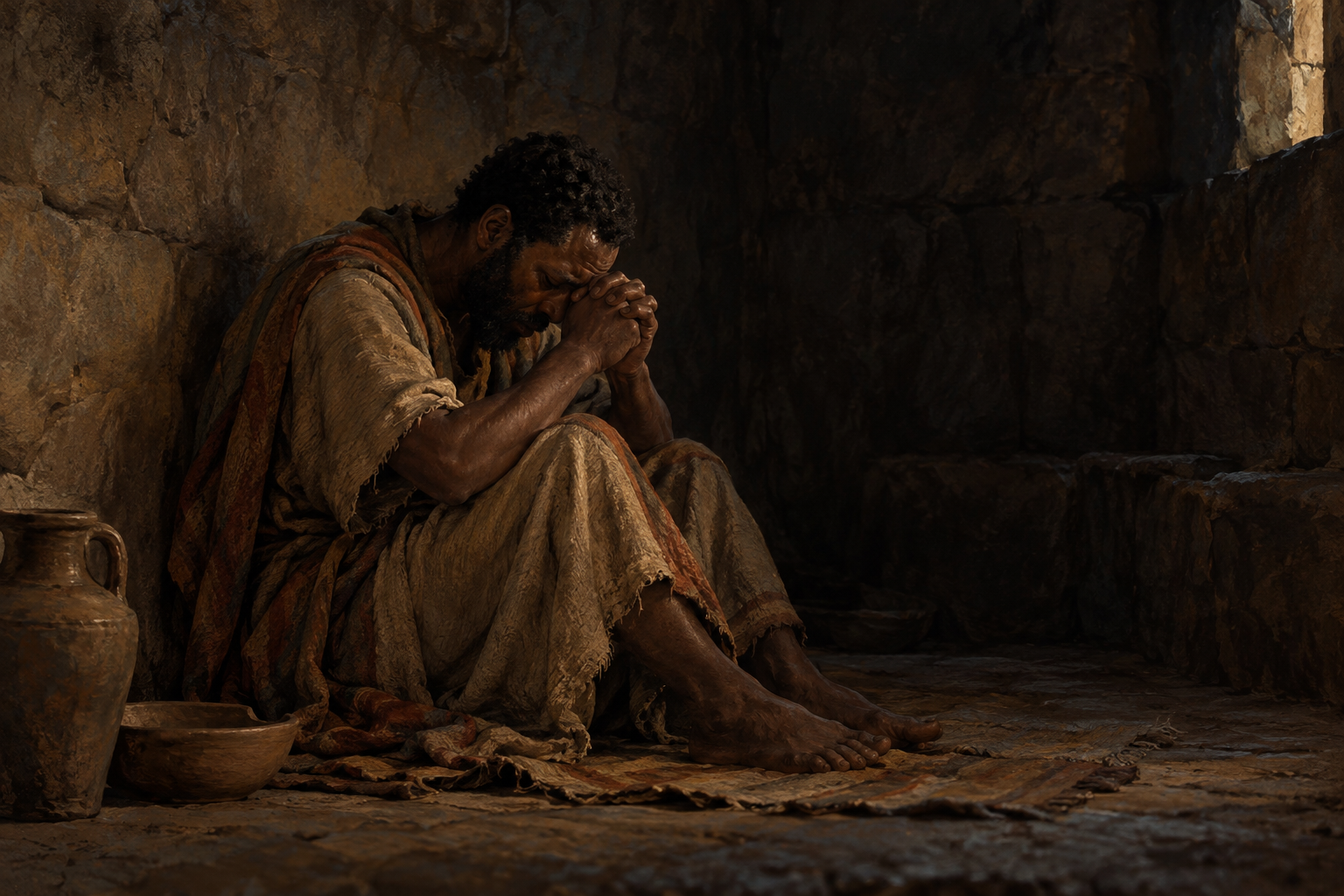
How can we keep calling to God when prayer ends in darkness?
01
Overview
An unanswered prayer, a lonely sufferer, and the faith that keeps calling to God
Key text — Psalm 88:1 (thematic rendering): “LORD, God of my salvation, I cry to you day and night.” This is a study rendering of the verse, not a verbatim quotation attributed to a particular English Bible edition.
Some nights seem longer than the hours on a clock. A person speaks, waits, and speaks again, but no reassuring answer comes. Friends are absent. Memories bring little relief. Even prayer seems to rise into silence. If such a person entered a gathering of God's people, would there be room for their voice—or would we hurry them toward a happier song?
Psalm 88 gives that voice a place in Scripture. It does not resolve the suffering before the last line. It lets the prayer end in darkness.
02
1.0 Introduction
What should believers pray when they have no testimony of deliverance to offer?
Many psalms begin with distress and end with renewed confidence, gratitude, or a promise of praise. Psalm 88 is different. Its speaker repeatedly addresses the LORD, describes an existence shadowed by death, asks why God seems to have turned away, and ends with the loss of human companionship. There is no narrated healing, no final rescue, and no closing declaration that all is well.
Yet this psalm has been preserved as a prayer. Its opening still names the LORD as the God of salvation, and its speaker does not cease reaching toward him. Scripture makes room for faith that cannot presently feel relief. It also gives congregations words with which to accompany people who find themselves unable to sing cheerful songs.
The juxtaposition with Psalm 87 is striking. There we heard a song about strangers welcomed into Zion. Here we hear a person who feels like an outsider even among familiar people. The God who registers the nations as citizens is addressed by one of his own worshipers who fears being forgotten.
Central message: Faith is not always able to announce that darkness has passed. Sometimes its costly expression is to keep telling the truth before God when relief has not arrived—and for God's people to refuse to abandon the one who prays this way.
03
2.0 Historical and Literary Context
The superscription is unusually elaborate. It associates the composition with the sons of Korah, identifies it as a maskil, includes the difficult musical or liturgical phrase Mahalath Leannoth, and names Heman the Ezrahite. Some traditions connect Heman with the worship leaders mentioned in 1 Chronicles 6:33 and 15:17–19; another Heman appears among sages in 1 Kings 4:31. The relationship among these references is debated. Neither the heading nor the poem establishes the date or an identifiable biographical crisis (Goldingay 2007, 642–46; Kidner 2014, 348–49).
Psalm 88 belongs among the Korahite psalms in Book Three (Psalms 84–89). Its darkness recalls the tears and apparent abandonment of Psalms 42–43, while its repeated questions also resonate with Psalm 77. It is commonly classified as an individual lament, although such a poem could also be sung by a congregation and applied to a community's experience. It is not safe to diagnose the writer with a particular illness or to claim certainty about what happened. The text communicates the experience of prolonged affliction, isolation, and nearness to death, without supplying a case history.
The psalm is held together by repeated appeals to God: day and night (vv. 1–2), every day (v. 9), and in the morning (v. 13). John Goldingay observes a threefold movement of appeal followed by lament: verses 1–9a, verses 9b–12, and verses 13–18. Derek Kidner arranges the verses by the themes of ceaseless pleading, approaching death, questions about the grave, and an unanswered cry. Both readings help us hear the persistence beneath the poetry (Goldingay 2007, 644–45; Kidner 2014, 348–51).
Unlike a lament that makes its way unmistakably to praise, Psalm 88 ends before resolution. Its refusal to give readers closure is not a mistake to be corrected. It is part of the psalm's theological witness.
04
3.0 Walking Through the Text
3.1 The first word of the night is still a cry to the God of salvation
Psalm 88:1–2
The opening address is extraordinary precisely because of what follows. The singer does not say that God has already rescued him. He calls the LORD the God of his salvation and begs him to hear. This is neither a denial of the crisis nor an announcement that the crisis is over. It is an appeal to the character of the God who is being experienced as painfully distant.
The prayer moves through day and night. Its urgency is not an impressive spiritual achievement; it is the sound of someone who cannot pretend to be at peace. The plea for God to incline his ear reminds us that the worshiper does not control God's response. He can bring the cry; he cannot manufacture the answer.
Kidner rightly emphasizes the significance of this initial confession. Goldingay presses the difficult question it raises: what does it mean to name God as deliverer when deliverance has not appeared (Kidner 2014, 349; Goldingay 2007, 646–47)?
Faith here is not the absence of questions. It is the direction in which the questions are spoken.
3.2 A living person feels counted among the dead
Psalm 88:3–5
The psalmist says his life is full of trouble and seems to have arrived at Sheol, the realm of the dead in much Old Testament language. He is regarded as one already descending into the Pit, without strength, and cut off from ordinary life.
These are not detached propositions about the geography of the afterlife. They are the language of a person who feels death intruding on life before his final breath. The references to graves, the dead, and being forgotten communicate a terrifying separation from the world of living relationship and worship.
The phrase about those no longer remembered by God expresses the speaker's fear in the moment. It should not be converted into a universal doctrine that God permanently forgets every person who dies. Psalm 49:15, for example, speaks of God redeeming a life from the power of Sheol. Biblical reflection on death develops across different writings and must not be compressed into one lament (Kidner 2014, 349–50).
The sorrow is severe: the sufferer feels as though he no longer belongs among the living, though he is still alive and calling out.
3.3 The most painful accusation is addressed to God
Psalm 88:6–9a
The poem grows more confrontational. The speaker says “you” have placed him in the depths; “your” wrath presses on him; “you” have removed his companions. Images of darkness, deep waters, and confinement gather around the experience.
Readers may instinctively try to protect God from these accusations. The psalm does not give us permission to settle the problem so quickly. It records how divine silence can feel to someone under relentless pressure. That is different from establishing that every blow has been sent as punishment by God. Significantly, the psalm includes no confession identifying a particular sin as the cause of the misery (Goldingay 2007, 644–46).
Verse 8 shifts the focus from imagined depths to the everyday cruelty of separation. Friends have become distant; the singer feels abhorrent to others and imprisoned in a situation he cannot escape. Suffering is not merely a private sensation. It can unravel ordinary ties and make an already vulnerable person more isolated.
The weakening of the eyes in verse 9 communicates exhaustion and grief. The psalm thus challenges communities that respond to distress by retreating from the distressed person. A friend who disappears can deepen a pain that was already almost unbearable.
3.4 Questions about death become an urgent plea for life
Psalm 88:9b–12
The singer lifts his hands daily and then asks a series of rhetorical questions. Will God work wonders for the dead? Will those in the grave rise to praise him? Will his steadfast love and faithfulness be declared in the places of destruction, darkness, and forgetfulness?
The questions draw on an Old Testament understanding of the grave as the place where ordinary worship, communal testimony, and visible participation in God's works cease (compare Psalm 6:5; Isaiah 38:18–19). The speaker's urgent point is not a systematic denial that resurrection could ever happen. It is a desperate appeal: If I disappear into death, who will remain here to tell of your faithfulness? Will you not act while I can yet live and praise?
The word Abaddon, often translated “Destruction,” is a term associated with the realm of the dead. It should not automatically be treated here as the named figure in Revelation 9:11. The psalm uses several parallel images to evoke the finality and isolation the singer fears.
Kidner reads these questions in light of the New Testament's hope that resurrection, rather than death, is God's final purpose. That Christian development is important, but it must not erase the original urgency of a person pleading for life now (Kidner 2014, 350).
3.5 Morning returns, but the question remains
Psalm 88:13–14
Once again the worshiper cries to the LORD. This time the prayer meets the morning, but the arrival of daylight has not changed the situation. The psalmist asks why God rejects him and hides his face.
We may be tempted to make morning a ready-made metaphor for rescue. This psalm refuses that shortcut. The sun can rise while distress remains. Someone may have prayed faithfully through the night and still wake to the same unanswered questions.
Yet the speaker directs those questions toward God again. The repeated plea does not prove that the person now feels optimistic. It shows that communion has not been abandoned, even while its comfort is missing.
3.6 This is not a brief season of trouble
Psalm 88:15–17
The singer looks back on suffering stretching from youth. He feels weak, close to death, terrified, and overwhelmed. The flood imagery returns: the dreaded forces are like waters encircling him all day, leaving nowhere to stand.
The poem offers no basis for claiming that every long illness, psychological struggle, or bereavement has one hidden spiritual cause. Nor should the speaker's fears be mistaken for a clinical diagnosis. What is clear is the duration of his suffering. The passing of time has not brought the relief others might expect.
This can be especially painful in religious communities where people are encouraged to report improvement before improvement actually exists. Psalm 88 gives the exhausted believer permission to speak truthfully about a condition that has not changed.
3.7 The psalm refuses a consoling final sentence
Psalm 88:18
The poem's last scene is not a rescued worshiper surrounded by grateful friends. It is a person separated from loved ones. The Hebrew ending is compressed; translations differ slightly over how to connect the words for acquaintances and darkness. Its effect, however, is unmistakable: darkness occupies the closing position.
A reader may wish for another verse: Then the LORD answered, and joy returned. No such verse is present. Goldingay emphasizes that the psalm reaches exhaustion rather than resolution. Kidner notes that deliverance at the end of a lament is a gift, not something every believer can claim as an immediate entitlement (Goldingay 2007, 644–45, 658–59; Kidner 2014, 350–51).
We must let the closing silence remain. The fact that Psalm 88 is included in Scripture does not transform the pain it describes into something trivial. It tells sufferers something more modest and more necessary: your prayer has a place among the prayers of God's people, even if it cannot yet end with praise.
05
4.0 Theological Reflection
4.1 Lament is an authorized language of faith
The Bible does not contain only the words of people who can explain their suffering. Psalm 88 permits protest, bewilderment, and grief to be spoken directly to God. The distinction is not between respectable religious sentences and forbidden questions, but between hiding one's anguish and bringing it into relationship with God.
4.2 God is not proved absent because deliverance has not arrived
The psalm does not offer evidence that God has answered. It also does not invite us to conclude that the worshiper's ongoing suffering is proof of divine rejection. It describes the experience of abandonment without giving the reader an omniscient explanation. To insist that the sufferer must have sinned or must secretly feel peace would add claims the text does not make.
4.3 The community must learn to pray beside those who have no joyful testimony
Psalm 88 is not only a private document; it is a liturgical resource preserved for a worshiping people. The community can say these words with a suffering member rather than judging the member for needing them. Supporting someone may mean staying present, listening carefully, providing practical help, and refusing to demand a smile before offering companionship.
4.4 The repeated prayer is costly faith, not a formula for quick relief
The singer continues to call upon the God whose help has not been visible. Goldingay regards this refusal to stop praying as a remarkable expression of relationship with God. But the repetition must not be turned into a technique that guarantees an immediate outcome. The poem does not tell us how to make God answer on our timetable (Goldingay 2007, 658–59).
4.5 The presence of this psalm questions our impatience with unresolved sorrow
Faith communities sometimes try to hurry people from lament into celebration. Yet Scripture itself allows Psalm 88 to stop where it stops. A mature faith is capable of holding both Psalm 87's welcome and Psalm 88's isolation, both the promises of God and the anguish of those still waiting.
06
5.0 Canonical and Christological Horizon
Psalm 88 must first be heard as an Israelite prayer in its own setting. It is not presented as a direct prediction of Jesus' crucifixion. Nevertheless, Christians can hear profound resonances between its lonely appeal and the story of Christ.
In Gethsemane, Jesus is deeply distressed, seeks the companionship of his disciples, and prays to the Father (Mark 14:32–42). His words “Abba, Father” in Mark 14:36 show that intimate address does not remove anguish. On the cross, darkness covers the land, and Jesus voices the lament of Psalm 22:1 (Mark 15:33–34). The Christian tradition has therefore heard prayers like Psalm 88 alongside the suffering of Christ without claiming that every detail belongs exclusively to him.
The New Testament also speaks beyond the horizon that Psalm 88 can presently see. Jesus' resurrection does not turn death into an illusion or make grief unnecessary; it declares that death is not the final ruler of God's creation (1 Corinthians 15:20–26). The Christian hope of resurrection answers the wider biblical longing that those who die will not remain beyond the reach of God's saving purpose (John 11:25–26; Revelation 21:1–5).
But Christian readers must resist using Easter to silence a person's Good Friday. Resurrection is God's promise, not our permission to dismiss another person's present darkness. Even those who believe that a new creation is coming may need others to sit beside them without explanations today (Romans 8:22–26).
This is how we honor both the psalm and the gospel: we allow Psalm 88 to end as written, while receiving from the wider biblical story a hope that does not require us to pretend the suffering has ended.
07
6.0 Life Application
- Tell the truth in prayer. If your experience is bleak, begin with a sentence you can honestly say to God. You do not need to manufacture gratitude or certainty in order to pray.
- Stay near someone whose grief has lasted. Avoid asking why they are not better yet. Offer companionship, food, transport, follow-up, or help with necessary tasks. Listening can be a form of faithful love.
- Do not diagnose another person's suffering from a distance. Psalm 88 does not identify a hidden sin that explains the pain. Resist easy claims that prolonged illness, emotional distress, or abandonment necessarily reveals deficient faith.
- Make room for lament in worship. In a Bible study or congregation, allow people to read a difficult psalm without requiring each person to conclude with an upbeat testimony. Silence can sometimes be a respectful communal response.
- Seek and offer appropriate support. Persistent hopelessness, isolation, and severe distress deserve practical care as well as prayer. Trusted relationships and qualified health or mental-health professionals can be important companions; seeking support is not a rejection of faith.
08
7.0 Reflection Questions
- Why might a worshiper continue addressing God as the source of salvation even when no rescue can be seen?
- What do the images of Sheol, floodwaters, and darkness communicate about the speaker's experience?
- How do the questions in verses 10–12 function as appeals for life rather than a complete teaching about resurrection?
- How does Psalm 88 challenge the way our churches respond to people whose suffering continues for months or years?
- What would faithful companionship look like for a person whose prayer presently has no happy ending?
09
8.0 Response Prayer
LORD, God of salvation, we come without polished words. You know the nights that do not seem to end, the mornings that bring no change, and the loneliness that grows when familiar voices disappear.
Hear those whose prayers have become questions. Hear those who are too weary to form another sentence. Do not let our communities turn away when the suffering of a neighbor lasts longer than we expected.
Teach us to stay close, to speak without easy explanations, to protect the dignity of the wounded, and to seek wise help where help is needed.
When we cannot see your face, receive even this unfinished prayer. Through Jesus Christ, who entered suffering and death, keep open the promise of your life beyond the grave.
Until then, hear us in the dark.
Amen.
10
9.0 Window into What Comes Next
Psalm 88 ends in darkness and isolation. Psalm 89 begins by announcing that the LORD's steadfast love will be sung forever. At first, the transition sounds like an answer. But as Psalm 89 unfolds, the community recalls God's covenant with David and then confronts the apparent collapse of that promise. The new psalm will not simply cancel the old one's questions.
Together, the two psalms bring Book Three of the Psalter toward its difficult conclusion. Psalm 88 asks what it means to pray when an individual cannot see deliverance; Psalm 89 asks what it means to trust God's covenant when a whole people cannot see its fulfillment. Both make room for the distance between what God has promised and what his people currently experience. Psalm 89 will take that unresolved tension into the story of the Davidic king and the larger hope of God's faithfulness.
11
10.0 Bibliography
The Bible. Psalm 88; Psalms 6:5; 22; 42–43; 49:15; 77; 87; 89; Isaiah 38:18–19; Mark 14:32–42; 15:33–34; John 11:25–26; Romans 8:22–26; 1 Corinthians 15:20–26; Revelation 21:1–5. Scripture is analyzed and paraphrased; the opening key text is identified as a thematic study rendering rather than a verbatim quotation from a named translation.
Goldingay, John. 2007. Psalms, Volume 2: Psalms 42–89. Baker Commentary on the Old Testament Wisdom and Psalms. Grand Rapids, MI: Baker Academic, 642–59 (discussion of Psalm 88).
Kidner, Derek. Psalms 73–150. Tyndale Old Testament Commentaries / Kidner Classic Commentaries. Originally published 1975; reprint edition 2014. Discussion of Psalm 88, 348–51.

Be the first to leave a comment.