

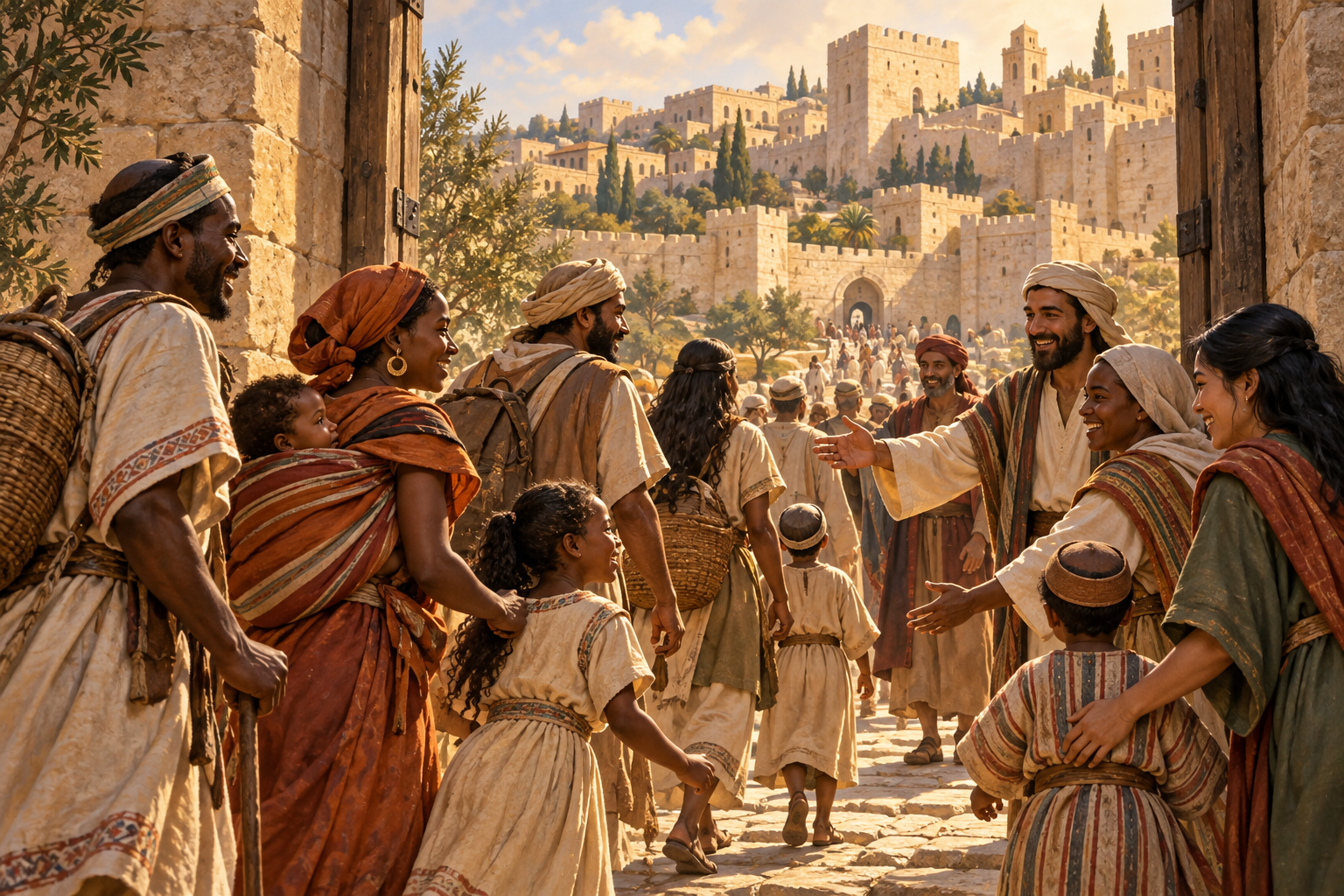
When strangers are called citizens of Zion, what do we learn about belonging to God’s people?
01
Overview
The city God loves, the nations he welcomes, and the astonishing promise of belonging
Key text — Psalm 87:6 (thematic rendering): As the LORD records the peoples, he declares of one after another, “This one was born there.” This is a thematic rendering for study, not a quotation attributed to a particular Bible translation.
Imagine standing at the entrance to a city whose residents have survived wars, exile, and the loss of their homes. The keeper of the register begins to read the names of new citizens. First comes Egypt. Then Babylon. Then Philistia, Tyre, and Cush. Some of these names belong to nations once feared as enemies. Yet the astonishing announcement is repeated: They belong here. Who has authorized their admission? Not the victorious nations, and not the anxious inhabitants. God himself is keeping the register.
02
1.0 Introduction
Who has the right to say, “This is my home”?
For many people, belonging depends on birthplace, family name, language, ancestry, or a document issued by the authorities. Such markers can preserve a community's history. They can also become walls that exclude those who have nowhere else to turn. Psalm 87 presents an extraordinary reversal. In the city identified most closely with God's presence, people from foreign nations are not treated merely as visitors. God declares that they were born there.
This is one of the shortest—and most startling—songs in the Psalter. It begins by praising Zion, the place God has chosen and loves. It quickly broadens its vision: Egypt, Babylon, Philistia, Tyre, and Cush are named within God's future for the city. It ends with singers celebrating the sources of life they find there. The brevity of the poem makes its message more arresting. The song does not explain how every problem will be resolved; it lets God's declaration challenge our assumptions about who belongs.
The placement after Psalm 86 matters. There a threatened servant confesses that all the nations God has made will come and worship him (Psalm 86:9). Psalm 87 imagines something more intimate than a visit by foreign worshipers: the nations are enrolled as citizens. Following Psalm 83, where hostile nations surrounded God's people, the inclusion of former enemies is especially provocative.
Central message: The God who chose Zion has not chosen it so that his blessing will remain the private possession of one people. He intends to welcome the nations into a shared life under his rule—granting a belonging that human hostility and inherited divisions cannot create by themselves.
03
2.0 Historical and Literary Context
The superscription identifies Psalm 87 as a song of the sons of Korah, linking it with the Korahite psalms in Book Three (Psalms 84–89). Its focus on Zion also recalls Psalms 46 and 48, where God's city is celebrated as a place of refuge and divine presence. The text offers no date or narrative setting. Scholars have proposed settings from the monarchy to the postexilic period, but the poem does not allow a precise occasion to be established (Goldingay 2007, 632–33).
The names in verse 4 locate the vision firmly within the biblical world. Rahab here is a poetic name for Egypt, not the woman Rahab in Joshua 2. Babylon recalls imperial power and exile. Philistia represents neighboring peoples who often fought Israel. Tyre was a prominent trading city to the north. Cush refers to an ancient region south of Egypt, broadly associated with Nubia and parts of what is now Sudan; it should not be equated simplistically with any single modern state. Taken together, the names suggest a surprisingly wide circle of nations, some remembered as adversaries and others as powerful outsiders.
Derek Kidner calls the poem's main picture a vision of Zion as a mother-city whose citizenship register now includes people from the wider world. John Goldingay describes it as a prophetic psalm: God announces a new relationship between Zion and the nations, the poet affirms the announcement, and a joyful celebration follows (Kidner 2014, 346–48; Goldingay 2007, 632, 637–40).
The poem's compact language has created textual and interpretive difficulties, especially in verses 1, 5, and 7. Nevertheless, its literary movement can be followed in four scenes:
1. Verses 1–3 — God establishes and loves Zion. The city's greatness begins with God's initiative. 2. Verse 4 — God names unexpected citizens. Peoples outside Israel are astonishingly described as born in Zion. 3. Verses 5–6 — Zion's belonging is affirmed in God's register. The declaration is repeated and secured by divine authority. 4. Verse 7 — A community celebrates its life-giving home. Singers and musicians speak of their springs or sources in Zion.
The main claim is not that Zion has always been morally superior to every other city. Its dignity is grounded in God's choice, and its future is opened by God's welcome.
04
3.0 Walking Through the Text
3.1 God establishes a city for his presence
Psalm 87:1–2
The poem opens abruptly with the city's foundation among the holy mountains. The wording of the first Hebrew line is compressed, and translations differ in how they connect it to verse 2. But the emphasis is clear: Zion stands because God has established it. The city is not holy because its inhabitants are naturally better than other peoples, nor because its geographical elevation makes it powerful. It is distinguished by the Lord's commitment.
Verse 2 declares that the Lord loves the gates of Zion more than all the other dwelling places of Jacob. City gates were places of entry, protection, public decisions, and communal identity. Goldingay points out an irony: gates that ordinarily guard a city's boundaries introduce a poem in which those boundaries are opened to unexpected peoples (Goldingay 2007, 633–35).
The Lord's love of Zion does not imply contempt for the rest of Israel or the rest of creation. In the biblical story, election has a purpose beyond privilege. Abraham was chosen so that all the families of the earth might be blessed (Genesis 12:1–3). Israel was called to bear witness to the one Creator and deliverer (Exodus 19:4–6). Psalm 87 shows that the city's special place becomes the setting for an unexpectedly generous invitation.
3.2 “Glorious things” are about people, not monuments
Psalm 87:3
The singer turns directly to Zion: glorious things are spoken concerning the city of God. The words sound at first like the beginning of a hymn celebrating architecture, wealth, or military prestige. But the next verses explain the glory differently.
The city's greatest distinction is that God speaks a promise there. The glorious things concern who is welcomed, how they are named, and whose authority guarantees their place. Kidner observes that the splendor of Zion lies in its king and the astonishing list of its citizens, not merely in a city's reputation (Kidner 2014, 346).
This turns the congregation's imagination outward. A community can become so proud of its history, buildings, and familiar families that it forgets the people for whom God has opened its doors. Psalm 87 asks us to look again. What if the most glorious thing about God's city is not the walls that keep strangers out but the Lord who gives them a home?
3.3 The former outsiders are named: Rahab, Babylon, Philistia, Tyre, and Cush
Psalm 87:4
Verse 4 may be read as God's own proclamation. He mentions the nations in relation to those who know him, and the startling refrain begins: this one was born there. There is some debate over exactly how the first clause is to be punctuated and translated. The broader sense, however, centers on the registration of foreigners within Zion's community (Goldingay 2007, 635–37).
The names make the announcement uncomfortable. Egypt recalls Israel's enslavement. Babylon recalls the destruction of Jerusalem and exile. Philistia evokes generations of rivalry. Tyre represents a wealthy coastal neighbor whose history intertwined with Israel's in complicated ways. Cush carries the imagination far south into Africa. These are not a collection of people who already looked, spoke, or lived alike.
The text does not ask Israel to deny what happened in its past. It does something harder: it refuses to treat painful history as the ultimate limit of God's future. The list of peoples is not a warrant for their domination, assimilation by force, or erasure of their identities. It is a picture of peoples being given a place before the God of all nations.
Goldingay notes that the nations are not required to stop being recognizable as Egypt, Babylon, Philistia, Tyre, or Cush. Their new belonging does not make their histories vanish. Their relationship to Zion changes because God has declared it so (Goldingay 2007, 636–39).
3.4 “This one was born in her”: belonging that cannot be bought
Psalm 87:5
Verse 5 repeats and widens the birth language: one person after another is said to have been born in Zion, and God himself establishes the city. The image is not a census report claiming that people from these nations were physically delivered as infants in Jerusalem. It is a striking metaphor of recognized belonging, comparable to an adoption that grants someone a secure family status.
Citizenship in the ancient world was not simply a sentimental idea. To be recognized as a city's own meant having a place in its story and in its common life. Psalm 87 presses beyond the more limited idea that foreigners might come to visit, trade, or pay tribute. They are spoken of as people with a rightful home.
Some ancient Greek witnesses make the image explicit by referring to Mother Zion in verse 5. The Hebrew text as preserved does not expressly call Zion a mother in this verse, although the idea of people being born in the city naturally invites that association. This distinction helps us appreciate the historical development of the image without confusing translation and interpretation (Kidner 2014, 347; Goldingay 2007, 638).
For anyone who has experienced exclusion because of ancestry, language, tribe, nationality, poverty, or a difficult past, this is a powerful vision. Human societies often ask, “Where are you really from?” God's promise imagines another question: “Where have I given you a home?”
3.5 The Lord himself keeps the register
Psalm 87:6
The singer now depicts God recording the peoples and writing down their names. Again comes the declaration that each was born in Zion. The repetition is deliberate. The announcement does not depend only on generous feelings among the existing citizens; the Lord makes the judgment.
A human official can forget a name, refuse an application, or withdraw recognition. God's register in this vision is an image of his authority to define the city's future. What the Lord establishes cannot simply be overturned by a resident who would prefer a smaller community.
This image is not a claim that every person, regardless of response, automatically possesses every promise of God; nor does the psalm describe a modern immigration system. It presents God's purpose to draw the nations into recognition of him. The community that already knows God's name is called to receive this announcement, not veto it.
The language reaches beyond individual hospitality. It asks whether people formed by God's mercy will allow God's welcome to reshape their understanding of community, identity, and neighborliness.
3.6 All my springs are in you: the joy of a shared home
Psalm 87:7
The final verse is as brief and enigmatic as the opening. Singers and musicians—or, in some translations, dancers—celebrate and declare that all their springs are in “you.” Does “you” refer to God or to Zion? The grammar allows discussion, but both Kidner and Goldingay consider Zion a natural referent within the poem's movement (Kidner 2014, 347–48; Goldingay 2007, 639–40).
Springs suggest water, refreshment, fruitfulness, and life. Goldingay also considers a connection with the birth imagery: the nations' life has, in a figurative sense, sprung from Zion. It is therefore wise not to flatten the picture into a single literal meaning. In the flow of this song, the singers rejoice because God has made the city a life-giving home.
Notice how the psalm ends. It began with a divine foundation and a city's gates. It ends with human voices and shared celebration. The last sound is not the closing of a gate but music. This is what belonging looks like when it becomes more than a legal statement: people can sing together.
05
4.0 Theological Reflection
4.1 Election serves God's generous purpose
The Lord's love for Zion is real. Psalm 87 does not discard Israel's distinct story in order to affirm the nations. Instead, that particular story becomes the place from which blessing reaches outward. This is the movement from Abraham's calling to the prophetic vision of the nations learning God's ways (Genesis 12:3; Isaiah 2:2–4).
The contrast between chosen and welcoming is therefore false. Zion's being chosen becomes meaningful through God's larger purpose to draw other peoples toward himself.
4.2 Belonging is God's gift before it is our achievement
The repeated birth declaration emphasizes recognition from God. A stranger cannot manufacture a new origin by determination alone. In the psalm, the Lord grants a status the nations could not assign themselves. That should produce gratitude in those already inside and humility when they meet someone new.
4.3 God's people must remember history without imprisoning the future in it
Egypt and Babylon were not harmless names in Israel's memory. Yet the psalm refuses to imagine an eternal future in which hostility must remain the final relationship between nations. This is not a demand for victims to pretend that injustice never happened. It is the hope that God can create a community not governed forever by inherited enmity.
4.4 Worship is incomplete when it praises inclusion but practices exclusion
The final celebration tests the sincerity of the earlier claims. Can people whose names have been recognized by God find room to sing among God's people? The question reaches churches and communities divided by ethnicity, class, citizenship, generation, or inherited suspicion. A congregation's language about God's family should be visible in how it receives real people.
06
5.0 Canonical and Christological Horizon
Psalm 87 belongs to a larger biblical movement. God calls Abraham for the blessing of the nations (Genesis 12:1–3). Isaiah imagines peoples streaming to the Lord's mountain to learn peace (Isaiah 2:2–4). Isaiah 19:23–25 goes further, placing even Egypt and Assyria within God's blessing alongside Israel. Psalm 87 adds its own vivid picture: these peoples are entered into the city's register as its own.
The New Testament announces this hope through Israel's Messiah, Jesus. His coming does not erase the fact that salvation's story arises from Israel (John 4:22). At Pentecost, people from many regions hear the mighty works of God in their own languages (Acts 2:5–11). In the letter to the Ephesians, people who were once strangers and foreigners are described as fellow citizens and members of God's household through Christ (Ephesians 2:11–22). The verbal echo is especially close to Psalm 87's register of belonging.
Paul's image of the Jerusalem above as mother (Galatians 4:26) resonates with the maternal development of Zion's birth language in the Greek tradition. This does not mean every line of Psalm 87 is a direct prediction of the church. It means Christians may recognize in Jesus' reconciling work a widening of the ancient promise while honoring the Jewish scriptures and people through whom that promise came.
The vision reaches its broadest horizon in the multitude from every nation, tribe, people, and language before God's throne (Revelation 7:9–10), and in the nations bringing their glory into the New Jerusalem (Revelation 21:24–26). The biblical hope is not that human diversity disappears or that believers escape a worthless earth. It is that God renews creation and gathers reconciled peoples into his presence (Revelation 21:1–5; 22:1–5).
Psalm 87 therefore offers a powerful Christian question: Are our communities becoming signs of the reconciled world God has promised, or do we still behave as though his city were owned by a few?
07
6.0 Life Application
- Look again at who feels like an outsider. Think of a person in your congregation, neighborhood, school, or workplace who may be welcomed politely but not treated as someone who truly belongs. Ask what meaningful inclusion would require.
- Tell the truth about painful history without passing hatred to the next generation. Remember injustice honestly, pursue appropriate accountability, and refuse to teach children that an entire people must remain enemies forever.
- Let shared worship become shared life. Invite people across language, tribal, class, and generational boundaries not only to attend events but also to contribute, serve, learn, and lead according to their gifts and the community's responsibilities.
- Hold identity and openness together. The psalm's welcome flows from knowing the Lord, not from treating every conviction as unimportant. Practice generous hospitality without abandoning truth, wisdom, or safeguarding.
- Become an agent of belonging. Offer one concrete act this week: learn someone's name correctly, listen to a story unlike yours, make room at a table, or advocate fairly for someone whose voice is routinely overlooked.
08
7.0 Reflection Questions
- Why is it significant that Psalm 87 begins with God's special love for Zion but ends with peoples from other nations rejoicing there?
- Which of the names in verse 4 would have been most surprising to Israel, and what does that teach us about the reach of God's purposes?
- How does God's act of writing names in verse 6 challenge the idea that existing members alone decide who matters in the community?
- What forms of ethnic, national, economic, or religious exclusion might Psalm 87 call us to examine carefully today?
- If a congregation really believed its deepest life came from God, what might change in the way people worship, share responsibility, and welcome newcomers?
09
8.0 Response Prayer
God of Zion, Lord of every nation, you know the names of people whom others overlook. You remember the wounds of history, yet you refuse to let our hostility decide the end of your story.
Forgive us when we guard our circles more carefully than we care for the people standing outside them. Teach us to honor the people and promises of Israel, and to rejoice in your purpose to bless all nations.
Give the displaced a place of safety, the excluded a voice, and the proud the humility to recognize your gifts in others. Make our congregations communities of truth and welcome, where mercy is practical and belonging is more than a word.
Through Jesus Christ, who brings strangers near, teach us to live as citizens of your coming new creation. Let our songs become acts of reconciliation, and let your life flow among us like living springs.
Amen.
10
9.0 Window into What Comes Next
Psalm 87 ends with singing. People who once seemed far away are counted among the citizens of God's city, and the city becomes a place of shared life. Then Psalm 88 opens a very different door. Instead of public celebration, we enter the darkness of a worshiper whose suffering has not lifted and whose companions have disappeared.
This is not an awkward interruption in the Psalter. It is part of its honesty. A community can confess a sweeping vision of God's welcome while some of its members still feel forgotten and alone. Psalm 88 will ask whether the worshiping community has room for the person who cannot yet join the song. The God whose register includes outsiders must also hear the voice of the sufferer in the night.
11
10.0 Bibliography
The Bible. Psalm 87; Genesis 12:1–3; Exodus 19:4–6; Isaiah 2:2–4; 19:23–25; John 4:22; Acts 2:5–11; Ephesians 2:11–22; Galatians 4:26; Revelation 7:9–10; 21–22. Scripture is referred to and paraphrased; the key text is a thematic rendering rather than a quotation from a named translation.
Goldingay, John. 2007. Psalms, Volume 2: Psalms 42–89. Baker Commentary on the Old Testament Wisdom and Psalms. Grand Rapids, MI: Baker Academic, 631–41 (discussion of Psalm 87).
Kidner, Derek. Psalms 73–150. Tyndale Old Testament Commentaries / Kidner Classic Commentaries. Originally published 1975; reprint edition 2014. Discussion of Psalm 87, 346–48.
Be the first to leave a comment.