

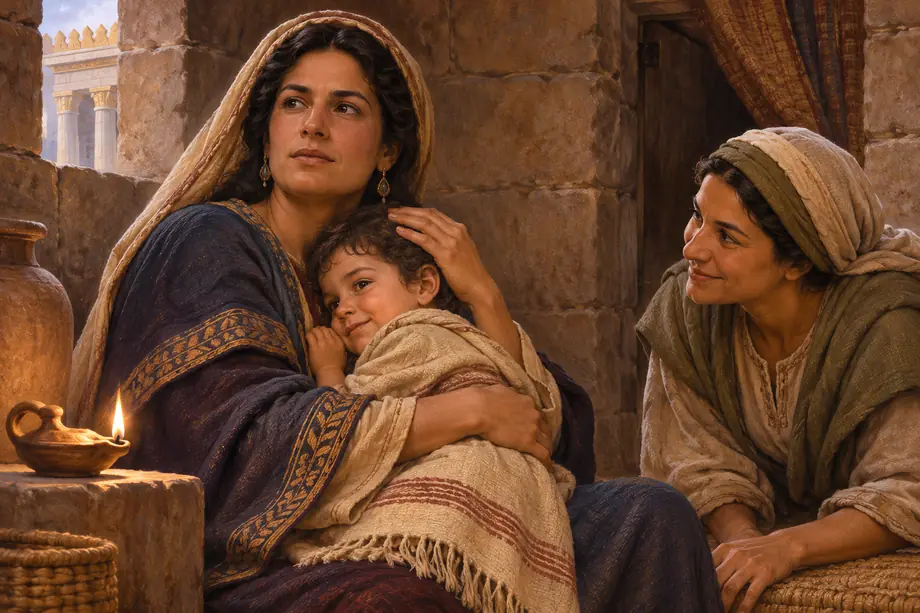
Why does preserving David’s child leave the work of restoring covenant life unfinished?
Study overview
Jehosheba, Jehoiada, and David’s promise in the shadow of the palace
The chariot wheels have quieted in Samaria, but Jerusalem hears footsteps of fear. A throne tries to secure tomorrow with blood; a woman gathers a child into safety. For six years the secret survives. In the house of the LORD, a small life continues to breathe. Then silence gives way to a crown and clapping hands; a child stands where a king should stand. The promise is not kept alive by palace walls but by courageous hands protecting life. David's lamp burns low, yet the flame has not gone out.
- Primary passage:
- 2 Kings 11:1–21.
- Guiding question:
- What happens when those in power seek safety by destroying lives, while faithful people protect the vulnerable future of God's promise?
- Central thesis:
- Second Kings 11 tells how David's royal line survives Athaliah's attempt to eliminate potential heirs. Through Jehosheba's courage, Jehoiada's leadership, and a community willing to act, the LORD preserves a promise that does not depend on royal strength. But dynastic survival is not the whole victory: king and people must again submit to the covenant of the LORD.
Introduction — When Hope Has to Hide in a Room
Human history is usually told through the names of the powerful. A new ruler enters the palace. An army changes its allegiance. A throne passes from one household to another. The names are carved into stone, while the names of people who protected children during the crisis fade from memory. Scripture often tells history differently. At the turning point of a nation, the biblical narrator may move away from the throne and toward a room where a child is being kept alive.
That is the startling movement of 2 Kings 11.
The previous chapter ended with Jehu's revolution in the northern kingdom. Ahab's house had been destroyed and the official temple of Baal dismantled, but Jeroboam's golden calves remained. One kind of idolatry had been removed while the new ruler's own loyalties remained divided. Now the narrative turns south to Judah. Ahaziah, king of Judah, has died during Jehu's purge (2 Kgs 9:27–29). The royal succession has become dangerously uncertain.
Athaliah, Ahaziah's mother, responds by trying to destroy the royal family. David's promised line seems to be approaching its end. But Jehosheba rescues Joash, a child without the means to defend himself. A nurse shares the danger. Six years pass, and the future of the dynasty remains hidden from the palace.
This chapter is about a covenant lamp kept burning by people willing to protect life—and about placing restored authority back under God's word. The story asks more than who will sit on the throne. It asks what kind of kingdom will be built: one secured through the fear of death, or one shaped by fidelity, protection, and accountability.
Historical and Literary Context — Two Royal Houses and One Enduring Promise
Kings is not merely a collection of royal biographies. It is a prophetic interpretation of public life. The narrator follows the rise and fracture of Solomon's reign, the divided kingdoms, prophetic confrontations, and the long movement toward national ruin. Throughout, rulers are assessed by covenant faithfulness rather than popularity, military success, or claims to personal greatness. Israel's king is meant to live under the instruction of the LORD, not above it (Deut 17:14–20).
Second Kings 9–10 narrated judgment upon Ahab's dynasty in northern Israel. But the royal marriages linking northern Israel and southern Judah had already tied the two houses together (2 Kgs 8:18, 26–27). Jehu's killing of Ahaziah of Judah left a political opening in Jerusalem. Athaliah was connected to the Omride-Ahab royal family. The biblical text does not disclose every motive behind Athaliah's actions; what the narrator explicitly records is the attempt to destroy the royal heirs (Brueggemann 2000, 407–8).
The crisis reaches beyond ordinary succession politics. The LORD had promised David an enduring house and kingdom (2 Sam 7:12–16). Since the division of the monarchy, Kings has spoken of a lamp preserved for David in Jerusalem (1 Kgs 11:36). Even when Judah's King Jehoram acted wickedly, the narrator recalled that the LORD would not destroy Judah because of the promise to David (2 Kgs 8:19). At the opening of chapter 11, that lamp appears to be resting on the life of one little boy.
The choice of characters is equally important. Elijah does not stand on a mountain, and Jehu's chariot does not occupy the center of the stage. Instead, Jehosheba rescues, a nurse sustains, and the priest Jehoiada organizes faithful people to preserve a threatened future. The parallel account in 2 Chronicles 22:10–23:21 adds that Jehosheba was Jehoiada's wife. Second Kings identifies Jehosheba as Ahaziah's sister. The text does not establish that Jehosheba was Athaliah's own daughter; a more precise family relationship should not be asserted without qualification.
Literarily, the chapter begins with the royal seed under threat of extermination and ends with a surviving child seated on David's throne. Between those scenes come concealment, protection, anointing, covenant-making, and public participation. Survival is not presented simply as a palace victory. The narrator frames restoration through worship, Torah, and responsibilities shared by king and people (Provan 1995, 221–24).
Walking through the Text — From a Hidden Room to a Public Throne
When the Palace Tries to Erase Tomorrow — Athaliah and the Rescued Child (11:1–3)
Athaliah learns that Ahaziah has died and begins destroying the royal family. The language of royal offspring matters. These are not only political rivals. For readers remembering the promise to David, the loss of the royal seed threatens the visible continuity of God's covenant (2 Sam 7:12–16).
The unexpected opposition comes from someone who does not command an army: Jehosheba, Ahaziah's sister. Jehosheba takes Joash from among the children marked for death, together with the child's nurse. The wording of verse 2 associates the child's removal with a bedroom; verse 3 identifies the temple of the LORD as the hiding place for the years that follow. Translations handle the precise placement of the bedroom differently, but the sequence establishes that Joash is rescued and then concealed in the temple (Provan 1995, 223–24).
Athaliah rules for six years. Jerusalem presumably experiences those years as years of established authority. Yet the temple holds a secret unknown to the palace: a living descendant of David.
The chapter therefore begins with a powerful moral contrast. A ruler tries to secure authority by taking the lives of children. Another woman risks safety to preserve the life of a child. It would be careless to turn that contrast into a judgment against women exercising leadership; the narrative itself places two women before the reader and assesses the opposite directions of their actions. The question is what power is used to protect.
The first victory is neither a battle nor a coronation. It is a child surviving another day.
When Courage Makes a Plan — Jehoiada and the Guards (11:4–8)
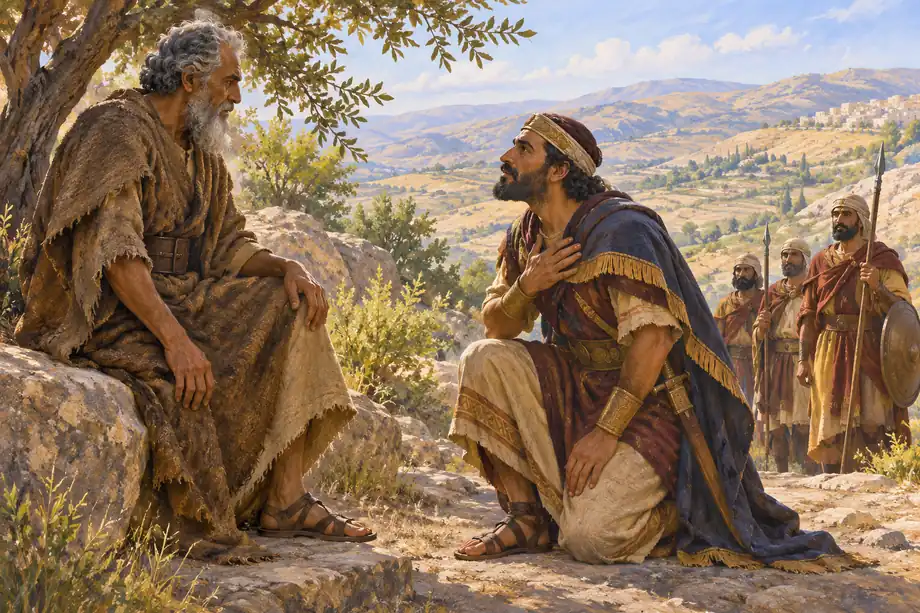
In the seventh year, Jehoiada moves the rescue from secrecy toward public restoration. The priest summons commanders and guards, binds the group by an oath, and reveals the king's son. The hidden promise becomes a shared responsibility. Protection can no longer depend on one woman and one nurse alone.
The instructions name Sabbath duty rotations, divisions of guards, and entrances associated with the royal and temple compounds. The exact arrangement of these units and certain gate names is disputed because the Hebrew text is difficult. Commentators differ over how the groups were deployed (Provan 1995, 222–24). The central point, however, is unmistakable: the child must be protected at every exposed point of the transition.
Jehoiada does not merely announce confidence in God's promise. Jehoiada builds a network of trust, gives responsibilities to identifiable people, and prepares for danger. Prayer and careful planning do not compete with one another. A community that believes God values children also needs practical measures to protect children.
Sabbath appears here in the organization of guard shifts. This passage does not itself develop a theology of weekly Sabbath observance. The narrator's interest is the timing and effectiveness of the protection strategy. Responsible interpretation should allow a logistical detail to remain a logistical detail.
Jehoiada's preparation offers a different picture of leadership from Jehu's repeated public displays of zeal. A faithful leader may do the most important work without making personal prominence the center of the story.
When the King Receives a Crown and a Testimony — Authority under Instruction (11:9–12)
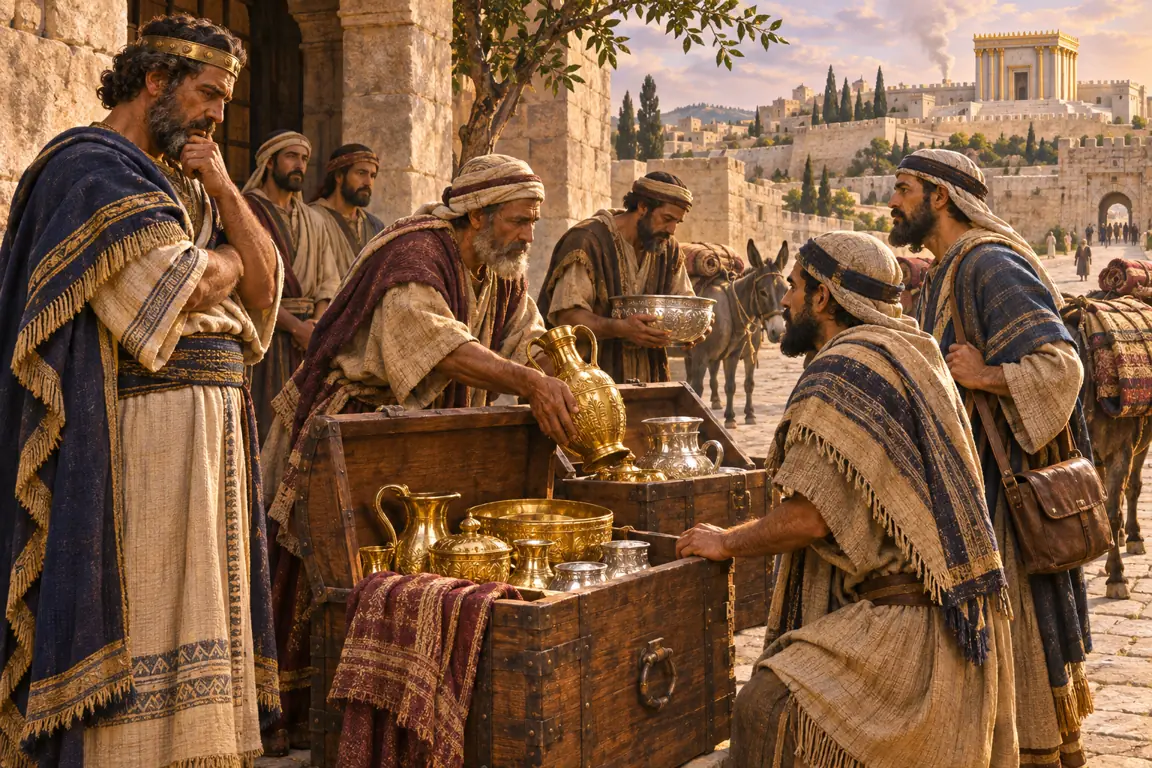
The commanders carry out Jehoiada's orders. Weapons associated with King David, preserved in the house of the LORD, are distributed to the guards. The memory of the earlier king now serves to protect the future of David's house. The guards form a defensive circle around the place of coronation.
Jehoiada brings out Joash, places the crown upon the child, and gives what the biblical text calls the testimony. The expression has been understood in different ways: some readings suggest a written charter of royal obligations, while others discuss an emblem associated with royal authority. The narrative does not provide a detailed description of the object. Yet its presence alongside the crown invites consideration of kingship under covenant instruction (Deut 17:18–20; Brueggemann 2000, 409–10).
Joash is anointed. The assembled people clap and acclaim the king. After six years of secrecy, the promised line becomes visible again.
But the most significant picture is not the crown by itself. It is the crown placed alongside a reminder that authority is answerable to a word greater than royal preference. A throne without covenant instruction can become a license to seize and exploit. A throne under Torah is called to restrain itself and protect the people.
The rescued child has not yet displayed political skill or moral greatness. Joash's survival is a sign of God's faithfulness, not proof that the future king will automatically live faithfully.
When Both Sides Cry Treason — The Fall of Athaliah (11:13–16)
Athaliah hears the commotion and goes to investigate. The ruler discovers Joash standing in the royal place, with officials, guards, and celebrating people around the child. Athaliah tears royal garments and cries out that treason is taking place.
That word exposes a struggle over legitimacy. From Athaliah's perspective, the new coronation is rebellion. From the perspective of those who rescued Joash, Athaliah's attempt to kill the royal heirs was the grave betrayal. The louder accusation does not determine moral truth; covenant obligations and the treatment of life must be examined.
Jehoiada orders the guards to remove Athaliah from the sacred precincts before the execution. Verse 16 locates Athaliah's death near the horses' entrance to the palace. The narrator does not hide the violence that accompanies this political change.
A Christian reader must not turn this royal execution into a timeless prescription for religious reform. The episode belongs to the violent struggle over ancient Judah's monarchy. Jesus directs disciples away from the coercive leadership practices of rulers who dominate others and toward service (Mark 10:42–45). The defense of justice matters deeply, but claims about divine purpose do not exempt human violence from moral scrutiny.
A story may report a violent political judgment without commanding the church to imitate that violence.
When Covenant Returns to Public Life — The LORD, the King, and the People (11:17–18)
Jehoiada does not stop after restoring the crown and removing Athaliah. The priest leads a covenant involving the LORD, the king, and the people, so that the community again understands itself as belonging to the LORD. Jehoiada also establishes covenantal obligations between king and people.
This scene is the theological heart of the chapter. Replacing a ruler is easier than reforming the habits of government. A new king does not own the nation like private property. The crown is accountable to God, and public authority has obligations to the people. The covenant therefore challenges the attitude that allowed Ahab and Jezebel to treat Naboth's land as an extension of royal desire (1 Kgs 21). Deuteronomy's royal law likewise places the king under instruction and warns against self-exaltation (Deut 17:14–20; Brueggemann 2000, 411–13).
The people then break down the temple of Baal, destroy its altars and images, and kill Mattan, Baal's priest. This marks a decisive shift in the public worship of Jerusalem. It also confronts modern readers with the ancient narrative's uncompromising and violent religious politics. Faithfulness to Jesus must not be confused with attacking religious opponents. The kingdom that Jesus announces advances through truthful witness, love, and repentance, not forced conversion or religious violence (John 18:36; Matt 5:43–48).
A lasting reform requires shared commitments, not merely a common enemy.
When the Child Sits and the City Grows Quiet — A New Beginning (11:19–21)
The leaders, guards, and people escort Joash from the house of the LORD into the palace. The young king takes the royal throne. The people rejoice, and the city becomes quiet after Athaliah's death.
The quiet does not mean that Judah's wounds have all healed. Peace after a change in power is an opportunity for covenant life; it is not a guarantee that subsequent rulers will remain faithful. The narrative ends by reporting Joash's age at accession: seven years old (2 Kgs 11:21; some editions associate the notice with the opening of chapter 12).
A seven-year-old cannot independently settle the theological, economic, and political problems of a nation. Joash's future will depend upon guidance, instruction, accountability, and the willing service of other people. The chapter therefore gives no encouragement to treat even a legitimate king as beyond correction.
The opening scene threatened a child with death. The final scene sets a surviving child upon the throne, surrounded by a community that has renewed the covenant. The promise endures because of the faithfulness of the God who made it, not because the surviving child possesses extraordinary strength.
Theological Reflection — Why Does David's Lamp Continue Burning?
God's promise calls forth human courage
The LORD's promise to David is real (2 Sam 7:12–16; 2 Kgs 8:19). Yet the promise does not make Jehosheba's intervention unnecessary. Jehosheba acts, a nurse protects, and Jehoiada brings others into the work. God's faithfulness and human responsibility meet in the same story. Promise is not an excuse for passivity. It is a reason to take courageous, thoughtful action. The temple itself becomes a place where a threatened future is preserved, not merely a place where rituals are performed (Leithart 2006, commentary on 2 Kgs 11–12).
The king's crown belongs beneath the covenant
The child receives a crown and a testimony, and the people renew an agreement with God and one another. This arrangement rejects the idea that a ruler's power is unlimited. Deuteronomy instructs kings not to hoard resources, exalt themselves above their neighbors, or abandon God's teaching (Deut 17:14–20). Even spiritual leaders should welcome accountability. When leaders refuse to answer questions about justice, finances, and human dignity, authority has begun to drift from covenant responsibility.
Protecting the vulnerable belongs to the work of God's kingdom
Athaliah attempts to secure the throne by eliminating children who might become rivals. Jehosheba uses available access to save a threatened child. The contrast echoes the preservation of Moses during Pharaoh's oppression (Exod 2:1–10). It also anticipates the endangered childhood of Jesus under Herod (Matt 2:13–18). These are canonical parallels in the shape of the story: threatened children, violent rulers, courageous protectors, and the surprising continuation of God's purpose. Joash is not another savior equal to Jesus. Jesus is the promised Son of David whose kingdom fulfills rather than merely prolongs the royal hope (Luke 1:32–33).
Worship reform must reach the life of the community
The breaking of Baal's temple accompanies a covenant involving the people. The narrator refuses to separate the direction of worship from the moral structure of the nation. Genuine devotion should affect how neighbors are treated, how the weak are protected, and how the powerful answer for their decisions (Deut 10:12–19; Mic 6:6–8). David's lamp continues not to excuse royal pride but to prepare the biblical story for the King who comes to serve and give life (Mark 10:45).
Life Application — Protect Life and Restore Covenant
- Protect someone whose voice carries little weight. When a child, patient, prisoner, or vulnerable neighbor faces danger, fear of losing influence must not silence action. Find a safe and lawful way to report concerns and seek trustworthy help (Prov 31:8–9).
- Turn concern into a safeguarding plan. Jehoiada does not rely on encouraging words alone. Congregations and institutions need practical child-protection policies, responsible supervision, clear reporting procedures, and checks that cannot be bypassed by status.
- Evaluate leaders by covenant responsibilities, not by applause. Before celebrating a successful transition, ask how the new leadership handles money, disagreement, the rights of ordinary people, and the truth (Deut 17:18–20).
- Honor hidden service. Jehosheba and the nurse protect a life without attracting public admiration. Thank caregivers, teachers, cleaners, medical staff, and others whose quiet faithfulness makes tomorrow possible.
- Never use faith to excuse intimidation or violence. Church disputes and community disagreements need truthful processes, legal safeguards, patient listening, and protection for everyone involved. Ancient royal bloodshed is not a Christian method of discipleship (Matt 5:43–48).
- Write down the commitments that follow a leadership change. After a painful transition, define responsibilities, financial procedures, safeguarding standards, and fair ways to hear complaints. Without changed practices, a new officeholder can repeat an old injustice.
- Keep the next generation in view. Spend time teaching Scripture, listening to young people, and creating environments where children can flourish. The future of a community is often being shaped in decisions that seem small today (Ps 78:4–7).
Reflection Questions
- Whose safety is currently at risk in a family, church, school, or community, and what practical step would responsible protection require?
- Jehosheba accepts danger without the prospect of public acclaim. Where has the desire for recognition made quiet faithfulness difficult?
- Why do the crown and the testimony belong together in 2 Kings 11:12 when read alongside Deuteronomy 17:14–20?
- What safeguards can prevent a new leadership team from repeating the abuses of the previous administration?
- How does Joash's rescue echo the stories of Moses and the young Jesus, and why must Jesus be understood as more than another rescued Judean king?
Response Prayer — Lord, Guard the Lamp You Have Lit
LORD, faithful God of the covenant,
When earthly power tries to secure itself through fear, open the eyes of your people to lives in danger. Give communities the courage of Jehosheba to protect the vulnerable, the patient kindness of the nurse to remain beside those in need, and the wisdom of Jehoiada to prepare carefully for the safety of others.
Do not allow leaders to hide behind titles, ceremonies, or loud promises. Place your word above every crown, every governing meeting, every household, and every ministry. Teach your church to guard children, honor brave and faithful women, listen to overlooked neighbors, and pursue justice with mercy.
When the six silent years of the hidden child come to mind, remind us that divine promises are not forgotten during seasons of waiting. When the bloodshed of royal conflict comes to mind, deliver us from using your holy name to excuse cruelty.
Jesus, Son of David and Prince of Peace, teach your people to lead in truth, humility, courage, and love. Amen.
Window into the Next Chapter — The Crown Is Saved, but the Temple Needs Repair
Second Kings 11 ends with Jerusalem quiet and the young Joash seated on the throne. David's family line has not disappeared. The people have renewed covenant allegiance, and Baal's temple has fallen. But preserving a child king does not automatically restore the spiritual and practical health of the nation.
Second Kings 12 will follow Joash through the years of kingship, especially under the influence of the priest Jehoiada. Attention will turn to the temple's condition, the collection and stewardship of repair funds, the responsibility of the priests, and the pressure brought by Hazael of Aram.
Watch the movement from protecting the child who carries the promise to forming a king who must live faithfully within that promise. Saving the royal line was an urgent beginning; maintaining honest worship and accountable leadership will require longer obedience. Will the rescued king care faithfully for the LORD's house and the LORD's people? Or will the throne begin to defend itself at a cost the nation must bear?
Bibliography
- Brueggemann, Walter. 2000. 1 & 2 Kings. Smyth & Helwys Bible Commentary. Macon, GA: Smyth & Helwys.
- Leithart, Peter J. 2006. 1 & 2 Kings. Brazos Theological Commentary on the Bible. Grand Rapids: Brazos Press.
- Provan, Iain W. 1995. 1 and 2 Kings. New International Biblical Commentary. Peabody, MA: Hendrickson. Reprinted by Baker Books, 2012.
Reading note
Editorial note: This study distinguishes details found in 2 Kings 11 from additions in 2 Chronicles 22–23. The positioning of the guards and the exact form of the “testimony” in verse 12 remain interpretive questions. Christian application does not treat ancient political or religious executions as permission for violence today.
Be the first to leave a comment.