

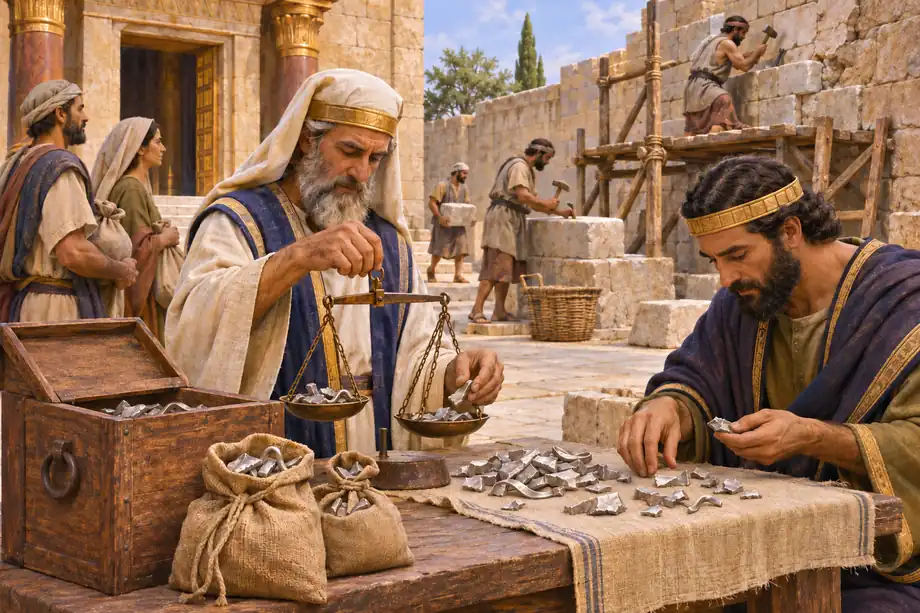
How do the collection chest and Hazael’s payment expose the distance between repairing a temple and remaining faithful?
Study overview
Joash, the repair of the LORD's house, and the testing of a king's faithfulness
The hidden child has grown; the rescued crown has learned the weight of years. But the house of the LORD has cracks, and promises alone cannot repair a wall. Money is gathered. The work stands still. Then a chest receives the gifts of ordinary hands. Craftsmen begin to restore what neglect has worn away. Yet war rises from the north, and consecrated treasures leave Jerusalem. Hands may mend the stones of a temple; what will mend the heart of a king?
- Primary passage:
- 2 Kings 12:1–21 (read also 11:21 and 2 Chronicles 24).
- Guiding question:
- What happens when a ruler can repair God's house yet still struggles to trust God when fear comes to the palace door?
- Central thesis:
- Second Kings 12 is about faithfulness tested over time. Joash sets out to repair the temple and eventually establishes a more effective system for handling its funds. Yet the high places remain, Hazael's threat draws consecrated treasures out of the temple, and the reign ends in an assassination. Lasting renewal requires more than a repaired building: it requires a heart, public decisions, and leadership continually shaped by God's covenant.
Introduction — Being Saved Is Only the Beginning
Rescuing a house from a storm is one thing. Making the rescued house fit to live in is another. In the countryside, a family may celebrate when the roof remains standing after a night of fierce wind. But morning brings its own questions. Are the beams rotten? Is the wall cracking? Has rain found a path through the ceiling? Can the household afford the repairs? A surviving roof does not mean that the whole house is sound.
Second Kings 12 begins in just such a morning.
The previous chapter told of a child pulled away from death. Jehosheba hid Joash. Jehoiada organized protection and called the people to renewed covenant loyalty. At seven years of age, Joash took the throne of David. Athaliah's violent rule ended, Baal's temple in Jerusalem was demolished, and the city found a measure of peace. The crown had been preserved; the long work of cultivating a faithful king was only beginning.
Now the camera moves from a coronation to ordinary years of government. The child becomes an adult. The temple that once sheltered Joash needs repair. The king orders a collection, but years pass with little progress. A new arrangement involving a collection chest and appointed workers finally brings results. Then Hazael of Aram threatens Jerusalem, and the king sends treasures from the temple and palace to turn the attacker away. The reign ends not in public celebration but in a plot against the king's life.
The chapter concerns repairs to a building that expose a greater need: the continuing repair of covenant loyalty. Cracked stones are not the only problem. Worship, money, responsibility, fear, and the meaning of security are all under examination.
Historical and Literary Context — David's Lamp in a House That Needs Repair
The book of Kings evaluates rulers by covenant faithfulness rather than the length of their reigns or the grandeur of their achievements. Deuteronomy 17:14–20 requires a king to remain under God's instruction and not exalt the royal heart above fellow Israelites. God's promise to David establishes the endurance of a royal hope (2 Sam 7:12–16), but that promise never turns each descendant's conduct into something beyond criticism.
Second Kings 11–12 therefore belong together as a two-part story. Chapter 11 concerns the survival of David's royal house. Chapter 12 asks what the surviving king does for the LORD's house. Jehoiada, the priest who helped protect the child, remains an important teacher. Joash reigns forty years in Jerusalem, beginning in the seventh year of Jehu of Israel. His mother is Zibiah of Beersheba (2 Kgs 12:1).
The temple was not simply a monumental building. From the wilderness sanctuary onward, Israel's Scriptures describe God's gracious decision to dwell among the people (Exod 25:8; 40:34–38). Solomon's dedication prayer connects the temple with God's name, prayer, forgiveness, the stranger's plea, and the life of a repentant people (1 Kgs 8:27–30, 41–43, 46–53). In the ancient Near Eastern world, maintaining a sanctuary was also a public expression of a ruler's religious obligations and political identity. Kings refuses to let the two be separated too easily: royal care for sacred buildings may be genuine devotion, but public religion can also become a way to display or protect authority (Brueggemann 2000, 419–25).
The parallel story in 2 Chronicles 24 supplies additional background. According to the Chronicler, Athaliah's household had misused objects belonging to God's house (2 Chr 24:7). Second Kings 12 does not detail every cause of the temple's deterioration. Chronicles also narrates Joash's later unfaithfulness following Jehoiada's death, an account much fuller than the version in Kings. The two biblical presentations may illuminate one another without pretending that both narrate every episode in the same way.
The chapter's financial pattern carries a quiet irony. Resources come in to repair the temple; consecrated treasures later go out to avert a military attack. The first movement concerns the failure to turn good intentions into work. The second raises the question of what religious treasures become when the kingdom feels unsafe (Leithart 2006, 228–31).
Walking through the Text — From a Collection Chest to a Palace Conspiracy
A King Who Does Right, Yet Leaves the High Places (12:1–3)
The narrator begins with familiar royal information: forty years of rule, Zibiah as the queen mother, and a largely favorable assessment. Joash does what is right in the LORD's eyes under Jehoiada's instruction. After Athaliah's reign, the opening lines sound like a welcome clearing of the sky.
Yet there is a qualification. The high places are not removed. People continue to make offerings and burn incense there. The passage does not require every such site to be identified as a shrine of Baal. The point is that Judah's worship remains short of the covenant ideal associated with worshiping the LORD faithfully at the place God chooses (Deut 12:5–14).
There is also a translation question in verse 2. Joash's doing right can be linked to the period during which Jehoiada instructed him, or to his upbringing because Jehoiada instructed him. The wording alone does not settle every question about Joash's later spiritual condition. Second Chronicles 24:15–22 expressly describes a later departure from the LORD, but that narrative detail should be identified as coming from Chronicles (Provan 1995, 224–27).
A good beginning is a gift. Remaining faithful is a daily calling. A long reign and a worthy mentor do not make continued obedience automatic.
When Money Is Collected but Repairs Do Not Happen (12:4–8)
Joash instructs the priests to collect money brought to the LORD's house and apply the funds to damage requiring repair. The wording encompasses various kinds of offerings, including payments associated with sacred obligations, monetary valuations, and voluntary contributions. Israel's earlier experience of raising resources for the tabernacle provides a meaningful background (Exod 30:11–16; 35:20–29; Lev 27).
But by the twenty-third year of the reign, the temple has not been repaired as directed. Joash summons Jehoiada and the other priests, asks why the work remains unfinished, and changes the arrangement. The priests will no longer handle the collection for repairs in the old way; the money must be directed to the work itself.
The chapter clearly records delay. It does not explicitly narrate every reason for the delay. Brueggemann cautions that the passage does not establish embezzlement, while Provan and Leithart take a more critical view of how the priests handled the money and their responsibilities (Brueggemann 2000, 420–21; Provan 1995, 225–26; Leithart 2006, 228–29). A responsible reading can acknowledge the disagreement without converting an inference into a proven accusation.
A congregation can receive many gifts and still leave an urgent need untouched. The problem may involve unclear authority, competing priorities, poor systems, or wrongdoing. The first obligation is to establish what happened and to create a better way forward.
A Chest, a Count, and the Hands of Skilled Workers (12:9–12)
Jehoiada takes a chest, makes a hole in the lid, and places the chest near the altar, on the right as people enter the LORD's house. The priests at the threshold put the people's money into the chest. When substantial funds have accumulated, the royal secretary and the high priest count and prepare the collection. The money is then entrusted to supervisors overseeing the repairs.
The narrative follows the money all the way into work: carpenters, builders, masons, stonecutters, supplies of timber and dressed stone. These workers are not decorative characters. Their labor is the visible evidence that a project has finally moved beyond announcements.
The new system joins the purpose of the gift, a visible means of collection, a count involving responsible officers, and delivery to the workers. Such a system does not imply that every priest was dishonest. It shows that a process should actually serve the purpose for which a community entrusted resources to it.
Kings offers no detailed manual of contemporary accounting. Still, the scene presents an enduring principle: stewardship must connect good intentions with trustworthy procedures and completed work. Faithfulness has hands, measurements, tools, and fair payment.
Repairing the Structure First: Priorities and Trust (12:13–16)
The text next clarifies how the repair collection was used. The money was not first spent on silver bowls, utensils, trumpets, or other precious furnishings. It went to the people repairing the building. At this point, removing damage had priority over adding fine objects.
The narrator then gives the workers an unusual commendation. Those entrusted with the money acted honestly (12:15). They were not required to provide an individual accounting of every transaction. This is not a universal command for modern ministries to abandon audits. In the very same passage, the collection has been counted before distribution, and the supervisors' character is explicitly recognized. Integrity and accountability are partners, not competitors.
Verse 16 adds a further distinction. Money belonging to the priests from guilt offerings and sin offerings was not part of the temple repair collection (see also Lev 5:14–6:7). Sacred income had more than one legitimate purpose. The story makes room for proper support of priestly service while insisting that donations collected for repairs be used for repairs.
For church leadership, the practical point is larger than a ledger. Honest work, wages paid on time, designated gifts used properly, and truthful reports are expressions of respect for God and neighbor alike.
When the Treasury Goes Out: Hazael's Threat (12:17–18)
The noise of hammers gives way to the noise of war. Hazael, king of Aram, attacks and captures Gath, then turns toward Jerusalem. Readers have already met Hazael's rise in 2 Kings 8:7–15 and Aram's pressure on Israel during Jehu's reign (2 Kgs 10:32–33).
Joash gathers consecrated treasures dedicated by earlier kings and by Joash himself. The king also takes the gold found in the treasuries of the LORD's house and the royal palace. These valuables are sent to Hazael, who withdraws from the intended attack on Jerusalem.
We should not claim that the valuables given to Hazael were necessarily the very same coins collected in the repair chest. Kings refers specifically to consecrated treasures and palace funds. Nor does the text disclose every element of Joash's reasoning. Sending a payment might be understood as a way to preserve lives under a military threat. The narrator, however, places two memorable pictures side by side: resources brought into the LORD's house to repair the sanctuary, and sacred treasures carried away to obtain political safety.
Does the payment show prudent diplomacy, a failure of trust, or a troubling combination of the two? Second Kings does not report Joash seeking the LORD in this crisis, but it does not provide a full account of the royal deliberations either. Second Chronicles 24:23–24 gives a more explicit theological explanation of Aram's attack in relation to Judah's apostasy. That is a statement from Chronicles, not an explicit judgment voiced in 2 Kings 12.
The scene invites a practical question: when fear enters a community, what is the first thing a leader is prepared to surrender—money, justice, truth, or faithfulness?
The Rescued King Falls to a Conspiracy (12:19–21)
The final verses return to the familiar royal record. Other actions of Joash are said to appear in the annals of Judah. But the concluding event is far from ordinary. Members of the king's own household or service conspire against him and kill him near the house of Millo, on the road that goes down to Silla. Amaziah, Joash's son, succeeds him.
The narrative reversal is painful. A child once protected from palace violence becomes a ruler killed by palace violence. Chapter 11 opened with an attempt to destroy the royal heirs. Chapter 12 closes with servants conspiring against an established king.
Kings does not fully explain the conspirators' motives. Second Chronicles 24:15–26 gives additional information: Jehoiada dies, Joash abandons the LORD, Zechariah son of Jehoiada speaks against the king's unfaithfulness and is killed at the king's command, and the eventual conspiracy is connected to the bloodshed. The Chronicler's account offers a fuller interpretation, but readers should be told which details belong to which book (Brueggemann 2000, 423–24).
A crown saved in childhood can still be lost amid violence in adulthood. The biblical story leaves readers longing for more than a ruler who repairs a building. It creates a longing for the King whose faithfulness will endure.
Theological Reflection — God's House and the King's Heart
Torah measures leadership even after visible success
Joash receives an initially positive verdict, but the high places remain (2 Kgs 12:2–3). Forty years of rule and a repaired sanctuary do not erase the unresolved question of covenant loyalty. Deuteronomy 17:18–20 pictures a king who must keep learning God's instruction throughout life. This remains a needed word for leaders in congregations, homes, schools, and public institutions. Success in one important project does not remove the need to examine the next decision.
Money entrusted for worship is a spiritual and communal matter
Jehoiada's chest becomes a sign that willing gifts can accomplish something concrete. But the chest works because money is counted, responsibilities are assigned, skilled people are paid, and the intended repairs happen (Exod 35:21–29; 2 Kgs 12:9–16). Transparent stewardship does not diminish faith. It guards the trust of donors, protects workers, and helps communities address real needs. At the same time, the chapter should not be used to level unproven accusations against every priest involved in the delay.
The temple is a meeting place with God, not an insurance policy
Solomon's temple had been dedicated for prayer, repentance, forgiveness, and the hope of God's presence (1 Kgs 8:27–30). Yet the treasury that testifies to the sanctuary's sacred significance can become a resource for royal crisis management. God cannot be reduced to a political asset. Nor can a beautiful building contain or control the LORD. Jeremiah later warns against trusting in the temple's visible presence while refusing justice and obedience (Jer 7:1–11).
For Christian readers, the temple story leads toward Jesus, who speaks of his own body in temple language (John 2:19–22) and confronts the misuse of the house of prayer (Mark 11:15–17). Through Christ, the community is called to be a dwelling of the Spirit (1 Cor 3:16–17; Eph 2:19–22). This does not make worship buildings unimportant. It means that buildings must serve the purposes of the living God rather than replace obedience to God.
David's promise points toward the King who finishes the work
Joash was hidden and rescued so that David's throne would not fall silent (2 Kgs 11). Joash later repaired the temple, but the reign did not produce complete covenant faithfulness and ended in conspiracy. The contrast deepens the biblical longing for David's faithful Son, a ruler whose justice and mercy will not collapse beneath fear and political pressure (Isa 11:1–5; Luke 1:32–33).
Jesus does not buy lasting peace with sanctuary treasures. The cross exposes the cost of human violence and sin; the resurrection announces the beginning of God's new creation. The story reaches toward the day when God's dwelling with humanity will no longer depend on a vulnerable palace or a sanctuary needing repeated repair (Rev 21:1–3, 22). What Joash could repair in stone, the true King will surpass in the renewal of creation.
Life Application — Repair the House, Guard the Heart
- Name the cracks before painting the walls. In a church, school, or household, identify urgent problems involving safety, teaching, finances, care, and accountability before spending money on public appearance. Real renewal begins by admitting what has been damaged (2 Kgs 12:5).
- Protect the purpose of designated gifts. Separate money given for building repairs, support of vulnerable people, and ordinary operating costs. Make the purpose clear to donors and provide honest progress reports (2 Kgs 12:9–12).
- Investigate delays without rushing into accusations. When a project stalls, examine the timetable, responsibilities, budgets, suppliers, and obstacles. Rebuild the process and seek evidence before concluding that theft occurred (Prov 18:13).
- Honor and pay skilled workers fairly. Carpenters, builders, engineers, cleaners, and administrators contribute essential service. Pay agreed wages on time and recognize the dignity of practical work (Jas 5:4).
- Never substitute personal reputation for safeguards. Good character matters, but transparent accounts, lawful oversight, shared authorization, and periodic review protect both leaders and the community (2 Cor 8:20–21).
- Think carefully before making a decision driven by fear. When a threat arises, do not immediately surrender shared resources or core principles. Consult trustworthy people, consider the consequences for vulnerable neighbors, and make decisions openly wherever safety permits (Prov 15:22).
- Develop conviction that survives the mentor's absence. Jehoiada guided Joash, but Joash needed his own settled obedience to the LORD. Build habits of Scripture reading, accountable leadership, teachability, and preparation of a faithful next generation (Deut 17:18–20; 2 Tim 2:2).
Reflection Questions
- What cracks in a household, congregation, or institution are being hidden behind a respectable appearance?
- In 2 Kings 12:4–12, what is the difference between receiving donations and ensuring that the intended work is completed?
- Why does responsible interpretation distinguish a recorded delay in temple repairs from an allegation of theft that the chapter does not explicitly prove?
- What does Hazael's threat reveal about the pressure leaders experience when security, influence, or life itself seems at risk?
- Why do Joash's rescue and temple renovations fail to satisfy the deeper biblical hope for David's final and faithful King?
Response Prayer — Lord, Repair the Cracks No One Sees
LORD, God of the covenant and guardian of David's promise,
Thank you for lives preserved, places of worship restored, and hands willing to work with skill and honesty. Yet before your word, we confess that a shining building can conceal a heart in need of repair.
Give your people courage to identify the cracks in ministries, families, and communities. Teach us to receive and use money transparently, to honor workers, to protect vulnerable neighbors, and to tell the truth when projects fail to move forward. Grant wisdom to investigate without slander and humility to repent when wrongdoing is established.
When fear approaches like the army of Hazael, do not let anxiety turn holy commitments into a price paid for temporary comfort. Guide leaders to preserve life without selling justice, truth, or faithfulness.
Jesus, Son of David and true Temple, make your people a dwelling place for the Holy Spirit. Heal the cracks of pride, greed, and hypocrisy. Let the work of our hands and the direction of our hearts bear witness to your kingdom of mercy and truth. Amen.
Window into the Next Chapter — Another Crown, a Crying Nation, and an Aging Prophet
Second Kings 12 ends with Joash of Judah murdered by his own servants. His son Amaziah succeeds him. The temple has received its repairs, but the king's story has not ended in peace. Across the divided kingdom, Aram remains a powerful source of fear, war, and public suffering.
Second Kings 13 will turn primarily to northern Israel. Jehoahaz, son of Jehu, will rule while Hazael and Ben-hadad press the nation hard. The people will suffer; the LORD will hear a plea for help and provide a measure of relief. Yet the sins of Jeroboam will remain deeply rooted. Later, Jehoash of Israel will visit Elisha near the prophet's death. A bow, arrows, and the striking of the ground will raise a question about how firmly a king receives God's word of promise.
Watch the distance between God hearing the suffering of the people and the people abandoning the practices that keep them in bondage. Mercy may open another door, but a new opportunity calls for renewed loyalty. Will the nation receive deliverance as an invitation to return to the LORD, or merely as a pause before going back to the old path?
Bibliography
- Brueggemann, Walter. 2000. 1 & 2 Kings. Smyth & Helwys Bible Commentary. Macon, GA: Smyth & Helwys.
- Leithart, Peter J. 2006. 1 & 2 Kings. Brazos Theological Commentary on the Bible. Grand Rapids: Brazos Press.
- Provan, Iain W. 1995. 1 and 2 Kings. New International Biblical Commentary. Peabody, MA: Hendrickson. Reprinted by Baker Books, 2012.
Reading note
Editorial note: The names Joash and Jehoash may vary by translation, and Hebrew/English verse numbering differs around 2 Kings 11:21. The article distinguishes the account in 2 Kings 12 from the additional narrative material in 2 Chronicles 24. Kings does not explicitly establish every cause of the delayed repairs or the palace conspiracy; differences among scholarly interpretations are therefore preserved.

Be the first to leave a comment.