

Why do mercy for Israel and life in Elisha’s tomb still leave a question about faithful response?
Study overview
Israel's cry, the covenant promise, and Elisha's final ministry
The army lies scattered like chaff on the threshing floor. A kingdom struggles to breathe beneath Aram's weight. Yet a cry travels beyond Samaria's walls; the LORD hears, even where covenant loyalty has failed. An old prophet lies upon a bed of sickness. A king lifts a bow; an arrow flies through an eastern window. Three strikes fall upon the earth—and stop. Then a grave receives another man's body, and the place of death becomes a witness to life. Will mercy turn the nation toward its God, or merely delay the coming storm?
- Primary passage:
- 2 Kings 13:1–25.
- Guiding question:
- What happens when God hears a nation's cry for help, but the nation continues to hold on to the worship that helped bring disaster?
- Central thesis:
- Second Kings 13 is a story of mercy enduring amid rebellion. The LORD rescues Israel from oppression because of the covenant with Abraham, Isaac, and Jacob, while Israel's kings continue the sins of Jeroboam. The sign of the arrows exposes obedience that stops too soon, and the surprising resurrection beside Elisha's bones opens a window of hope: the covenant God can bring life even when human strength is spent.
Introduction — A Cry Rising from the Dust
There is a kind of village silence that does not mean peace. Fields have been trampled. Grain has been taken. Young people have gone to war. Families count the days instead of the harvests. In such a season, a hungry person's cry may be more truthful than a ruler's carefully prepared speech.
Second Kings 12 ended with the death of Joash of Judah. The king had tried to repair the temple, faced the threat of Hazael of Aram, and met a violent end. Chapter 13 now turns the camera northward. Jehu's royal house still rules Israel, but a surviving dynasty is not the same thing as a secure nation. Jehoahaz, Jehu's son, lives beneath Aramean pressure. Israel's military strength is reduced to something like dust crushed on a threshing floor (13:7).
The king cries to the LORD. God listens. A deliverer is given, and ordinary life becomes possible again. Yet the rescue does not produce a lasting return to covenant faithfulness. That is the heartbreak of the chapter: mercy opens a door, but the nation continues walking the road that led to suffering.
Then another king takes the throne. Jehoash of Israel—the son of Jehoahaz, not the Joash of Judah described in chapter 12—visits Elisha on the prophet's deathbed. The aging servant of God still has a word of life for a threatened nation. A bow is raised, an arrow is shot eastward, and a striking sign is performed. But the king stops after three blows upon the ground. At the end, an interrupted burial brings the reader to a tomb where death itself is unexpectedly overturned.
This is not a story about good people earning rewards. It is about a faithful God sustaining an unfaithful people while calling the people to respond before another day of judgment arrives.
Historical and Literary Context — An Ancient Promise in an Unsteady Kingdom
The book of Kings measures public life by God's covenant. A ruler is not judged only by military success, longevity, or the ability to pass a crown to the next generation. A king stands under God's instruction and must not exalt the royal heart above fellow Israelites (Deut 17:14–20). Ever since Jeroboam I established alternative royal sanctuaries at Bethel and Dan (1 Kgs 12:26–33), the northern kingdom has been haunted by a repeated verdict: its rulers continue in Jeroboam's sins.
Jehu destroyed Ahab's dynasty and eliminated the state-sponsored cult of Baal, yet Jehu retained the golden calves (2 Kgs 10:28–31). Chapter 13 reveals the consequences of reform that does not reach the roots. Jehoahaz and Jehoash possess legitimate royal succession within Jehu's dynasty, but both continue the religious pattern the narrator condemns. Hazael of Aram and Hazael's son Ben-hadad, meanwhile, press Israel militarily. The resulting crisis is geopolitical and deeply theological: Kings asks what happens when power and worship refuse God's covenant boundaries (Brueggemann 2000, 427–35).
The chapter begins with the reign of Jehoahaz (13:1–9) and turns to the reign of Jehoash of Israel (13:10–25). The narrative of Elisha's approaching death interrupts the royal notices and places the prophet's word at the center. Verse 12 mentions Jehoash's conflict with Amaziah of Judah, but the fuller account follows in chapter 14. Kings is not merely a royal calendar. It is prophetic history, arranging public events to disclose the spiritual meaning of kingship, violence, mercy, and covenant loyalty.
An older biblical pattern lies beneath the chapter. In Judges, Israel does evil, experiences oppression, cries out, and receives deliverance (Judg 2:11–18; 3:9, 15). In Exodus, God hears the groaning of enslaved Israelites and remembers the covenant with the ancestors (Exod 2:23–25). Thus the pivotal statement in 2 Kings 13:23 reaches back far beyond Jehu, David, and even Moses: the LORD shows mercy because of the promise to Abraham, Isaac, and Jacob (Gen 12:1–3; 17:7–8).
But remembering the covenant is not the same thing as ignoring rebellion. Israel's later exile will be narrated in chapter 17. Here, divine mercy and the warning of judgment remain painfully close together. The opportunity to turn has not yet been withdrawn (Provan 1995, 228–32).
Walking through the Text — Two Kings, One Prophet, and a Promise That Remains
Jehoahaz: A Heard Cry and Unabandoned Idols (13:1–7)
Jehoahaz, son of Jehu, becomes king of Israel during Joash of Judah's reign. The opening assessment is severe. Jehoahaz does evil before the LORD and follows the sins of Jeroboam. The narrative again resembles Judges: covenant rebellion is followed by domination, this time under Hazael and Ben-hadad of Aram (13:2–3).
Then the story turns. Jehoahaz seeks the LORD's favor, and the LORD listens because God sees how severely the Arameans have oppressed Israel (13:4). The narrator says that God provides a deliverer or savior for Israel (13:5). The deliverer is not named. Perhaps the reference concerns Elisha, an Israeli commander, or a shift in the wider political situation; the biblical passage does not settle the identity. What the narrator makes clear is the source of deliverance: the LORD.
People are again able to live with a measure of ordinary security. Yet verse 6 delivers an unsettling verdict. Israel does not depart from Jeroboam's sins. An Asherah symbol remains in Samaria, exposing the persistence of compromised worship even after Jehu's campaign against Baal.
The price of oppression appears in verse 7. Jehoahaz is left with only fifty horsemen, ten chariots, and ten thousand infantry. The defeated military is compared to dust beaten down at threshing time.
Mercy has answered the cry, but enduring repentance has not answered mercy. God has opened a way for life; Israel has not forsaken the practices that threaten that life.
Jehoash of Israel: Another Crown, the Same Verdict (13:8–13)
Jehoahaz dies, and Jehoash becomes king. This ruler is Jehoash of Israel, not Joash of Judah, the temple-repairing king of chapter 12. The nearly identical names can easily confuse readers. Keeping the northern and southern kingdoms distinct is essential to following the account.
Jehoash reigns in Samaria for sixteen years. The religious assessment has not changed: the new ruler continues in Jeroboam's sins. The narrator mentions the king's warfare against Amaziah of Judah, then reports death and burial. The campaign itself will receive extended attention in 2 Kings 14:8–14.
The repetition has a purpose. Sin can become institutional memory. A new generation inherits a throne, a court, and established worship practices. The new ruler may receive an office from an ancestor; faithfulness cannot be inherited without being learned, chosen, and practiced.
Elisha's Last Illness: Who Are Israel's Real Chariots? (13:14–17)
Elisha, the prophet who received Elijah's mantle in 2 Kings 2, now suffers the illness from which he will die. Jehoash of Israel comes and weeps over the prophet, crying, “My father, my father, the chariots of Israel and its horsemen!” (13:14; compare 2 Kgs 2:12).
Elisha had spoken those words as Elijah departed. Now the king uses the same language for Elisha. Israel's military has suffered devastating losses, and the king appears to recognize that the nation's real protection cannot be reduced to horses, equipment, and soldiers. The LORD's prophetic word has sustained Israel through dangers that royal weapons could not master.
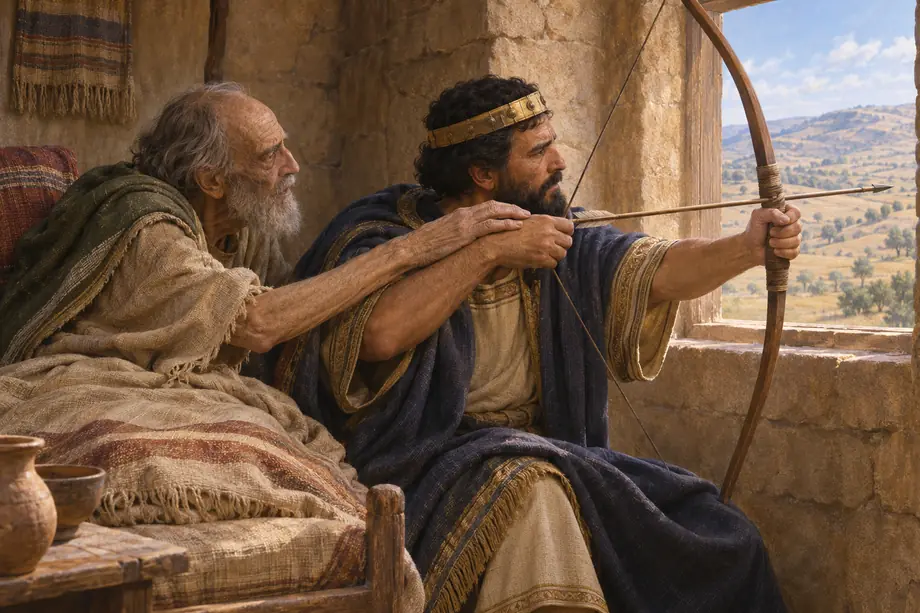
Elisha asks for a bow and arrows. The king takes the bow; the prophet places his hands over the king's hands. An eastern window is opened, and an arrow flies. Elisha declares the shot to be the LORD's arrow of victory against Aram, and names Aphek as the setting of the promised victory (13:15–17).
The image is carefully balanced. The king is the one who holds the bow, yet royal skill cannot manufacture the promise. The prophet's hands over the king's hands portray political power being directed by God's word rather than ruling independently of it.
Three Strikes: Obedience That Stops Too Soon (13:18–19)
Elisha tells the king to take the remaining arrows and strike the ground. Jehoash strikes three times and stops. The prophet becomes angry. The king should have struck five or six times; then the defeat of Aram would have been complete. Instead, the king will strike Aram only three times (13:18–19).
The passage never reports Elisha giving the king a required number in advance. Therefore this episode should not become a mechanical rule that prayers must be repeated five or six times before God acts. The prophetic sign concerns the depth of the king's response. Provan argues that Jehoash's problem is not total refusal, but a failure to respond wholeheartedly enough to the prophetic word (Provan 1995, 229–30).
Three strikes become an image of obedience begun but not pursued to its full reach. The king holds a sign of deliverance, yet the response ends before the prophet considers the work complete. Leadership can fail not only through blatant rejection of God's word, but also through caution that keeps commitment shallow.
A Grave That Bears Witness to Life (13:20–21)
Elisha dies and is buried. Around that time, bands of Moabites make raids into the land. During another funeral, the mourners notice approaching raiders and hurriedly place the dead man in Elisha's tomb. When the corpse touches Elisha's bones, the man comes to life and stands on his feet (13:20–21).
The episode is strange, and the narrator does not pause to explain a repeatable mechanism. Neither does Scripture command believers to seek healing through the bones of deceased servants of God. The sign concerns the LORD's power to give life, even after the prophet's death. Elisha's body has entered the grave, but the God who worked through Elisha has not been confined to the grave.
The moment recalls the restoration of the Shunammite woman's son in 2 Kings 4:32–37. It also prepares the biblical imagination for Ezekiel's later vision of dry bones restored by God's breath (Ezek 37:1–14). That is a canonical connection for reflection, not a claim that this incident explicitly predicts every detail of Ezekiel's vision.
The Covenant That Holds Back Destruction (13:22–25)
The chapter ends by looking back to Aramean oppression. Hazael had pressed Israel throughout Jehoahaz's reign, but the LORD was gracious, compassionate, and attentive because of the covenant with Abraham, Isaac, and Jacob (13:23). The LORD was not yet willing to destroy Israel or cast the people away from the divine presence.
This is the chapter's theological center. Grace has not arrived because Israel's kings passed a test of faithfulness. Grace arises from God's own character and enduring commitment. Exodus 2:24 seems to echo across the centuries: God hears the cry and remembers the covenant.
Yet the phrase “until now” matters. Present mercy is not permission to practice idolatry forever without consequence. Chapter 17 will tell of Samaria's fall and Israel's exile. Following Hazael's death, Jehoash recovers towns previously taken by Ben-hadad, Hazael's son. The king defeats Aram three times, exactly as Elisha had said (13:25).
The narrative closes its circle: the nation's cry, the divine promise, the arrow sign, and the limited victories now belong to one story. The LORD has remained faithful. The unresolved question is whether Israel will become faithful in return.
Theological Reflection — Mercy Stronger Than the Weakness of Kings
Covenant is the root of hope, not a license for sin
The ground of mercy is explicit in 13:23: God's covenant with Abraham, Isaac, and Jacob. Deliverance does not begin in Jehoahaz's military competence or Jehoash's skill with a bow. It begins in God's long history of promise. Across Scripture, Abraham's calling points toward blessing for the nations, not pride in special status (Gen 12:2–3). Grace that forgives also calls God's people to reject idols and practice justice (Deut 10:12–19).
God hears those crushed by oppressive power
In verse 4, the LORD sees Israel's suffering. The image echoes the cries of enslaved Israel in Exodus (Exod 2:23–25) and the oppressed communities in Judges (Judg 3:9). The suffering is not imaginary. The army has been shattered, and families have paid the price. Mercy is not merely a religious explanation that minimizes injustice; mercy opens a way toward life. Communities that confess the God who hears should learn to hear the people who carry the costs of bad leadership.
Prophetic authority resides neither in weapons nor in relics
Jehoash mourns Elisha as Israel's chariots and horsemen. God's authority exposes the limits of military self-reliance. The arrows function as a prophetic sign, not magic. The bones appear in a miracle, not in a system for producing miracles. No bow, tomb, or human remains receive independent power. The living LORD remains the giver of victory and life (Ps 20:7; 2 Kgs 13:17, 21).
Elisha's story leads toward the King who conquers death
Elisha's ministry involves water, bread, healing, and restored life (2 Kgs 2:19–22; 4:1–44; 5:1–14; 13:21). The Gospels portray Jesus feeding the hungry, healing the sick, and raising the dead (Mark 6:34–44; Luke 7:11–17; John 11:38–44). Jesus is not merely another Elisha. Jesus announces God's kingdom, confronts evil through self-giving at the cross, and rises as the beginning of God's new creation (1 Cor 15:20–26). Elisha's tomb witnesses one person's return to life. Jesus' empty tomb announces a victory that points toward the resurrection of God's people.
Life Application — Arrows of Faithfulness for Today
- Listen to suffering before defending institutions. In a church, hospital, or community, set aside time to hear those harmed by leadership decisions. Identify concrete ways to help instead of offering only quick explanations (2 Kgs 13:4; Jas 1:19).
- Do not confuse relief with repentance. When a crisis eases, examine the practices that helped create the crisis: misuse of funds, favoritism, cruelty, or superficial worship. Change the pattern, not merely the circumstances (13:5–6).
- Question inherited wrongdoing. A new leader should not assume that every long-standing custom is right. Examine family and institutional habits under Scripture and by their effects upon neighbors (13:10–11; Deut 17:18–20).
- Finish the work of obedience. Choose one commitment left unfinished—an apology, restitution, a neglected promise, or a visit to someone who is sick. Set a date and involve trustworthy people in seeing the work through (13:18–19).
- Never substitute sacred objects for trust in God. Water, oil, graves, garments, and arrows must not become objects thought to possess independent spiritual force. Prayer and confidence belong to the living LORD (13:17, 21; John 4:23–24).
- Build a legacy of God's word, not dependence on one personality. Elisha died, but God's work continued. Train future teachers and leaders, document learning, share responsibility, and establish accountability (13:20–21; 2 Tim 2:2).
- Turn temporary recovery into an opportunity for justice. When economic or political conditions improve, use the breathing room to strengthen vulnerable communities rather than rebuilding the same oppressive habits (13:23–25; Mic 6:8).
Reflection Questions
- Whose suffering has been heard by community leaders but has not yet received a meaningful response?
- Which familiar practice has survived in personal life or ministry even after God provided a fresh opportunity to change?
- What unfinished act of obedience resembles the three strikes of Jehoash—an encouraging beginning followed by an early stop?
- How can a community honor a faithful servant's memory without turning the servant, a grave, or a relic into an object of devotion?
- If God showed compassion to Israel because of the ancestral covenant, what visible changes should such mercy awaken in worship and public justice today?
Response Prayer — God of the Promise, Open the Nation's Heart
LORD, God of Abraham, Isaac, and Jacob, no cry of suffering disappears before your throne. See families exhausted by oppression, illness, debt, and fear. See leaders who cling to office while neighbors bear the consequences. Teach your church to listen as you listen and to respond with mercy and justice.
Do not allow relief from hardship to become an excuse for forgetting repentance. Expose the idols sheltered behind respectable religious language. May our obedience not end after three strikes when faithfulness still calls for courage and perseverance.
God of Elisha, remind the church that servants pass away but your word endures. Lord Jesus, King who conquered death, breathe new life into weary hope. Build communities that feed the hungry, mend wounds, defend the vulnerable, and bear witness to your coming kingdom. Amen.
Window into the Next Chapter — When Victory Becomes Pride
Second Kings 13 ends with Jehoash of Israel defeating Aram three times and recovering lost towns. The victories bring relief, but Israel's deeper problem remains. Jeroboam's sins still shape public worship, and Elisha has now departed from the story.
Second Kings 14 opens in Judah. Amaziah will become king and receive a qualified positive assessment. A victory over Edom will create a dangerous opening for pride. Amaziah will challenge Jehoash of Israel and receive a parable about a thistle and a cedar—a warning against overconfidence. Battle will follow; a section of Jerusalem's wall will be broken down. Later, Jeroboam II will bring political success to Israel even while the spiritual verdict remains troubled.
Watch the question develop: When God gives victory, does victory become a reason for thanksgiving and obedience—or the seed of fresh arrogance? A nation may be rescued from an enemy's hand and still need to be rescued from the pride growing within its own heart.
Bibliography
- Brueggemann, Walter. 2000. 1 & 2 Kings. Smyth & Helwys Bible Commentary. Macon, GA: Smyth & Helwys.
- Leithart, Peter J. 2006. 1 & 2 Kings. Brazos Theological Commentary on the Bible. Grand Rapids: Brazos Press.
- Provan, Iain W. 1995. 1 and 2 Kings. New International Biblical Commentary. Peabody, MA: Hendrickson. Later reprinted by Baker Books.
Reading note
Editorial note: Spellings of Jehoahaz/Joahaz and Jehoash/Joash vary between Bible translations. This article distinguishes Jehoash of Israel from Joash of Judah. The “deliverer” of 13:5 is not identified by name in the text; the arrow sign is not a formula for repeating prayers a fixed number of times; and the resurrection in 13:21 does not authorize the magical or commercial use of human remains.
Be the first to leave a comment.