


Why can Amaziah’s victory and Jeroboam II’s success never provide a complete measure of faithfulness?
Study overview
When a king wins a battle but fails to guard his heart
Arrows have struck the ground three times; Israel has found some relief from Aram. But south of the border, victory drums are beating; Amaziah has returned from the Valley of Salt. When drums become louder than wisdom, a little thistle begins to measure itself against a cedar. Then Jerusalem's wall is broken, and treasure travels north to Samaria. Yet the Lord still sees a suffering people, and mercy opens a door that unfaithful worship could never open. Will success teach the heart to give thanks, or become the soil where pride takes root?
- Primary passage:
- 2 Kings 14:1–29.
- Guiding question:
- What happens when victory teaches a leader self-confidence rather than dependence upon the Lord?
- Central thesis:
- 2 Kings 14 is about the distance between victory and faithfulness. Amaziah demonstrates genuine respect for God's law in one matter, yet his victory over Edom feeds a challenge to Israel that leaves Jerusalem exposed. Jeroboam II, although he continues in sin, brings relief to Israel because the Lord sees the people's suffering and has not determined to erase Israel's name. National success must never be mistaken for God's endorsement of a ruler's character.
Introduction — When Victory Becomes a Mirror for the Self
Some victories heal old wounds. Other victories open new wounds, because the winner stops listening. A farmer may reap a rich harvest and forget the rain, the soil, and the neighbors who helped to plant. A ruler may win one battle and begin to believe that no voice remains worthy of offering correction.
Second Kings 13 ended by setting Jehoash's victories over Aram within the mercy of the Lord. Israel recovered lost towns even while the old patterns of false worship endured. Now chapter 14 turns toward Judah. Amaziah, son of Joash of Judah, begins with a decision that deserves respect: the king punishes the men who murdered his father but refuses to execute their children. The throne accepts a limit imposed by the Torah (14:5–6; Deut 24:16).
Then Amaziah defeats Edom. The victory does not bring rest. Instead, Amaziah challenges Jehoash, king of Israel. A warning comes in the form of a parable about a thistle and a cedar. Amaziah will not listen. The result is not another celebration but a demolished section of Jerusalem's wall, the removal of temple treasure, and the taking of hostages (14:8–14).
The second half of the chapter offers an even more unsettling contrast. Jeroboam II succeeds politically although the narrator condemns his religious conduct. The Lord is not declaring wickedness righteous. God sees the affliction of ordinary people and provides a measure of relief through a ruler whose worship remains corrupt.
This chapter warns against measuring spiritual health by favorable results alone. Victory can conceal pride. Prosperity can conceal idols. And mercy may reach a suffering people even while their leaders remain unchanged.
Historical and Literary Context — Two Kingdoms Under One Covenant Standard
The books of Kings are more than a register of battles, dynasties, and dates. Their narrator evaluates public life through the covenant: Does a king listen to the Lord's instruction? Does royal worship turn away from idols? Are human lives treated with justice? Deuteronomy 17:14–20 imagines a king who lives under God's Torah rather than placing the royal will above it.
Jehu had destroyed Ahab's dynasty and the state-sponsored worship of Baal, but his successors retained the sins of the first Jeroboam (2 Kgs 10:28–31; 13:10–11). Meanwhile Judah had survived Athaliah's attempt to destroy the Davidic family (2 Kgs 11). Joash of Judah repaired the temple, yet his reign ended amid Aramean pressure and palace violence (2 Kgs 12).
Amaziah inherits this fragile throne. In 14:1–22, the narrator gives the familiar royal assessment: family and length of reign, worship, notable actions, and death. One unusual feature is the insertion of a second closing account for Jehoash of Israel in the middle of Amaziah's story (14:15–16). The literary arrangement keeps Israel's dominance over Judah in view long after the battlefield encounter. Provan draws attention to the way Amaziah's defeat anticipates later humiliations of Jerusalem (Provan 1995).
Verses 23–29 turn to Jeroboam II, the son of Jehoash of Israel. The name Jeroboam recalls the first northern king, who established alternative worship centers and golden calves (1 Kgs 12:26–33). Although Jeroboam II restores Israel's territorial reach, the theological verdict does not change (2 Kgs 14:24).
The account can also be read alongside 2 Chronicles 25, which supplies additional material about hired troops, Edomite deities, and a prophetic warning after Amaziah's victory (2 Chr 25:5–16). Those details illuminate a broader canonical portrait, but they should not be quietly inserted into every verse of Kings. Second Kings 14 itself places special emphasis upon pride after military success and upon the costly consequences for Jerusalem.
Finally, God's compassion in 14:26–27 echoes the covenant mercy described in 13:23. The failures of kings have not erased the Lord's concern for Israel (Brueggemann 2000, 439–50).
Walking Through the Text — From Edom's Defeat to Mercy for Israel
Amaziah's Beginning: Justice Under the Torah (14:1–6)
Amaziah, son of Joash of Judah, reigns in Jerusalem for twenty-nine years. The narrator says Amaziah does what is right in the Lord's sight, though not as David did. The high places remain, and the people continue offering sacrifices there (14:1–4).
This is a mixed evaluation, not a dismissal of every good action and not an endorsement of everything the king does. After securing the throne, Amaziah executes those responsible for his father's assassination. But the king does not execute the killers' children. The stated reason is the law of Moses forbidding parents and children to be put to death for one another's sins (14:5–6; Deut 24:16).
In a royal culture where revenge could spread from one household to another, that restraint matters. Amaziah recognizes that even legitimate punishment must distinguish the guilty from the innocent. The opening scene shows that this king can submit to the Torah. The unresolved question is whether that submission will survive success.
The Valley of Salt: A Victory That Can Intoxicate (14:7)
Amaziah kills ten thousand Edomites in the Valley of Salt and captures Sela, renaming the stronghold Joktheel. The report is brief, but its account of death should not be emptied of human gravity. Warfare was one means by which ancient kings asserted territorial control and claimed honor.
Edom had previously rebelled against Judah during the reign of Jehoram (2 Kgs 8:20–22). Amaziah's campaign is therefore related to an effort to restore lost influence. Yet Kings does not present a divine command authorizing every subsequent military ambition of Amaziah. The victory is the narrative bridge to the next encounter, where Judah's king decides to measure himself against the king of Israel.
A triumph may invite thanksgiving or become an excuse for self-exaltation. Amaziah appears to choose the second road.
The Thistle and the Cedar: Wisdom That Goes Unheard (14:8–10)
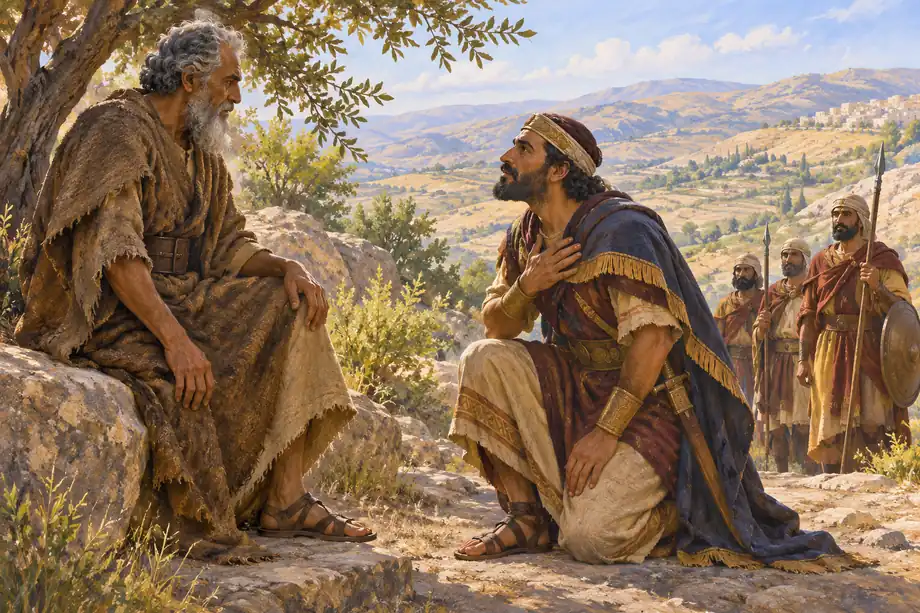
Amaziah sends word to Jehoash of Israel, proposing that the kings face one another. In the unfolding context the meeting is a challenge to armed confrontation. Jehoash replies with a parable: a thistle in Lebanon sends a marriage proposal to a cedar of Lebanon, but a wild beast passes by and tramples the thistle (14:9).
The countryside image stings more sharply than a speech from a palace balcony. A thistle is small; a cedar is imposing; a wild animal need not ask the thistle for permission to pass. The parable mocks Amaziah's claim to stand on equal terms with a stronger power. The details of the parable are discussed in different ways by commentators, but its warning against overreaching pride is plain (Brueggemann 2000, 440–42; Leithart 2006).
Jehoash then explains the point: Amaziah has defeated Edom; the king should enjoy that achievement and remain at home. Why invite destruction upon both the king and Judah? Remarkably, this sound warning comes from a ruler whom the narrator has already condemned for continuing the northern kingdom's sins (2 Kgs 13:11).
True counsel is not rendered false because the person delivering it lacks an exemplary life. Leaders need to discern the truth of an admonition, not merely the reputation of its messenger.
The Wall Comes Down: The Public Cost of a Ruler's Pride (14:11–14)
Amaziah refuses to listen. The kings meet at Beth-shemesh in Judah. Judah loses the battle, the soldiers flee home, and Amaziah is captured. Jehoash marches on Jerusalem and breaks a section of the city wall extending from the Ephraim Gate to the Corner Gate, a stretch of four hundred cubits. He removes treasures from the temple and palace, takes hostages, and returns to Samaria.
The broken wall is a theological image with real political consequences. A king had sought a war to magnify royal honor; now the capital has lost part of its protection. Resources belonging to the worshiping community and the public household are taken away, and people who never issued the challenge bear its cost.
Provan interprets this humiliation as an anticipation of Jerusalem's later capture and the removal of its treasures and people in 2 Kings 24–25. That is a useful literary connection, not a claim that the incidents were equal in scale or occurred at the same time (Provan 1995).
A leader's pride does not remain locked inside a leader's heart. It can tear down the walls upon which an entire community depends.
Amaziah Outlives the Battle, but Not the Turmoil (14:15–22)
The narrator briefly closes the record of Jehoash of Israel with the king's death and burial in Samaria, then returns to Amaziah. Amaziah lives fifteen years after Jehoash's death, but a conspiracy develops against the Judean king in Jerusalem. Amaziah flees to Lachish, where the conspirators pursue and kill him. His body is returned for burial in Jerusalem.
Kings does not identify every conspirator or establish the complete political motives for the killing. Those silences should not be filled with certainty. Second Chronicles 25:27 adds a theological perspective on the final period of Amaziah's reign, but it remains a distinct account.
The people of Judah install Amaziah's sixteen-year-old son Azariah as king. Azariah restores Elath to Judah (14:21–22). This king is also known as Uzziah in other biblical passages (2 Chr 26:1; Isa 6:1). The narrative moves from the defeated father to the son whose rule will be assessed in chapter 15.
Jeroboam II: Success without Repentance (14:23–29)
Jeroboam II, son of Jehoash of Israel, reigns for forty-one years in Samaria. The narrator gives the verdict before describing his achievements: Jeroboam does evil in the Lord's sight and does not turn from the sins of the first Jeroboam. Nevertheless, the king restores Israel's border from Lebo-hamath to the Sea of the Arabah, in keeping with the word delivered through Jonah son of Amittai from Gath-hepher (14:23–25; compare Jonah 1:1).
Why does God allow such recovery? The narrator supplies an explicit answer. The Lord sees the bitter affliction of Israel; people have no adequate helper; and the Lord has not declared that Israel's name should be wiped out from under heaven. So God provides rescue through Jeroboam (14:26–27).
This passage distinguishes an instrument of relief from an example of faithfulness. A ruler may be used to bring a measure of help without being vindicated in false worship. Political recovery does not turn injustice into goodness.
The wider prophetic witness makes the point more searching. In the setting of northern prosperity, Amos condemns exploitation, hollow religious celebration, and the neglect of justice (Amos 5:11–24; 6:1–7; 7:10–17). These are canonical connections that help readers understand the wider period, not statements placed directly into the mouth of 2 Kings 14. The chapter concludes with Jeroboam's death and succession by his son Zechariah (14:28–29).
The Lord has seen the people's suffering, and the king has achieved success. But the narrator has not said that Israel's heart is healed.
Theological Reflection — Victory, Torah, Mercy, and the True King
Torah limits power, even when a king has the upper hand
Amaziah deserves credit for refusing to execute the children of his father's assassins (14:6). The Torah restrains the spread of family revenge and upholds personal responsibility (Deut 24:16; Ezek 18:20). Yet obedience in one decision does not guarantee wisdom in another. The king who accepts a limit upon vengeance refuses a limit upon ambition. Faithful leadership cannot honor the parts of God's instruction that protect a leader's reputation while ignoring the warnings that confront a leader's pride.
Military success is not a certificate of spiritual righteousness
Amaziah wins against Edom yet loses against Israel. Jeroboam II does evil yet enlarges Israel's territory. These details resist a simplistic theology of outcomes. God cannot be reduced to a ledger of battles won and lost. Success is no permission to sin, and suffering is no automatic proof that God has rejected the sufferer (Job 1–2; John 9:1–3). Leithart notes that 2 Kings 14 challenges the expectation of a mechanical, immediate relationship between moral conduct and public success (Leithart 2006).
Divine mercy sees the people whose names never enter the royal records
Verse 26 says that the Lord sees Israel's severe affliction. In a history filled with royal names, battles, and changing borders, God attends to the condition of ordinary people. The compassion recalls 2 Kings 13:23 and Exodus 2:23–25: the Lord hears and sees, and the Lord is not held captive by the failures of national leaders. Mercy, however, does not abolish repentance. By 2 Kings 17, the northern kingdom's persistent covenant unfaithfulness will be exposed as a reason for Samaria's fall.
Jesus reveals a victory that does not grow into the thistle of pride
Amaziah seeks a face-to-face confrontation to prove superiority. Jesus enters Jerusalem in humility rather than self-display (Zech 9:9; Matt 21:1–11). Jesus rejects the attempt to secure his kingdom through the retaliatory sword (Matt 26:52–54; Phil 2:5–11). As the Son of David, Jesus bears the cost of saving others instead of transferring the price of personal pride to his people. Christ's resurrection declares that God's ultimate victory comes through self-giving love rather than a monarch's power to terrify neighbors (1 Cor 15:54–57). This does not turn every battle in Kings into a direct prediction of the cross. It means that the wider biblical story leads beyond the failures of these kings to a kingdom shaped by the faithful Messiah.
Life Application — Keeping Victory from Becoming an Idol
- Examine the heart after success. After finishing a project, increasing income, or resolving a conflict, ask whether success has made gratitude deeper or correction harder to hear (2 Kgs 14:7–10; Deut 8:11–18).
- Keep justice within its proper limits. Never punish innocent children, families, or communities for another person's wrongdoing. Even legitimate accountability must respect human dignity and individual responsibility (14:5–6; Deut 24:16).
- Listen to warnings from unexpected people. Evaluate counsel by Scripture and evidence rather than dismissing every message from a flawed messenger. Amaziah's pride made good advice sound small (14:9–11; Prov 12:15).
- Count the cost carried by the community. Before initiating public conflict, litigation, a church dispute, or an institutional change, consider the likely consequences for households, staff, worship, and shared resources. Jerusalem's wall fell at a price greater than Amaziah's bruised honor (14:12–14).
- Do not confuse institutional growth with covenant health. Increasing property, membership, revenue, or influence must be assessed alongside justice for the vulnerable and genuine worship of the Lord (14:23–27; Amos 5:21–24).
- Use new opportunities to help the wounded. When a ministry or community gains resources, attend first to those enduring debt, illness, hunger, and the consequences of conflict. The Lord saw affliction before the narrative celebrated territorial gain (14:26–27).
- Prepare a legacy of accountability. Kings die and successors arrive. Build honest financial systems, careful teaching, shared leadership, and meaningful oversight that do not depend on a single charismatic personality (14:20–22, 29; 2 Tim 2:2).
Reflection Questions
- Which recent success may have made good advice harder to hear than before?
- Who bears the cost when leaders enter conflicts to defend personal honor?
- Amaziah honored Torah in one matter but rejected wisdom in another. Where does partial obedience appear in present leadership or personal life?
- What does Jeroboam II's prosperity teach about the danger of using wealth, territory, or organizational size as the main measure of spiritual health?
- What concrete action this week would turn gratitude for divine mercy into justice for a person in need?
Response Prayer — Do Not Let Victory Rule Our Hearts
Lord of the covenant, God who hears the cries of the afflicted, thank you for opening doors of relief even when human hearts have not been entirely faithful. We confess that success can rise to the head like the heat of a noon sun. Praise sometimes becomes louder than truth, and the voice of wisdom disappears beneath the drums of celebration.
Protect leaders from making other people pay the price of preserving a reputation. Teach communities to honor your law when exercising justice and to receive correction when pride is exposed. Repair the walls of integrity, accountability, and compassion wherever those walls have begun to crumble.
God who saw the suffering of Israel, open our eyes to families facing hunger, debt, sickness, and exclusion. Lord Jesus, humble King and servant of all, turn the desire to impress into the courage to serve. May every victory become an opportunity to love and do justice, never an altar built to ourselves. Amen.
Window into the Next Chapter — Borders Expand, but Assyria's Shadow Approaches
Second Kings 14 closes with Jeroboam II having strengthened the northern kingdom and restored territory once lost. Politically, the story appears to be one of renewal. Yet the verdict of the covenant remains unchanged: the sins of the first Jeroboam continue. Judah, too, has moved into another reign after the violent end of Amaziah.
Second Kings 15 will begin with Azariah (Uzziah) of Judah and then move through a rapid succession of northern rulers—Zechariah, Shallum, Menahem, Pekahiah, and Pekah—amid conspiracies and violence. Assyria will enter the foreground of the story. Money paid to a foreign empire will disclose how fragile a nation's security becomes when protection is sought primarily through political arrangements. Jotham of Judah will also enter the account.
Watch the gathering question: A kingdom may look strong while its borders expand. But what happens when the heart of the nation, the justice of its public life, and its loyalty to the Lord fail to grow alongside its territory?
Bibliography
- Brueggemann, Walter. 2000. 1 & 2 Kings. Smyth & Helwys Bible Commentary. Macon, GA: Smyth & Helwys.
- Leithart, Peter J. 2006. 1 & 2 Kings. Brazos Theological Commentary on the Bible. Grand Rapids: Brazos Press.
- Provan, Iain W. 1995. 1 and 2 Kings. New International Biblical Commentary. Peabody, MA: Hendrickson. Subsequently reissued in the Understanding the Bible Commentary Series by Baker Books.
Reading note
Editorial note: The judgment on Amaziah is grounded in 2 Kings 14; details about the gods of Edom are explicitly identified as material from 2 Chronicles 25. Unspecified motives for the plot against Amaziah have not been invented. Interpretive possibilities within the thistle-and-cedar parable are not presented as certainties. Jeroboam II's prosperity is not portrayed as divine approval of idolatry.
Be the first to leave a comment.