

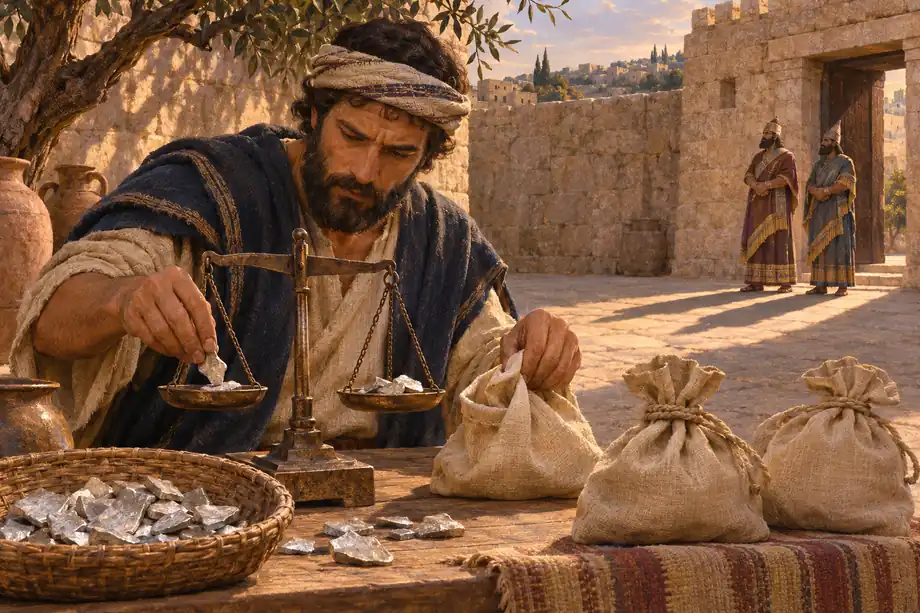
Why can tribute silver and a rebuilt temple gate never replace a nation’s roots of faithfulness?
Study overview
When a nation's borders seem secure, but its covenant foundations are cracking
Yesterday the borders stretched outward; today the thrones are overturned. Yesterday victory drums sounded in Samaria; today conspirators whisper in palace corridors. One king sits for fifty-two years; another barely lasts a month. Silver is collected from the houses of the wealthy, but silver cannot purchase a nation's future. In the distance, Assyria's marching feet approach; nearer still, the covenant asks its searching question: Who will build a kingdom upon justice, instead of building a throne upon fear?
- Primary passage:
- 2 Kings 15:1–38.
- Guiding question:
- Can a nation look strong from the outside while the foundations of worship, justice, and faithfulness to the Lord crumble within?
- Central thesis:
- Second Kings 15 shows that long reigns, repeated changes of government, and costly security arrangements cannot replace covenant faithfulness. Azariah and Jotham receive evaluations that recognize what is good while exposing what remains unfinished. Israel descends into assassinations, atrocities, tribute payments, and deportations. The narrator weighs national strength by the use of power under God's word—not by the length of a reign or the size of a kingdom.
Introduction — A House with Fresh Paint and Cracked Foundations
A house can look strong until the heavy rains arrive. Fresh paint, a new front door, and a shining roof cannot conceal a cracked foundation forever. A nation can also display long reigns, victorious armies, and healthy revenue while justice weakens quietly beneath the surface.
Second Kings 14 ended with a surprise. Jeroboam II recovered territory for Israel, but territorial expansion was no evidence that the nation had become faithful. The Lord had seen the suffering of ordinary Israelites and granted a season of relief (2 Kgs 14:26–27). Second Kings 15 pulls back the curtain and exposes the fragility that prosperity had hidden.
Judah's story opens with Azariah, also known as Uzziah. The king's fifty-two-year reign earns a favorable—but qualified—assessment. High places of worship remain, and a debilitating skin condition prevents Azariah from carrying out ordinary royal duties. Meanwhile, the northern kingdom becomes a procession of brief reigns and violent endings. Zechariah is assassinated after six months. Shallum lasts one month. Menahem seizes power, terrorizes a community, and buys the support of Assyria. Pekahiah is murdered by Pekah. Pekah loses northern territory and population to Assyrian conquest, then falls to another conspiracy.
The chapter closes with Jotham of Judah, another ruler commended for doing what is right but faulted because the high places remain. The combined pressure of Aram and Israel is beginning to threaten Judah.
This is a story about authority losing its roots. A tree may display a wide crown of green leaves in the dry season; a fierce wind reveals whether the roots are deep enough. The question is not merely who holds the throne. The question is what holds the throne upright.
Historical and Literary Context — From Temporary Mercy to Imperial Pressure
The books of Kings are prophetic history. Their purpose is not simply to list dynasties and battles but to interpret public life through the covenant. Deuteronomy 17:14–20 pictures a king who studies and obeys the Lord's instruction. Deuteronomy 12 connects worship with covenant loyalty, while Deuteronomy 28–30 warns that persistent rebellion has consequences for national life. Royal strength alone is never the final standard of judgment.
In 2 Kings 13–14, Israel experienced relief from Aramean domination. Jeroboam II extended the kingdom's territory, while the narrator emphasized the Lord's compassion for an afflicted people (14:26–27). The golden-calf worship associated with the first Jeroboam, however, remained established in the north (1 Kgs 12:26–33). In the wider prophetic setting, Amos condemned the oppression of the poor and religious ceremonies divorced from justice (Amos 5:10–24; 6:1–7). Hosea described a breakdown of faithfulness, truth, and mercy (Hos 4:1–3). These prophetic books illuminate the period; their words should not be presented as speeches actually quoted within 2 Kings 15.
Literarily, chapter 15 resembles a palace doorway swinging open and shut at alarming speed. Royal names are followed by reign lengths, brief verdicts, assassinations, and successors. The repeated conspiracies dismantle the appearance of stability created by Jeroboam II's earlier successes. Behind the royal names stand people who pay the price: pregnant women attacked at Tiphsah, property owners compelled to finance tribute, and families carried away into exile (15:16, 19–20, 29).
The great new presence is Assyria. Pul, the Assyrian king named in 15:19–20, is identified with Tiglath-pileser III, named in 15:29. Israel begins to trade financial resources and political independence for temporary security under an empire. Later, 2 Kings 17 will recount the fall of Samaria. Chapter 15 is the first rumble of a storm that will soon engulf the northern kingdom (Provan 1995; Brueggemann 2000, 451–62).
The biblical reign-year notices sometimes intersect with periods in which royal authority was shared or exercised by a regent. Establishing an exact historical timeline remains a scholarly matter. This study follows the narrator's sequence without forcing the various reign notices into a single unquestionable calendar.
Walking Through the Text — Every Crown Has a Story, Every Story Has a Cost
Azariah: Many Years, Yet Faithfulness Remains the Test (15:1–7)
Azariah, son of Amaziah, becomes king of Judah at sixteen and reigns fifty-two years in Jerusalem. The same ruler is also called Uzziah elsewhere in the narrative and in other biblical books (2 Kgs 15:13; 2 Chr 26:1; Isa 6:1). The theological evaluation initially sounds encouraging: Azariah does what is right in the eyes of the Lord, following the pattern of Amaziah. But the high places remain, and people continue sacrificing and burning incense there (15:3–4).
Then the account turns abruptly. The Lord strikes the king with a skin disease, and Azariah lives in a separate house until death. Jotham, Azariah's son, manages the palace and governs the people of the land (15:5). The Hebrew condition frequently rendered leprosy cannot be confidently equated with modern Hansen's disease. Moreover, 2 Kings 15 gives no detailed account of the offense behind the judgment. Second Chronicles 26:16–21 adds the story of Uzziah's pride and attempted intrusion into priestly responsibility. That explanation belongs explicitly to Chronicles; the Kings narrator does not spell it out here.
This passage must not become a weapon against sick people. The story does not teach that every illness is divine punishment for a particular sin. Rather, Azariah's long reign remains subject to limits. When the king can no longer perform royal duties, responsibility passes to another member of the household. A person's office, however important, cannot become the permanent center of a nation's life.
Zechariah: The Fourth Generation Reaches Its End (15:8–12)
Zechariah, son of Jeroboam II, reigns in Israel for six months. The familiar religious verdict returns: Zechariah does not turn away from the sins of the first Jeroboam. Shallum son of Jabesh organizes a conspiracy, murders the king in public, and takes the throne (15:8–10).
The narrator then recalls the Lord's word to Jehu: Jehu's descendants would sit on Israel's throne through the fourth generation (2 Kgs 10:30; 15:12). Jehoahaz, Jehoash, Jeroboam II, and Zechariah constitute those four successive generations of Jehu's descendants. God's word is fulfilled, but the fulfillment is not an endorsement of every act committed by the dynasty.
The assassination exposes the fragility of a government that seemed secure under Jeroboam II. A family name and a successful past cannot replace a just covenantal foundation. The throne changes hands, but the patterns of unfaithfulness remain.
Shallum and Menahem: A One-Month Crown, Lives Crushed by Violence (15:13–16)
Shallum reigns for a single month. Menahem son of Gadi comes from Tirzah, kills Shallum, and takes power. One month is shorter than the time needed for many crops to mature. Yet the month is long enough to make clear that Israel's throne has become a prize secured by murder rather than sustained by justice and fidelity.
Menahem's violence extends far beyond a palace conspiracy. The narrator reports a brutal attack against Tiphsah and its surrounding territory, including the ripping open of pregnant women when the town did not open to him (15:16). The location of Tiphsah and some aspects of the Hebrew phrasing are debated; the atrocity described against pregnant women is nevertheless unmistakable. The passage should not be softened into a military success story.
Such deeds are associated elsewhere with the horrors of war (2 Kgs 8:12; Amos 1:13). When a crown is maintained by crushing the most vulnerable, kingship has betrayed its covenant purpose. The narrative draws attention away from the question of who holds power to the deeper question of whose lives that power is meant to protect.
Menahem and Pul: Silver That Purchases Temporary Quiet (15:17–22)
Menahem rules for ten years and continues the religious sins of the first Jeroboam. During this reign Pul, king of Assyria, comes against the land. Menahem pays one thousand talents of silver to secure Assyrian support for his grip on the kingdom. The money is raised by a levy on wealthy Israelites, each assessed fifty shekels of silver (15:19–20).
The narrator reveals the political motive with unusual clarity: the payment is intended to strengthen Menahem's hold on royal power. A throne is protected for the moment, while the expense falls upon the population. Pul withdraws, but an army's departure does not mean the danger has ended. Israel has entered a relationship of growing dependence upon an imperial power.
Assyrian support cannot heal Menahem's violence, transform Israel's worship, or build public trust. Like a farmer who sells next season's seed to meet this season's debt, the ruler buys relief today at a price that threatens tomorrow. Brueggemann understands this scene as a pivotal entrance into Assyria's sphere of domination (Brueggemann 2000, 454–56).
There is a vital distinction between prudent diplomacy and making national survival depend upon the favor of a much stronger patron. Kings does not supply an exhaustive foreign-policy alternative, but it does show that Menahem's arrangement is bound up with protecting a contested throne.
Pekahiah and Pekah: Palace Murder Meets Mass Deportation (15:23–31)
Pekahiah, Menahem's son, reigns for two years and receives the same negative religious assessment. Pekah son of Remaliah, one of the king's officers, conspires against Pekahiah and kills the king inside the royal citadel at Samaria. The account mentions Argob, Arieh, and fifty men from Gilead (15:23–26). The identities and roles of all the named participants are not fully explained, and Kings gives no certain political motive for the conspiracy. What is clear is the recurrence of lethal royal struggle.
Pekah's reign is counted as twenty years, and Pekah continues in the sins associated with the first Jeroboam. During Pekah's rule, Tiglath-pileser of Assyria captures northern and eastern territories, including Ijon, Abel-beth-maacah, Janoah, Kedesh, Hazor, Gilead, Galilee, and the land of Naphtali. The inhabitants are deported to Assyria (15:27–29).
The contrast with chapter 14 is devastating. There, borders expanded; here, territory is stripped away. In 15:20, Israelite silver travels to Assyria. In 15:29, Israelite people are taken to Assyria. The empire now demands more than tribute. The empire removes people from their homes. Deportation is not merely a statistic of imperial administration. Deportation means abandoned fields, separated households, disrupted worship, and generations growing up far from their ancestral land.
Pekah's reign ends in another conspiracy. Hoshea son of Elah kills Pekah and seizes power (15:30–31). Hoshea will return in chapter 17 as the last king of the northern kingdom. The unraveling of Israel is already visible, though the final fall remains ahead.
Jotham: A Temple Gate Is Built While Pressure Mounts (15:32–38)
The narrator returns to Judah. Jotham, son of Uzziah, reigns sixteen years in Jerusalem. Jotham does what is right in the Lord's sight, following his father's example. Yet the high places are not removed, and people continue offering sacrifices there. Jotham builds the Upper Gate of the Lord's temple (15:32–35).
The gate is an important act of public and religious building. Yet a repaired temple entrance does not guarantee renewed covenant worship. A ruler can restore the stones of a sacred building while leaving the people's religious habits largely untouched. The favorable assessment of Jotham is therefore real, but it remains qualified.
The final lines introduce a growing danger: the Lord begins sending Rezin king of Aram and Pekah son of Remaliah against Judah (15:37). The political crisis will become central to Isaiah 7 and 2 Kings 16. Jotham dies, and his son Ahaz succeeds him (15:38).
There is no triumphant ending. The temple gate stands, but the test of trust is approaching that very gate.
Theological Reflection — Where Are a Nation's Roots Tested?
The Torah, not length of service, measures kingship
Azariah rules fifty-two years; Shallum lasts one month. The enormous difference in duration does not change the narrator's standard: each ruler stands under the covenant. Azariah and Jotham do what is right, yet retain the high places; northern kings perpetuate Jeroboam's sins. Decades in office do not necessarily mean that the needed reforms have been completed. Deuteronomy 17:18–20 requires royal obedience to divine instruction. Holding a position for a long time is not the same as growing in faithfulness.
Idolatry and social violence belong in the same moral landscape
References to Jeroboam's sins recur through the chapter (15:9, 18, 24, 28). These are not isolated comments about religious ceremonies. The same account records conspiracies, assassinations, and atrocities against vulnerable people (15:10, 16, 25, 30). This does not mean that every mistaken form of worship automatically produces the same acts of violence. The literary pattern of Kings is more specific: when a society rejects the Lord's covenant rule, public life becomes vulnerable to the worship of power itself. Amos also refuses to separate acceptable worship from justice for the poor (Amos 5:21–24).
Tribute and deportation expose the cost of power
Menahem taxes the wealthy to purchase Assyrian backing; Pekah watches Assyria carry away entire communities. First money leaves the land, then human beings. The narrative keeps asking who pays for royal decisions. God's law calls leaders to protect the needy rather than exploit them (Deut 24:17–22; Prov 29:4). The movement from tribute to deportation shows how short-term political bargains may precede a far deeper loss of freedom. The text does not supply an easy recipe for dealing with great powers; it insists that national policy must be judged by its human cost.
Hope for David's house calls for a different kind of king
Judah retains the Davidic dynasty while Israel's rulers succeed one another by the sword. Yet even Judah's better rulers fall short of complete covenant faithfulness. Isaiah dates a vision to the year King Uzziah died: an earthly king departs, but the Lord is seen enthroned in glory (Isa 6:1–3). Within the Christian reading of the whole biblical story, this vision prepares readers to look toward Jesus, the Son of David, who rejects rule through self-protection at other people's expense (Mark 10:42–45; Phil 2:5–11). Jesus bears the cost of redeeming others instead of charging others for the preservation of royal privilege. The kingdom Jesus announces brings good news to the poor and freedom to the oppressed (Luke 4:18–19). These are the roots Israel and Judah so often neglected.
Life Application — Repair the Foundation Before the Wall Falls
- Assess leadership by faithfulness, not years of service. In a family, church, school, or ministry, evaluate honesty, accountability, and the treatment of people as well as longevity and achievements (2 Kgs 15:1–7; Deut 17:18–20).
- Reject cruelty disguised as security. The violence against pregnant women at Tiphsah was not a glorious military achievement. Protecting children, women, and vulnerable neighbors is a basic measure of justice (15:16; Prov 31:8–9).
- Make the cost of decisions visible. Before taking on debt, raising contributions, or accepting an agreement that affects a community, ask who pays, who benefits, and who bears the long-term burden (15:19–20).
- Build ways to hear criticism without palace conspiracies. Samaria's coups reveal institutions unable to resolve contests for authority without violence. Create trustworthy processes for counsel, review, correction, and accountability (15:8–15, 23–26; Prov 15:22).
- Examine worship practices rather than preserving every habit. Azariah and Jotham perform good deeds, but the high places remain. Ask whether longstanding religious habits genuinely shape people in truth and justice (15:4, 35; John 4:23–24).
- Remember the people harmed by changes of power. The deportees had homes, work, children, and relationships. Measure organizational change by the well-being of ordinary people, not simply by the names of new officeholders (15:29; Isa 1:17).
- Seek security without selling the conscience. Menahem gains short-lived relief with silver. Before accepting protection from a more powerful patron, weigh the cost to integrity, freedom, and covenant commitments (15:19–20; Ps 20:7).
Reflection Questions
- What signs of visible success in family, church, or society might be concealing unresolved failures of trust and justice?
- Which present decisions will transfer their cost to children, vulnerable people, or future generations?
- What worship practices continue mainly because of tradition, even when Scripture calls for careful examination and reform?
- What does Samaria's succession of coups teach about creating healthy ways to receive criticism and resolve conflict?
- What one concrete action this week could protect someone without a voice and strengthen long-term trust?
Response Prayer — Teach Us to Grow Deep Roots
Lord of justice and mercy, the crowns of earthly kingdoms change, but the faithfulness of God endures. Forgive the temptation to mistake the size of our work, the length of our service, or the applause of others for a healthy foundation. We measure the height of the walls and forget to examine the roots of righteousness beneath the soil.
Deliver our communities from the hunger for power that lays its cost upon other shoulders. Guard the woman in danger, the child overlooked, the frightened family, and the worker paying for a leader's mistakes. Grant wisdom to hear warnings before an army reaches the gate. Reform our worship, our finances, and our relationships.
Lord Jesus, Son of David and Servant of the people, teach a way of leading that lifts rather than crushes. Build integrity within our lives so that homes, churches, and ministries stand in truth when the fierce winds begin to blow. Amen.
Window into the Next Chapter — The Temple Gate Is Built, but Where Will the King Seek Help?
Second Kings 15 closes with Jotham having built the Upper Gate of the temple, while Rezin of Aram and Pekah of Israel begin bringing pressure against Judah. Hoshea has seized Israel's throne after killing Pekah. Assyria is no longer merely a distant name on the map. Assyria has already touched the lives, freedom, and homes of Israel's people.
Second Kings 16 will follow Ahaz, Jotham's son, into a frightening test. Facing a military threat, Judah's king will appeal to Tiglath-pileser of Assyria. Treasure from the temple and palace will be drawn into the politics of survival. Then Ahaz will return from Damascus impressed by a foreign altar, and arrangements in the Lord's temple will be changed.
Watch the question that follows: When a king loses confidence in the Lord, can the protection of a mighty empire be obtained without also surrendering the nation's resources, loyalties, and altar? The shadow of Assyria is about to fall across the place of worship itself.
Bibliography
- BibleProject. n.d. The Books of 1 and 2 Kings. Bible book guide.
- Brueggemann, Walter. 2000. 1 & 2 Kings. Smyth & Helwys Bible Commentary. Macon, GA: Smyth & Helwys.
- Leithart, Peter J. 2006. 1 & 2 Kings. Brazos Theological Commentary on the Bible. Grand Rapids: Brazos Press.
- Provan, Iain W. 1995. 1 and 2 Kings. New International Biblical Commentary. Peabody, MA: Hendrickson. Subsequently reissued in the Understanding the Bible Commentary Series.
Reading note
Editorial note: Azariah's condition has not been identified with a particular modern disease; the account of Uzziah's pride and incense offering is explicitly distinguished as material from 2 Chronicles 26. Assyrian politics are described without forcing the reign-year figures into a disputed single chronology. The violence of 15:16 is reported without romanticizing or legitimizing the atrocity.

Be the first to leave a comment.