

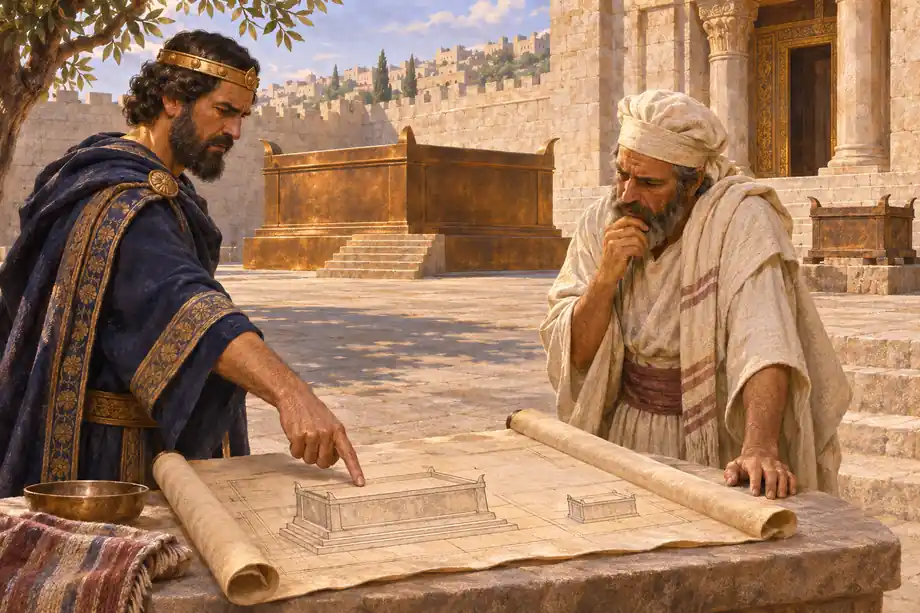
How does the movement of treasure and altar designs reveal a change in the authority governing worship?
Study overview
Ahaz seeks to protect a kingdom; yet when the pursuit of safety begins to govern worship, the altar becomes a mirror of the heart.
The winds of war blow from the north. Jerusalem's gates begin to tremble. A king counts soldiers and silver, but never counts the cost to the heart. Treasure leaves the temple for a distant throne; the drawing of an altar returns from Damascus. The enemy's sword is turned aside for a season, yet fear enters the house of worship. For a nation may be rescued by an army and still lose the road of trust in God.
- Primary text:
- 2 Kings 16:1–20.
- Guiding question:
- Can the fear of losing security lead a leader to surrender even the foundations of covenant faithfulness?
- Central thesis:
- Second Kings 16 reveals how fear, imperial dependence, and worship detached from God's instruction can reinforce one another. Ahaz obtains military relief from an immediate enemy, but yields to Assyrian power, transfers temple treasures, and remodels the sanctuary's altar. Short-term safety cannot replace covenant faithfulness.
Introduction — The Door Is Locked, but the Keys Have Been Handed to a Stranger
When a village faces an invading force, its leaders may seek the help of someone stronger. The decision can seem unavoidable. Children need protection, farms need security, and families need a night without the sound of danger beyond the fence. But help offered on the condition of handing over the house keys may change the meaning of rescue. The first invaders might depart while the new holder of the keys remains in charge.
At the end of 2 Kings 15, Israel was losing territory and people to Assyria, while Aram and Israel began pressing Judah from the north (2 Kgs 15:29, 37). Ahaz inherits Judah's throne amid that pressure. Rather than deepen the nation's commitment to the covenant, the new king follows the religious ways of Israel's kings. The narrator even includes a devastating accusation involving the king's own child (16:1–4).
When war reaches Jerusalem, Ahaz looks toward Tiglath-pileser of Assyria for deliverance. Sacred and royal treasures become the price of intervention. Later Ahaz visits Damascus, admires an altar, sends its design to Jerusalem, and orders a new arrangement of worship. In this chapter, the Assyrian army does not tear down the Jerusalem temple. Instead, the king of Judah begins altering its interior through royal orders.
This is a story about fear becoming a master. The central issue is not whether rulers may ever seek allies. The deeper question is what happens when a security agreement becomes more authoritative than the word of God. Has the door been closed against danger, or has the heart been opened to a different lord?
Historical and Literary Context — When Empire Enters Politics and the Temple
Kings is not merely an archive of royal activity. It is a prophetic interpretation of public life measured by covenant obligations. According to Deuteronomy 17:14–20, a king must read and obey the Torah rather than exercise power above it. According to Deuteronomy 12:1–14, Israel's worship must express loyalty to the LORD, not the ruler's taste or the prevailing customs of surrounding nations. Consequently, financial policy, military alliances, and altar construction are matters of theology as well as politics.
The crisis in 2 Kings 16 belongs to the Syro-Ephraimite War: Rezin of Aram and Pekah of Israel bring pressure upon Judah amid Assyria's increasing regional dominance. Isaiah 7:1–9 opens a prophetic window into that crisis. Isaiah tells Ahaz that the coalition will not achieve its ultimate plan and summons Judah's king to stand firm in faith rather than surrender to fear (Isa 7:4, 7–9). Second Kings, however, keeps its narrative attention on Ahaz's choices and their consequences.
Assyria was a formidable military and tribute-collecting empire. Tiglath-pileser III was also known as Pul, the name used in 2 Kings 15:19–20. Assyrian campaigns had already seized northern Israelite territory and deported inhabitants (15:29). Ahaz therefore knew something of the power being invited into Judah's affairs. The king turned toward an empire that had already demonstrated how it treated smaller neighbors (Provan 1995, 209–12; Brueggemann 2000, 463–72).
Literarily, the chapter moves from the king's religious character (16:1–4), through the border crisis (16:5–6), toward submission to Assyria (16:7–9), and finally into the temple itself (16:10–18). The sequence is deliberate. A political attempt to preserve the kingdom becomes a story about the reconfiguration of worship. Leithart observes that Ahaz's preoccupation with the altar occupies the structural center of the account. The narrative reveals where a frightened ruler's decisions eventually lead (Leithart 2006).
A note about parallel texts: Second Chronicles 28 adds episodes and gives the reign a somewhat different emphasis, including the wider hardships facing Judah and the long-term burden of Assyrian involvement. Isaiah 7 preserves prophetic speech not quoted in 2 Kings 16. Both passages illuminate the historical and theological background, but neither should be silently inserted into the wording of the Kings narrative.
Walking Through the Text — From the Fear of War to a New Altar
When a King Abandons David's Path (16:1–4)
Ahaz becomes king at twenty years old and reigns sixteen years in Jerusalem. The narrator's verdict is severe: Ahaz does not do what is right before the LORD as David did. Instead, Judah's king walks in the ways of the kings of Israel (16:1–2). The measure of the reign is not military ingenuity or administrative success but covenant loyalty.
The text then reports that Ahaz made his son pass through fire, following the detestable practices of the nations previously driven out of the land (16:3). Read alongside Leviticus 18:21 and Jeremiah 32:35, this language points to child sacrifice, not a harmless cultural ceremony. The practice stands in terrible opposition to the protection of life required by God's instruction. The king also offers sacrifices and burns incense on high places, hilltops, and beneath flourishing trees (16:4).
A leafy tree may offer welcome shade in a dry country, but its beauty cannot make every form of worship true. The point is not that trees or hills are inherently evil. The issue is religious allegiance grounded in unauthorized practices rather than the covenant. A ruler charged with protecting the vulnerable is introduced as a ruler who fails even to protect a child. The moral foundation is cracking before the enemy reaches the gates.
When Two Enemies Appear at the Gate (16:5–6)
Rezin of Aram and Pekah of Israel march against Jerusalem and besiege the city. They cannot overcome Ahaz there (16:5). Nevertheless, Judah loses Elath, a strategically important place near the Red Sea (16:6; compare 14:22). The Hebrew text and textual traditions around Aram and Edom in verse 6 raise questions about the precise sequence and identity of those occupying the area; the secure point is that Judah loses control of Elath.
This is no imaginary threat. Farms, households, travel routes, and commerce are at risk. The danger makes Ahaz's temptation understandable: in an emergency, the quickest diplomatic proposal can sound more persuasive than a summons to trust God's covenant promises.
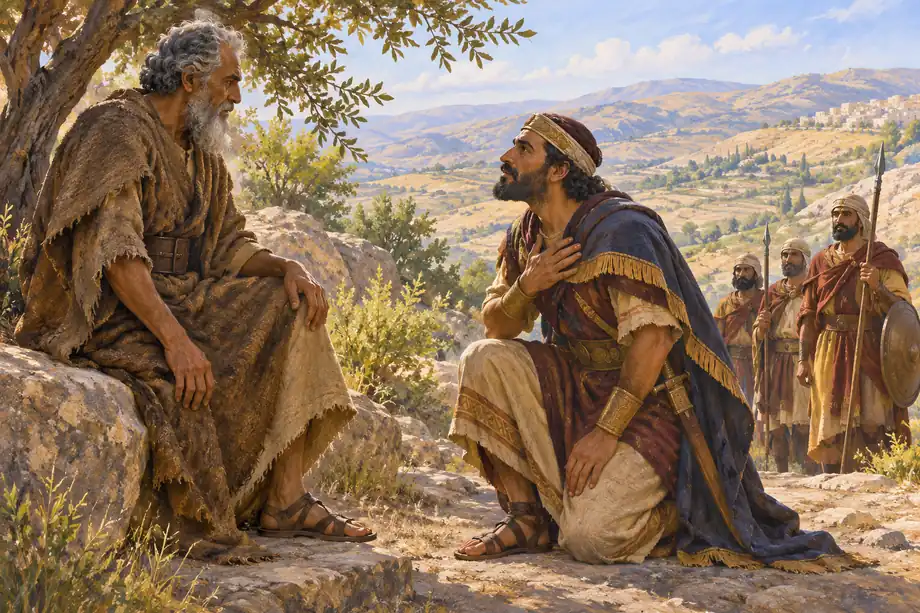
Isaiah 7:2 describes the heart of the Davidic house shaking like trees in a strong wind. Isaiah's message is to remain calm and stand firm in faith (Isa 7:4–9). Ahaz sees the trees shaking and seeks a supporting pillar from Assyria. Kings will show the eventual cost of that pillar.
When a Davidic King Says, “I Am Your Servant” (16:7–9)
Ahaz sends envoys to Tiglath-pileser. In the appeal, Judah's king describes himself as the Assyrian ruler's servant and son and asks to be rescued from Aram and Israel (16:7). Such language signals political submission within the imperial world. For a reader formed by the covenant, however, the phrase carries another resonance. The Davidic dynasty received its identity under the LORD's promise, not from Assyria's throne (2 Sam 7:12–16; Ps 2:7).
Ahaz removes silver and gold from the house of the LORD and the royal treasuries and sends the valuables as a gift to the Assyrian king (16:8). Resources entrusted to the worshiping community become the purchase price of imperial protection. The narrative does not provide a detailed household tax account for this payment, but its public and sacred cost is unmistakable.
The appeal works at once. Tiglath-pileser attacks Damascus, conquers the city, deports people to Kir, and kills Rezin (16:9). From a short-term military perspective, Ahaz's plan succeeds: one immediate enemy has been removed. Yet temporary success contains a trap. Judah has accepted the dependence of a smaller kingdom on an empire whose reach will continue growing. The king has obtained relief, but relief is not proof of covenant faithfulness.
When Damascus Supplies the Blueprint for Worship (16:10–13)
Ahaz travels to Damascus to meet Tiglath-pileser. In Damascus, Ahaz sees an altar and sends the priest Uriah a drawing and its specifications (16:10). Uriah constructs the altar according to the royal instructions before Ahaz returns to Jerusalem (16:11).
After returning, Ahaz approaches the new altar and presents burnt offerings and other sacrifices there (16:12–13). The actions resemble familiar worship practices, but the originating authority has changed. The model comes from what Ahaz admired in Damascus, not from a new divine instruction.
Second Kings 16 does not identify the altar's deity with certainty, nor does the chapter say that Assyria ordered its construction. Some commentators stress imperial-religious accommodation, while others note that Ahaz may simply have favored the appearance of the design. The complete motivation remains unstated (Provan 1995, 211–12; Brueggemann 2000, 469–71). Yet the narrative's central difficulty is plain: a king already condemned for religious unfaithfulness now uses royal preference to reorganize the place where the LORD is worshiped. Uriah, the priest, complies without recorded objection. The leader responsible for preserving worship becomes an executor of the king's architectural command.
When the Bronze Altar Is Pushed Aside (16:14–16)
The original bronze altar, which stood before the LORD, is moved from its usual location to the north side of the new altar (16:14). Ahaz directs that the regular morning, evening, royal, and public sacrifices—and the blood of offerings—be presented on the new large altar (16:15). Uriah does precisely what the king orders (16:16).
The older bronze altar remains for a purpose described by an ambiguous Hebrew expression often understood as seeking guidance or inquiry (16:15). The narrative does not explain the particular ritual envisioned. A confident claim that a fully specified form of divination occurred here goes beyond what the verse actually establishes.
The visual drama is unmistakable. The former altar is displaced, and the altar modeled on Damascus receives the prominent role. Sacrifices continue in abundance, yet religious activity alone cannot establish fidelity to God. Paul later reminds readers that zeal without true knowledge can miss the righteousness of God (Rom 10:2–4). Kings asks whether religious officers will protect God's instruction or simply sanctify whatever the royal court commands.
When Temple Furnishings Are Altered for an Imperial World (16:17–20)
Ahaz cuts off parts of the bronze movable stands, removes the basins, and lowers the great bronze Sea from its support of twelve bronze oxen onto a stone base (16:17; compare 1 Kgs 7:23–39). The king also alters a Sabbath-related installation and the royal entrance to the temple on account of the king of Assyria (16:18). The Hebrew architectural terminology in this final verse is difficult; the exact physical arrangement cannot be reconstructed with confidence.
Imperial pressure now shapes the ordering of temple life. The narrator does not explicitly say that every change was commanded by Assyria. Ahaz nevertheless modifies the royal and religious environment in consideration of an outside power. Political submission has acquired a visible expression in worship.
The chapter closes with Ahaz's death, burial in the city of David, and the succession of his son Hezekiah (16:19–20). The Davidic line has not been extinguished. Still, before Hezekiah's story comes fully into view, the narrator turns back toward Samaria, where the northern kingdom is nearing its end.
Theological Reflection — What the Altar Reveals About the Heart
Fear becomes dangerous when it receives final authority
Fear itself is not a moral failure. Parents fear for children, communities fear invasion, and leaders face genuine responsibilities during crises. Ahaz's failure is to let fear become a greater authority than God's word. Isaiah calls Ahaz to stand firm in faith (Isa 7:4–9), but the king chooses the identity of an Assyrian servant. Faith does not forbid prudent action; faith refuses to worship security. Psalm 20:7 contrasts trust in military equipment with remembering the name of the LORD.
Political arrangements, money, and worship are deeply connected
Silver and gold leave Jerusalem for Assyria; an altar design travels from Damascus into Jerusalem. These movements tell a spiritual story. A kingdom sends resources toward a foreign throne and imports a model for worship from the world of its new imperial connection. The lesson is not that every international partnership is sinful. The danger is the surrender of conscience to a power that promises security, status, or resources. Deuteronomy 17:16–20 restrains royal accumulation and reminds kings that political authority must remain under God's instruction.
The altar can expose loyalties more clearly than official statements
Uriah obeys Ahaz without recorded dissent. Worship continues; the sacrifices appear orderly. Yet the bronze altar has been pushed aside. The sanctuary becomes a mirror of allegiance. Prophetic criticism consistently asks whether worship is joined to justice and covenant obedience, not merely whether religious ceremonies are being performed (Isa 1:11–17; Amos 5:21–24). A church can have a beautiful building and a full program while quietly neglecting truth, the vulnerable, and faithfulness to Christ.
The Davidic promise points toward a King who will not serve fear
Ahaz belongs to David's line, yet he describes himself to Assyria as another king's son and servant. The contrast leaves a longing at the center of the story: what sort of king will live faithfully under God's reign? Isaiah 7:14 announces the sign of Immanuel amid Ahaz's immediate political emergency; that passage must first be heard against the horizon of the Syro-Ephraimite crisis. Matthew 1:22–23 subsequently rereads the language to proclaim Jesus as God with us. The canonical connection deepens the story without erasing Isaiah's original setting.
Jesus, the son of David (Matt 1:1, 9), rejects an offer of worldly kingdoms in exchange for worshiping another master (Matt 4:8–10). Jesus also speaks of his body as the true temple in the light of death and resurrection (John 2:19–21). Ahaz alters an altar in pursuit of protection; Jesus remains faithful and offers his life to bring reconciliation and life. God's kingdom is not secured by selling allegiance to the highest bidder.
Life Application — Do Not Hand Fear the Keys to Your Conscience
- Name the fear behind a major decision. Before a partnership, ministry appointment, or family agreement, identify the genuine threat and the long-term cost of the proposed solution. Test the decision against Scripture and trustworthy counsel (2 Kgs 16:5–7; Prov 15:22).
- Reject protection purchased at the price of integrity. Money, a loan, an influential connection, or promised security becomes destructive when it requires concealing the truth or abandoning what is right (16:7–9; Deut 17:17–20).
- Distinguish useful innovation from changing the foundations of worship. Language, technology, music, and administration may develop. The gospel, loyalty to God, and love of neighbor must not be traded for a fashionable external model (16:10–16; John 4:23–24).
- Create space for leaders to be challenged. Uriah carries out the king's orders. Elders, pastors, and governing committees need clear, respectful ways to question decisions, apply Scripture, and correct mistakes (16:11, 16; Acts 5:29).
- Let budgets bear witness to real priorities. Review how a church or ministry spends entrusted resources. Ask whether spending protects people in need or merely buys prestige and powerful approval (16:8; 2 Cor 8:20–21).
- Protect children and vulnerable people from religious harm. Any practice that endangers a child or treats human lives as the price of success must be rejected. True worship does not turn cruelty into an offering (16:3; Mark 9:36–37).
- Begin restoring the inner altar. Make time for prayer, biblical study, and an honest examination of fear-driven choices. Seek the courage to reverse a decision even when influential people have already approved it (Isa 7:9; Rom 12:1–2).
Reflection Questions
- What fear in personal life, family, church, or society is most likely to claim authority above God's word?
- Which ministry resources might be diverted toward purchasing influence or status rather than serving people and honoring God?
- Which changes in worship are faithful expressions of creativity, and which might quietly displace loyalty to Christ?
- Who has permission to tell a leader the truth when an instruction appears to contradict Scripture?
- What specific decision needs reconsideration this week so that fear or the desire for acceptance does not govern the conscience?
Response Prayer — Do Not Let Fear Build Our Altar
LORD, God of Abraham, Isaac, and Jacob, faithful keeper of the promise to David, the sound of approaching danger can shake the strongest heart. When security, work, relationships, or the future feels uncertain, human eyes turn quickly toward strong walls and powerful protectors. Forgive the temptation to listen to fear more readily than to your word.
Forgive every misuse of resources entrusted for worship and service. Forgive the moments when a congregation's practices have been reshaped to impress the powerful rather than to honor your presence. Protect children, the poor, and people whose voices are easily ignored from decisions made in the name of success.
Give leaders wisdom to distinguish responsible cooperation from the surrender of conscience. Give pastors, elders, and members courage to speak truth with love. Lord Jesus, faithful King and true presence of God, rule our hearts. Let the sanctuary of our lives be built not upon the blueprint of fear but upon truth, mercy, and steadfast love. Amen.
Window into the Next Chapter — The Altar Has Changed, but Samaria Is About to Fall
Second Kings 16 ends with the death of Ahaz and the succession of Hezekiah. Jerusalem has survived Rezin's pressure, but Assyria has entered Judah's political calculations and influenced its religious arrangements. Temple treasures have been sent away; an altar has been displaced; a Davidic ruler has described himself as the servant of a foreign king.
Second Kings 17 turns the reader northward again. Hoshea will rule Samaria under Assyrian pressure. A further attempt to seek outside help will be followed by siege, defeat, and deportation. The narrator will then interrupt the political narrative to explain the covenant dimensions of the disaster: rival gods, rejected prophetic warnings, and persistent disobedience to the LORD.
Watch the question that follows: When a nation loses its land, is the cause simply the strength of an invading army, or has a long history of rejecting God's voice prepared the ground for disaster? The next chapter distinguishes the immediate politics of imperial conquest from the deeper covenant judgment that Kings insists readers must face.
Bibliography
- Brueggemann, Walter. 2000. 1 & 2 Kings. Smyth & Helwys Bible Commentary. Macon, GA: Smyth & Helwys.
- Leithart, Peter J. 2006. 1 & 2 Kings. Brazos Theological Commentary on the Bible. Grand Rapids: Brazos Press.
- Provan, Iain W. 1995. 1 and 2 Kings. New International Biblical Commentary. Peabody, MA: Hendrickson. Reissued in the Understanding the Bible Commentary Series.
Reading note
Editorial note: The deity associated with the Damascus altar is not identified by 2 Kings 16; the architectural details of verse 18 are uncertain; and Isaiah 7 and 2 Chronicles 28 provide complementary perspectives rather than dialogue directly narrated by Kings.
Be the first to leave a comment.