

Why does Kings return to the Exodus and prophetic warnings after recounting Samaria’s military defeat?
Study overview
An army can break a city wall in a season. A people may have been breaking the foundations of their common life for generations.
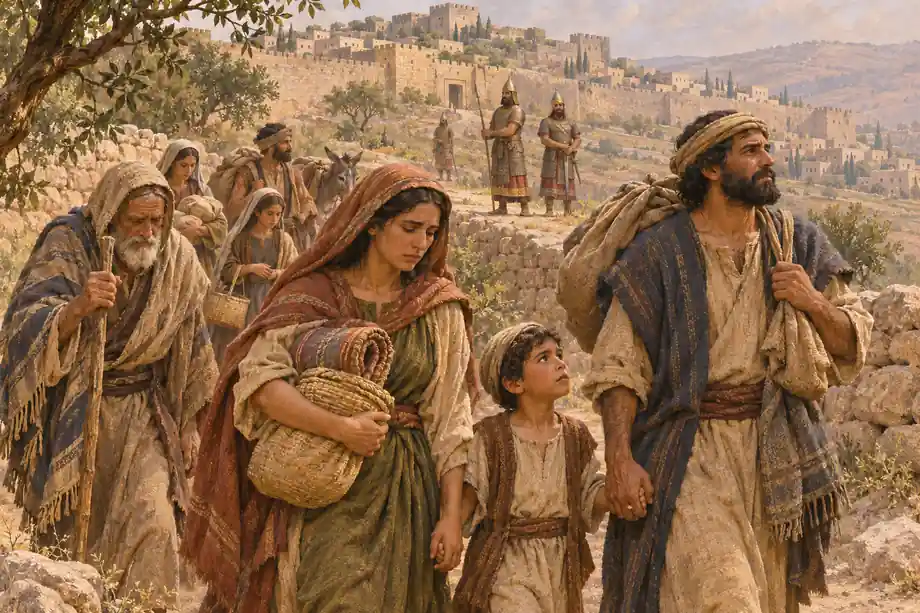
Dust rises above the hills of Samaria. Soldiers approach; mothers gather children. Royal treasures cannot still the Assyrian wind. But before the final gate gave way, another sound had filled the land: the warnings of prophets, the call to worship the LORD alone, the plea to do justice and hear the truth. Now families are carried beyond familiar fields, and one question remains in the soil: Who listened when God spoke? Can the promise still put down roots in ground broken open by judgment?
- Primary text:
- 2 Kings 17:1–41.
- Leading question:
- Did Samaria fall because Assyria possessed the stronger army, or does the narrator invite readers to recognize generations of covenant unfaithfulness beneath the political disaster?
- Central thesis:
- Second Kings 17 portrays the northern kingdom's fall as the culmination of persistent covenant rebellion—worshiping other gods, rejecting prophetic warnings, and abandoning the ways of the LORD. Yet judgment does not mean God has lost the power to fulfill his promises. The catastrophe raises the deeper question of how a scattered people might learn to hear, trust, and live under God's reign again.
Introduction — The Wall Began Cracking Before the Soldiers Arrived
When a country house collapses after a storm, passersby often blame the heavy rain. The family that lived there may tell a longer story. A hairline crack had appeared years before. Water had entered the foundation. The warnings of skilled builders were postponed because daily life was busy and the house still appeared to stand. The storm did not invent the weakness; the storm exposed a weakness that had become part of the building.
Second Kings 17 is a story of a wall whose foundations have been neglected for generations. In chapter 15, Israel's kings rose and fell through conspiracies while Assyria claimed land, tribute, and people (15:19–20, 29). Chapter 16 followed Judah's King Ahaz as fear led to political dependence on Assyria and changes in Jerusalem's temple worship. Chapter 17 turns the camera north again, toward Samaria, Israel's royal capital.
Hoshea becomes Israel's final king. The kingdom struggles between paying tribute to Assyria and looking for another protector in Egypt. The empire answers the rebellion with imprisonment, siege, conquest, and forced resettlement. Those events belong to the real world of imperial strategy, economics, military strength, and the displacement of families.
Yet the narrator refuses to leave the story at the level of military explanation. The account moves from the gate of Samaria to a courtroom of memory, placing the kingdom's long religious history under the standard of the LORD's covenant. The author recalls gods worshiped, prophetic voices ignored, and habits handed from one generation to another. The chapter is about a refusal to listen that becomes the organizing habit of a nation.
This is a severe chapter, not a sentimental story about how every setback can be reversed. It is also not an invitation to blame people who suffer. The warning is for communities, especially communities with power and responsibility, that assume yesterday's privileges will preserve tomorrow's life without repentance or faithfulness.
Historical and Literary Setting — History before the Court of the Covenant
Kings is not a record of royal dates alone. It is prophetic history: it measures political power by Israel's covenant obligations. The king is not above the Torah (Deut 17:14–20). The people belong to the God who brought Israel out of Egypt and commanded undivided worship and a distinct way of life (Exod 20:1–6; Deut 6:4–9; 12:1–14). The blessings, warnings, exile, and possibility of return in Deuteronomy 28–30 form part of the scriptural background.
The story reaches back to the division of Solomon's kingdom. Jeroboam I, fearing the loss of northern political independence, established alternative worship centers at Bethel and Dan (1 Kgs 12:26–33). The narrator repeatedly refers to these religious arrangements when evaluating subsequent northern kings. Prophets repeatedly interrupted the story: Elijah opposed Ahab's household, Elisha brought life and warned rulers, and other prophetic voices confronted Israel's loyalties. In the eighth century BCE, Hosea and Amos also condemned false worship and communities where truth and justice were disregarded (Hos 4:1–3; Amos 5:21–24).
Assyria, meanwhile, had developed the capacity to subdue kingdoms, impose tribute, besiege fortified cities, and relocate substantial populations. Second Kings 17:3–6 names Shalmaneser during the early crisis and later describes Samaria's capture by “the king of Assyria.” The fall of Samaria is generally placed around 722/721 BCE. Modern historical discussion associates Shalmaneser V and Sargon II with different phases of conquest and imperial control. The precise identification of the ruler responsible for every stage is more complicated than a single unqualified sentence would suggest. Kings itself does not identify every phase (Provan 1995, 247–51; Brueggemann 2000, 475–86).
Literarily, the chapter unfolds in three movements: the fall of Samaria (17:1–6), the narrator's covenant explanation (17:7–23), and the arrival and mixed worship of resettled populations (17:24–41). Brueggemann reads the central indictment as the theological turning point toward which the northern monarchy's history has been moving (Brueggemann 2000, 475–86). Leithart notices a further unsettling detail: Judah is implicated in verse 19. The north's fall is a warning for the south, not a license for Judah to claim moral superiority (Leithart 2006).
An interpretive boundary matters. Second Kings presents the narrator's covenantal explanation of a particular ancient national history. Christians must not convert that explanation into a general claim that people suffering from present-day war, disease, displacement, or natural disasters deserve divine punishment. Jesus challenges the automatic connection between suffering and personal guilt (Luke 13:1–5; John 9:1–3).
Walking through the Text — The Voice Refused and the Gate Broken
When the Last King Looks for Another Door (17:1–6)
Hoshea son of Elah rules in Samaria for nine years. The narrator evaluates his conduct negatively, though noting that his evil did not reach precisely the degree of the kings before him (17:1–2). The detail is unsettling. A comparatively less wicked ruler cannot easily reverse a system formed across generations.
Shalmaneser king of Assyria marches against Hoshea, who becomes a tributary ruler (17:3). Later Hoshea stops paying tribute and seeks support from So, associated with Egypt (17:4). The precise identity of “So,” whether a ruler or another designation, is debated. The point in the narrative is clearer than the uncertain identification: Hoshea attempts to escape one imperial relationship through another. Assyria responds by imprisoning the king and besieging Samaria for three years (17:4–5).
In Hoshea's ninth year, Samaria falls. Israelites are deported to locations described as Halah, the region of Habor and Gozan, and the cities of the Medes (17:6). These are not merely points on an ancient map. Families lose homes and familiar language communities; fields are separated from their owners; the ordinary rhythms of worship, work, and kinship are violently disrupted. The text does not require readers to suppose that every Israelite was deported. It does describe the end of the northern monarchy as a functioning political kingdom.
Assyrian power helps explain the military event. The following verses ask why a people shaped by the Exodus covenant reached this particular crisis.
When Hills and Villages Become Altars to Other Gods (17:7–12)
The explanation begins with a memory older than Samaria itself. Israel sinned against the LORD who had brought the people from Egypt, out from under Pharaoh's power (17:7). That opening establishes the contrast. The tragedy is not simply that Israel failed to find a sufficiently powerful foreign protector; Israel forgot the God who had already freed the nation from an ancient imperial master.
The people followed the customs of the surrounding nations and their own corrupted royal practices (17:8). They built or maintained high places, erected sacred pillars and Asherah poles, and burned incense to other gods (17:9–12). Verse 9 describes actions done secretly or deceptively against the LORD, suggesting that the loss of fidelity could grow quietly through ordinary communities and institutions.
These religious practices existed in towns, on hills, and beneath trees. Beautiful places could provide shade, community, and the appearance of sacred belonging. Yet beauty and familiarity did not make covenant infidelity faithful. The land given for covenant life had become a landscape of alternative loyalties. God's blessing was treated as an opportunity to forget the Giver.
When the Prophets Speak and the Nation Stiffens Its Neck (17:13–18)
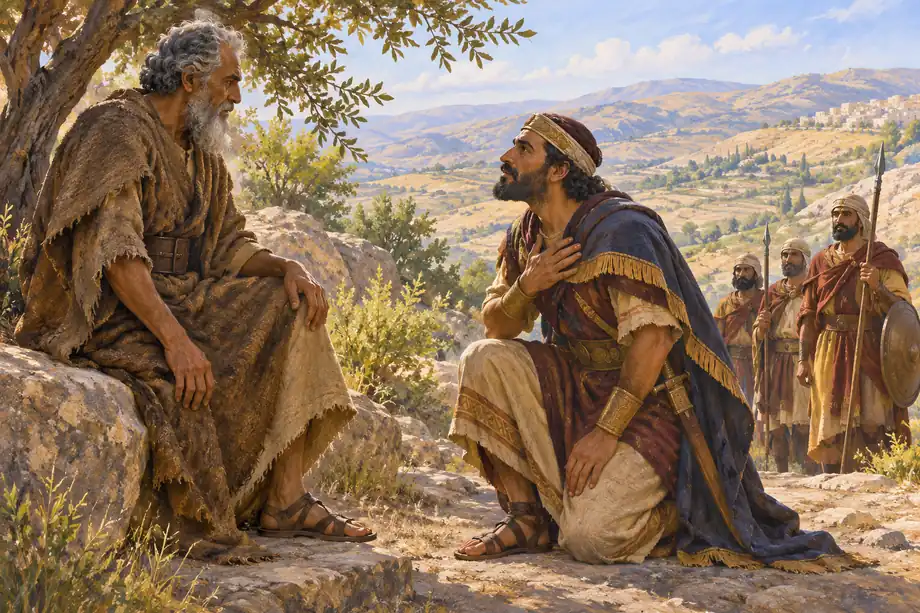
The LORD warned both Israel and Judah through prophets and seers, calling the people to turn from evil ways and obey the commandments (17:13). Judgment, then, is not presented as a sudden divine whim without prior summons. The prophets were not an interruption of the national story; the prophets were witnesses who reminded rulers and ordinary people of obligations already received.
The people refused to listen. The narrator compares their stubbornness to that of earlier generations who would not believe (17:14). They rejected God's decrees, covenant, and warnings. Verse 15 describes them pursuing what was worthless and becoming worthless. The phrasing captures a spiritual process: what a people consistently worships begins to shape what that people becomes (compare Ps 115:4–8; Hos 4:1–3).
The catalogue grows darker. The people made two calves and an Asherah, bowed to the host of heaven, worshiped Baal, passed sons and daughters through fire, and practiced divination and omens (17:16–17). “The host of heaven” here refers to heavenly bodies treated as objects of worship, not simply a harmless appreciation of the night sky. Child sacrifice is a grave violation of the protection of human life, not a legitimate variation of devotion (Lev 18:21; Jer 32:35).
Verse 18 speaks of the LORD removing Israel from his presence, leaving Judah for the time being. This is covenant-judgment language, not a statement that the LORD ceased to rule beyond the borders of Israel or that every future promise became impossible. Dwelling in the land was never permission to defy the covenant indefinitely.
When Judah Is Also Reflected in the Mirror (17:19–23)
The narrator does not grant Judah a privileged seat from which to condemn the north. Verse 19 states that Judah also failed to keep the LORD's commandments, following practices associated with Israel. Judah's continued existence is not proof that Judah's conduct was innocent or that judgment could never reach Jerusalem.
The story then looks back to the kingdom's division. The LORD separated Israel from David's house, and the northern people made Jeroboam king (17:21). Jeroboam led the nation into grievous sin, and the people continued in those patterns until exile came, as warned through the prophets (17:21–23; compare 1 Kgs 14:15–16).
The narrator is not saying one man alone performed every later act. Jeroboam established a religious-political system, and successive generations sustained it. Public sins can become inherited institutions, teaching children to regard compromise as normal life. The siege of Samaria is an event in history; the long cultivation of destructive habits is part of the history behind the event.
The chapter therefore addresses everyone tempted to think that a new leader, a successful military campaign, or a period of prosperity can automatically repair the foundations of society.
When New Families Move into Abandoned Towns (17:24–33)
The Assyrian king relocates people from Babylon, Cuthah, Avva, Hamath, and Sepharvaim to towns in the Samarian region (17:24). Conquest changes more than the ruler on a throne. It uproots populations and reorganizes land, memory, and community. The new settlers enter a place marked by the forced absence of earlier inhabitants.
The narrator reports that lions attacked some of the settlers. In an official explanation, the problem is said to be failure to know the custom of the “god of the land” (17:25–26). That phrase reflects a territorial way of thinking about deities: each land supposedly has a god whose requirements must be learned to secure safety. The Assyrian king commands the return of a priest who had been deported. The priest settles in Bethel and instructs the newcomers about worshiping or fearing the LORD (17:27–28).
Nevertheless, the settlers make their own gods and continue worship in the high places (17:29–31). They adopt forms of reverence for the LORD while continuing to serve other gods (17:32–33). The narrator does not treat the addition of one more divine name as the same thing as covenant loyalty. The historical religious training of the returned priest is not fully explained, and his presence should not be romanticized as proof of complete renewal.
A necessary distinction: The biblical narrator offers an ancient account of particular transplanted populations and their practices. It would be historically careless and pastorally harmful to apply every judgment in this passage indiscriminately to all Samaritans in later centuries. In John 4, Jesus engages a Samaritan woman as a person of dignity capable of receiving God's living water, rather than reducing the woman to a stereotype drawn from an earlier national history.
When Religious Respect Does Not Become Faithfulness (17:34–41)
The text appears to describe a contradiction: the settlers “fear the LORD” in one sense (17:33), but in the fuller covenant sense do not truly fear the LORD (17:34). That tension is the narrator's point. People may practice rites meant to avert danger while withholding exclusive allegiance from the God whose name those rites invoke.
Verses 35–39 repeat covenant demands: do not bow to other gods; remember the LORD who brought Israel out of Egypt; keep God's laws and commands; trust the LORD alone. The transplanted population cannot simply place the LORD on a local roster of gods. Like the earlier Israelites, the newcomers face the call to listen. Yet verse 40 says they would not listen.
The chapter ends with inherited practice: communities continue their ways of worship, and their children and grandchildren do likewise (17:41). The ending is deliberately sobering. Genuine renewal is not simply knowledge of God's name. Genuine renewal takes shape in faithful worship, justice, and love that one generation teaches another. What will the next generation inherit from those who claim to serve God now?
Theological Reflection — Land, Word, Covenant, and Hope
The land is a covenant gift, not an exemption from faithfulness
Israel was redeemed before entering the land (Exod 20:2). The relationship with the LORD gave the land its covenant meaning, not the reverse. Deuteronomy warned that possession could be forfeited through persistent unfaithfulness (Deut 28:58–64). Second Kings 17 portrays displacement as the consequence of this particular covenant history. Yet judgment must not be mistaken for the cancellation of divine mercy. Second Kings 13:23 has already affirmed God's continuing regard for the covenant with Abraham, Isaac, and Jacob. Deuteronomy 30:1–6 preserves a vision of return and renewed hearts. The promise calls the scattered people to repentance, not despair.
Rejecting prophets means rejecting opportunities to change
Verse 13 emphasizes that God repeatedly called the nation to change course. Prophetic warnings were expressions of divine patience. A community that systematically refuses truth loses the capacity to correct damaging behavior before its consequences grow. The prophets addressed worship and public justice together. Amos could challenge elaborate religious assemblies while demanding justice in the common life of the people (Amos 5:21–24). God's word does not exist to flatter those with power. God's word exposes the truth for the sake of a community's life.
Idolatry can become an enduring political and social system
Jeroboam's calves began in the context of a political fear: the king feared losing northern allegiance if the people worshiped in Jerusalem (1 Kgs 12:26–33). In chapter 17, political control and corrupted worship cannot be separated. The danger is larger than a single ceremony. Institutions, habits, and stories can train citizens to accept falsehood, overlook cruelty, and abandon the vulnerable. This does not mean every tragedy has a single identifiable sinner behind it. It means patterns repeatedly chosen by the powerful can become a shared inheritance of harm. Torah continues to measure kings and peoples alike.
Exile opens a longing that comes to fulfillment in Jesus
Second Kings 17 ends without national restoration. Yet the prophetic Scriptures speak of a new covenant, new hearts, and a people brought together again (Jer 31:31–34; Ezek 36:25–27; 37:15–28). Christians hear those promises moving toward Jesus, the faithful King who calls people to the Father and establishes the new covenant through his death (Luke 22:20). Jesus also insists that genuine worship involves spirit and truth rather than loyalty reduced to a geographical contest (John 4:21–24).
The conversation between Jesus and the Samaritan woman (John 4:4–26), followed by the gospel's arrival in Samaria (Acts 8:4–17), is a striking canonical bridge. Where history bore division and displacement, Christ opens an invitation into faithful worship and a reconciled people. The point is not to erase Israel's history or disparage Samaritan identity. The gospel declares that the kingdom of God gathers people through grace, truth, and allegiance to the living Lord. Exile makes the hope of new creation all the more precious.
Life Application — Repair the Foundation before the Wall Falls
- Listen to warnings while correction is still possible. When credible concerns arise about misconduct, financial abuses, harmful teaching, or unfair treatment, leaders should examine the evidence instead of attacking the messenger (2 Kgs 17:13–14; Prov 12:15).
- Examine the spiritual inheritance handed to children. Children learn through examples: honesty or manipulation, prayer or public performance, care for neighbors or contempt for the vulnerable. Name one family or community habit that needs to change (17:22, 41; Deut 6:6–9).
- Make worship and justice belong together. A full schedule of religious events cannot substitute for concern about hunger, mistreatment, or people without representation. Commit to specific acts of protection and practical generosity (17:13; Amos 5:24).
- Do not mistake success for God's endorsement of every decision. A ministry can grow financially or a nation can win a battle while moral foundations deteriorate. Evaluate conduct through Scripture, not impressive statistics alone (17:7–12; Deut 17:18–20).
- Stand beside people who have been displaced. Forced migration brings loss of home, identity, family ties, and security. Offer hospitality, practical help, and human dignity to refugees and other marginalized people today (17:6, 24; Matt 25:35–40).
- Reject religion used only as a technique for avoiding trouble. Reverence for God is more than prayers to avert danger or ceremonies to attract prosperity. Loyalty becomes visible in truth, mercy, and obedience without guaranteed personal advantage (17:33–39; Jas 1:22).
- Make room for corporate repentance. Honest listening sessions, transparent leadership reviews, restitution, and the repairing of relationships can become concrete ways to respond before a longstanding fault expands into communal damage (17:15; Deut 30:1–6; Jas 5:16).
Reflection Questions
- What crack in the foundations of trust, worship, or justice has become so familiar that a family, church, or community no longer notices the danger?
- Which truthful warnings have leaders repeatedly postponed in the name of stability, reputation, or institutional survival?
- How can a community maintain respectable religious activity while resisting God's will in finances, relationships, and the treatment of vulnerable people?
- How should Christians explain the narrator's covenant judgment in Israel's history without condemning modern victims of war, displacement, illness, or disaster?
- What one action of repentance, justice, or practical protection needs to begin this week?
Response Prayer — Teach Us to Hear before the Walls Fall
LORD, God who brought Israel out of Egypt, the fall of Samaria is painful to read. We remember broken gates, abandoned homes, and families scattered far from familiar fields. We confess how quickly human hearts can grow accustomed to wrongdoing until prophetic warnings seem no more important than wind passing over a roof.
Do not allow worship to become a curtain concealing injustice. Teach communities to respect truthful voices, faithful teachers, and neighbors who cry out for fairness. Give leaders courage to listen, admit wrong, make restitution, and protect people without power. Comfort those displaced by conflict and those whose homes and familiar communities have been lost.
Lord Jesus, faithful King, cleanse worship that seeks appearance more than truth. Give new hearts and lives aligned with God's word. As families and congregations plant seeds of faithfulness, let justice and mercy begin to grow again. Even among ruins, let listening to your voice become the beginning of hope. Amen.
Window into the Next Chapter — Samaria Has Fallen, but Jerusalem Still Stands
Second Kings 17 recounts the end of the northern kingdom. Assyria has taken Samaria; people have been deported; newcomers have established different forms of worship; and the narrator has explained the covenant rebellion underlying the nation's collapse. Yet verse 19 has already warned that Judah is not innocent merely because Judah is still standing. The southern kingdom also has a history of hearing and refusing God's commands.
Second Kings 18 introduces Hezekiah, the son of Ahaz, as a king of Judah who chooses a different path. Hezekiah removes high places, breaks religious objects associated with idolatry, and seeks to hold fast to the LORD. At the same time, Assyrian power has not disappeared. The empire will threaten Judah, and the question of faithful trust will move from the ruined gates of Samaria toward the gates of Jerusalem.
Watch what follows: Will Hezekiah's faithfulness mean there are no armies to fear, or will it become the way to stand firm when the same empire that drew Ahaz into submission approaches Jerusalem? After a chapter about judgment, a new test of trust begins.
Bibliography
- Brueggemann, Walter. 2000. 1 & 2 Kings. Smyth & Helwys Bible Commentary. Macon, GA: Smyth & Helwys.
- Leithart, Peter J. 2006. 1 & 2 Kings. Brazos Theological Commentary on the Bible. Grand Rapids: Brazos Press.
- Provan, Iain W. 1995. 1 and 2 Kings. New International Biblical Commentary. Peabody, MA: Hendrickson. Reissued in the Understanding the Bible Commentary Series.
Reading note
Editorial note: The precise date and attribution of Samaria's capture to Shalmaneser V or Sargon II involve historical discussion; 2 Kings 17 does not resolve every stage. The account of the resettled populations in verses 24–41 should not be generalized to all later Samaritans or used to stigmatize any present-day community.
Be the first to leave a comment.