

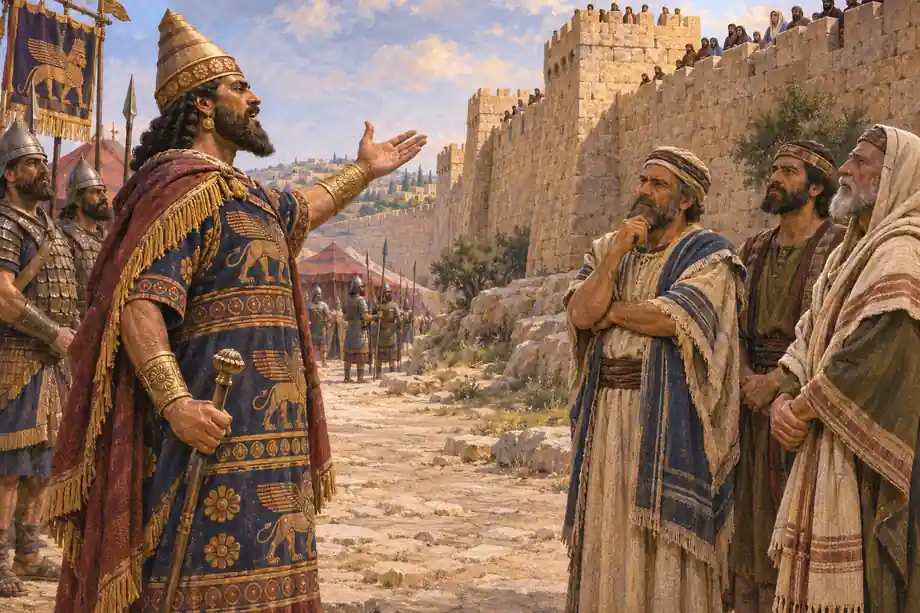
How does Assyria’s spokesman turn a fragment of truth into an argument portraying Hezekiah’s reforms as grounds for fear?
Study overview
Samaria has fallen. Jerusalem still stands. But a wall that remains standing cannot silence the fear of the people living behind it.
The bronze serpent is broken. The shrines on the hills come down. A king begins to learn the ways of the covenant. Then the armies gather beyond the fields. Silver is carried from the sanctuary; gold is stripped from its doors. At last a voice rises outside the wall: “What are you trusting?” And a city of children, elders, and emptying stores must learn to tell the difference between the promise of the living God and the promise of an empire.
- Primary text:
- 2 Kings 18:1–37.
- Leading question:
- Does trusting the LORD mean danger will never approach a family or a nation, or does trust mean refusing to give fear the final word when danger arrives?
- Central thesis:
- Second Kings 18 places Hezekiah's faith under public pressure: reforming worship reorients the king toward the LORD, but Assyria's army, the payment of tribute, and a campaign of intimidation reveal that faithfulness does not remove hardship. Faithfulness means discerning which voice has final authority when fear and truth collide.
Introduction — When Faithfulness Meets Fear at the Gate
There is a difference between laying a good foundation during the dry season and sitting inside the house when the storm strikes. The builder may know the foundation is strong. Yet the sound of roofing iron lifting in the night can still produce fear. A solid foundation does not make the wind imaginary. The question is which reality will guide the next decision: the foundation beneath the house or the noise above it.
Second Kings 18 places Hezekiah inside that kind of storm. Chapter 17 ended with the fall of the northern kingdom. Assyria had conquered Samaria, deported many inhabitants, and brought the northern monarchy to its end. The biblical narrator explained that tragedy against a long history of covenant rebellion and rejected prophetic warnings (2 Kgs 17:7–23). Chapter 16, meanwhile, had shown Judah's King Ahaz paying for Assyrian protection with temple wealth and reshaping worship in Jerusalem (2 Kgs 16:7–18).
Ahaz's son Hezekiah chooses another direction. He dismantles places of corrupt worship, breaks religious images, and clings to the LORD. The narrator offers an unusually strong assessment of the new king's trust and obedience (18:3–6). For a moment, the reforms seem to open the way toward political strength and independence.
Then Assyria comes.
Fortified cities fall. Hezekiah tries to quiet the crisis through payments of silver and gold. Even after the tribute, Assyrian officers arrive outside Jerusalem. Their chief spokesman attempts to capture something that the army has not yet captured: the people's confidence.
This chapter is about faithfulness tested by fear. Threats are not automatic proof that obedience has failed. Religious reforms do not mean that a faithful leader makes every decision perfectly. The decisive issue is whose account of reality the people will accept when military power speaks as though military power were God.
Historical and Literary Setting — Between Samaria's Ruins and Jerusalem's Walls
Kings is more than a chronicle of palaces. It interprets public life through Israel's covenant. The king is answerable to the Torah rather than standing above it (Deut 17:14–20). In chapter 17, the narrator described idolatry, the persistent rejection of prophets, and the disobedience that had eroded the northern kingdom for generations. Chapter 18 introduces a king in Judah who deliberately changes course.
Hezekiah is measured against David (18:3), unlike Ahaz, who had adopted the religious practices of northern Israel (16:2–4). Removing the high places, pillars, and Asherah image expresses the Torah's call to worship the LORD alone (Deut 12:2–7). Second Chronicles 29–31 gives a fuller account of Hezekiah's restoration of temple worship and celebration of Passover. Those details illuminate the wider canonical portrait, but not every event mentioned in Chronicles appears in 2 Kings 18 itself.
Politically, Assyria has already dismantled the monarchy in Samaria and now presses into Judah. Sennacherib's campaign against Judah is usually dated to 701 BCE. Assyrian royal records describe the campaign from the empire's perspective; the books of Kings frame the crisis through Judah's life before the LORD. The exact synchronization of Hezekiah's regnal years with the fall of Samaria and the campaign of Sennacherib is debated. The chronological notices in 18:9–13 deserve careful reading rather than a false claim that every figure fits an uncontested modern reconstruction (Provan 1995, 252–56; Brueggemann 2000, 489–92).
The narrator deliberately places two scenes together: the destruction of Samaria is recalled (18:9–12), and Jerusalem is threatened (18:13–37). The memory of the north raises a question that hangs over every sentence: Will Judah follow the same road into exile?
A geographical echo sharpens the drama. Isaiah had met Ahaz near the conduit of the upper pool when Judah feared a northern coalition (Isa 7:3). Assyrian representatives now appear at the conduit of the upper pool to confront Ahaz's son (2 Kgs 18:17). The father had sought security from Assyria. The son now hears the voice of Assyria threatening the security of Jerusalem. The location has become a classroom in the difference between inherited fear and living faith.
Brueggemann (2000, 489–99) emphasizes the confrontation between trust in the LORD and imperial intimidation. Leithart (2006) draws attention to the Assyrian spokesman's disturbing ability to borrow arguments resembling prophetic warnings while redirecting the people's allegiance toward the king of Assyria. The conflict is not only over territory. It is over the authority to interpret reality.
Walking through the Text — Whose Voice Will Carry Beyond the Wall?
When a King Breaks an Idol That Used to Be a Sign (18:1–6)
Hezekiah becomes king in Judah. The narrator says Hezekiah did what was right in the sight of the LORD, following the pattern of David (18:1–3). This is an exceptional verdict in a book crowded with rulers whose reigns contain compromise and covenant failure. The narrator then explains the verdict through public decisions: Hezekiah removes high places, breaks pillars, cuts down the Asherah, and crushes the bronze serpent (18:4).
The bronze serpent demands particular care. Moses made the bronze serpent at God's command during a crisis in the wilderness (Num 21:4–9). In that moment, looking toward the appointed sign in faith was associated with the LORD's gift of life. Generations later, however, people had begun burning incense to the object. A sign that once directed attention toward God had become a recipient of worship.
Hezekiah destroys the object and gives it the name Nehushtan, a name associated through wordplay with bronze and serpent. The action does not deny what God did through Moses. It rejects the transformation of a historical memorial into a rival to the living God. A useful instrument of yesterday's faithfulness can become today's idol when people begin treating the instrument as the source of life.
The narrator then supplies a cluster of defining verbs: Hezekiah trusted, held fast, did not depart, and kept the commandments given through Moses (18:5–6). Faith is not presented as inward feeling alone. Trust reorganizes worship, corrects public habits, and places royal power under God's instruction.
When Trust Produces Courage to Resist an Empire (18:7–8)
The LORD is with Hezekiah, and the king prospers in the affairs of the kingdom. Hezekiah rebels against the king of Assyria and campaigns against the Philistines (18:7–8). In the story's immediate contrast, Hezekiah is no longer following Ahaz's policy of making Judah a dependent servant of the empire.
Yet these verses must not be turned into a guarantee that every obedient person will achieve military, financial, or professional success. The very same chapter will bring Hezekiah face-to-face with a devastating threat. The narrator affirms God's presence without claiming that God's presence makes suffering impossible.
Breaking an unhealthy dependency can be the right decision. Breaking that dependency may also carry real costs. Faith that has counted the cost is still called to be faith.
When the Fall of Samaria Becomes Judah's Warning (18:9–12)
In the middle of Hezekiah's story, the narrator repeats the fall of Samaria. Assyria besieges the city, captures it, and deports Israel's people (18:9–11). The covenantal explanation returns: Israel did not obey the voice of the LORD, broke the covenant, and failed to keep what Moses commanded (18:12).
The repetition is deliberate. Jerusalem cannot presume that a different capital or a surviving Davidic dynasty provides automatic immunity. Judah is meant to learn from the catastrophe to the north. Chapter 17 supplied the warning; chapter 18 shows what a different response to the covenant might look like, even while judgment threatens.
The contrast must not become a reason to despise deported Israelites. Exile destroys homes and separates families. A serious reading of the covenant should deepen compassion for the displaced rather than turn their pain into an occasion for religious superiority.
When the Temple Treasury Is Emptied to Purchase Relief (18:13–16)
In Hezekiah's fourteenth year, Sennacherib king of Assyria attacks and captures Judah's fortified cities (18:13). Hezekiah sends a message admitting the wrong of his rebellion against Assyria and agrees to pay the required tribute. Sennacherib demands three hundred talents of silver and thirty talents of gold (18:14).
Hezekiah takes silver from the house of the LORD and from royal treasuries. The king even strips gold from the temple doors and doorposts (18:15–16). The story now becomes uncomfortable. A king praised for trust in God takes an action that touches the resources of the sanctuary in the hope of stabilizing a frightening political situation.
Should the payment be read as prudent diplomacy, a failure of faith, or an attempt to protect civilians when no painless choice is available? Second Kings 18 does not explicitly pronounce the tribute payment a sin. Yet the image of stripped temple doors is painful. The cost of an agreement with an empire is displayed on the building devoted to the worship of the LORD.
The tribute does not end the confrontation. Sennacherib still dispatches military representatives and a substantial force to Jerusalem (18:17). Money can sometimes purchase time without purchasing trustworthiness. A powerful ruler may accept a payment and still demand more.
When the Enemy Uses Religious Language to Plant Doubt (18:17–25)
From Lachish, Sennacherib sends high-ranking representatives toward Jerusalem. Judah's delegation consists of Eliakim, Shebna, and Joah (18:17–18). The setting is a diplomatic encounter backed by an army. Yet the primary weapon of the Assyrian spokesman, commonly called the Rabshakeh, is a question: What is the basis of Hezekiah's confidence? (18:19).
The spokesman ridicules reliance on Egypt, describing Egypt as a broken reed that pierces the hand of anyone leaning on it (18:21). The criticism resembles the warnings of Judah's own prophets about an unreliable alliance with Egypt (Isa 30:1–3; 31:1). The danger lies in what follows: a partly sound observation becomes the opening for a deeply misleading conclusion.
The speaker claims that Hezekiah has offended the LORD by removing high places and altars, as though the king had destroyed legitimate worship sites (18:22). Yet the biblical narrator has already praised those reforms (18:3–6). Imperial propaganda redefines an obedient action as religious disobedience. The spokesman also mocks Judah's cavalry resources and claims that the LORD commanded Assyria to invade (18:23–25). The narrator never confirms the spokesman's claim to have received such a command. The assertion belongs to an intimidating speech, not to a verified divine oracle.
A significant lesson emerges. Not every public voice using God's name is conveying God's word. Religious vocabulary can be pressed into the service of domination. A persuasive sentence can contain one part truth and another part distortion; discernment requires testing the entire argument.
When Threats Speak the Language of Ordinary People (18:26–37)
Eliakim, Shebna, and Joah ask the Assyrian spokesman to use Aramaic, the language of international diplomacy, rather than the language of Judah understood by people on the wall (18:26). The request is refused. The intended audience is not merely the royal administration. The army wants ordinary families to hear, imagine the worst, and lose confidence.
The spokesman paints a frightening picture of siege conditions, then urges the people to stop listening to Hezekiah. Assyria promises peace, vines, fig trees, water, and eventually another land described as possessing the abundance of their own country (18:27–32). The offer sounds merciful because it names the ordinary things people long to preserve. But beneath the promise lies forced removal from their homeland. Chapter 17 has already shown what imperial resettlement can mean for families and communities.
The speech reaches its climax by setting the LORD alongside the gods of nations already defeated by Assyria (18:33–35). Imperial victory is presented as the final test of divine authority. But Kings has repeatedly challenged the assumption that the God of Israel is simply one more local deity whose power can be measured by a battle's outcome (1 Kgs 20:23–28).
The people on the wall remain silent because Hezekiah has ordered them not to answer (18:36). The silence need not mean surrender. When an adversary seeks to control public emotion, refusing to fight on the adversary's terms may be an act of communal discipline. The officials return with torn clothes, visibly expressing distress and grief (18:37).
The chapter ends without a resolution. Jerusalem is still standing, and the threats are still ringing. The reader must now ask where Hezekiah will take the crisis that words and payments have not solved.
Theological Reflection — Trust, Signs, Propaganda, and the True King
Covenant trust transforms public practices
Hezekiah receives praise for trusting and clinging to the LORD, not merely for speaking the language of faith (18:5–6). Reform requires changing habits with deep historical roots, institutional prestige, and emotional attachments. Deuteronomy 12 and 17 hold worship and kingship accountable to God's instruction. The same principle challenges a congregation, family, or ministry today: a beloved tradition cannot be allowed to govern Scripture. Scripture must evaluate the tradition, even when correction is costly.
A sacred memorial is not the living God
The bronze serpent was originally made at God's instruction, yet the people later burned incense to it (Num 21:8–9; 2 Kgs 18:4). The distinction between a sign and the God to whom the sign points is crucial. Jesus recalls the lifted serpent when speaking about the lifting up of the Son of Man (John 3:14–15). The point is not the preservation or worship of an ancient object. It is life given by God through faith in Christ. Honoring the past becomes idolatry when the past is used to resist the living Lord's call in the present.
An empire can conquer the imagination before conquering a city
The Assyrian spokesman tries to rename reality: reform becomes offense, surrender becomes peace, and deportation becomes a fertile new homeland. Ancient Near Eastern military victories were often described in terms of the superiority of the conqueror's gods. The speaker exploits such assumptions to humiliate Judah's God. Kings refuses the claim that the strongest army possesses the right to define truth. Jesus exposes another kind of kingship. Mocked and challenged before suffering, Jesus remains faithful to the Father rather than establishing truth by intimidation (Matt 27:39–43; 1 Pet 2:23). The loudest voice is not necessarily the voice with authority.
God's mercy does not guarantee a storm-free road
Hezekiah is commended yet faces tribute, the loss of fortified cities, and an army outside the capital. Faithfulness does not abolish history's pain. The difference between Hezekiah and Ahaz is not the absence of enemies in Hezekiah's reign; it is Hezekiah's covenantal orientation toward the LORD. Jesus, the greater Davidic King, does not avoid suffering but passes through the cross into resurrection (Luke 24:26–27). Christian hope is not a promise that every danger will disappear. Christian hope rests in the righteous King whose final victory cannot be defeated by death.
Life Application — Do Not Give Fear the Throne
- Examine traditions in the light of Scripture. Identify one cherished practice in a family, congregation, or ministry that once served a good purpose but now obscures love, truth, or justice. Begin a respectful conversation about reform (2 Kgs 18:4; Mark 7:8–13).
- Distinguish wise precautions from surrender to fear. When facing debt, family pressure, or an uncertain livelihood, list legitimate ways to reduce risk. Then identify any proposed shortcut that would compromise conscience for temporary relief (Prov 3:5–6).
- Ask who pays the price of an alliance. Before accepting support with conditions, account for money, decision-making freedom, and the well-being of vulnerable people. The stripped temple doors remind every leader that political decisions have communal costs (18:15–16).
- Test spiritual claims used to justify power. When a leader invokes God's name to support a threat or an institutional demand, compare the claim with Scripture, evidence, and observable conduct (1 John 4:1).
- Tell communities the truth about danger. The people on Jerusalem's wall were targeted by fear. In church, school, and family leadership, give clear information, explain reasonable precautions, and include people in responsible decisions instead of manipulating emotion.
- Practice disciplined responses to provocation. Silence in 18:36 suggests that not every insult deserves immediate engagement. Silence must never excuse injustice, but refusing an argument designed only to provoke can protect a community from needless escalation (Prov 26:4–5).
- Support those already harmed by conflict. Judah's towns were captured before Jerusalem heard the threat. Identify a displaced family or a household under severe pressure, and offer food, accompaniment, practical assistance, or advocacy rather than only reassuring words (James 2:15–17).
Reflection Questions
- What “bronze serpent” in a church, family, or institution was once helpful but has gradually been given a place that belongs only to God?
- Hezekiah trusted the LORD and still faced invasion. How should a Christian community speak about faithfulness when obedience does not remove hardship?
- Which agreement might purchase short-term security at a serious cost to conscience, worship, or the wider community?
- What signals reveal propaganda that uses religious language and fragments of truth to produce fear or obedience to an earthly power?
- When many voices gather outside the walls of ordinary life, what concrete step of prayer, discernment, and responsible action is required now?
Response Prayer — King of Peace, Guard Our Ears and Hearts
O LORD, God of the covenant, God of David, Hezekiah, and all who call upon your name, we come with many voices ringing in our ears. Some voices tell us that money is salvation, that might is truth, and that fear is the only road toward tomorrow.
Teach us to break the idols hidden inside good traditions. Help us honor the past without worshiping the past. Give leaders the wisdom to protect communities without selling their conscience. Bring real help to families wounded by war and want— not soothing speeches that leave the table empty.
When threats gather at the gate, give us discipline to listen before replying, courage to speak truth, and faith to bring every fear before you. In Jesus Christ, our righteous and merciful King, make us people who trust your word more than the shouting of empires. Amen.
Window into the Next Chapter — A Threatening Letter Before the LORD
Second Kings 18 closes with Judah's officials returning to Hezekiah in torn clothes. Assyria's claims have been shouted within hearing of the ordinary people. The imperial spokesman has insisted that no god can save Jerusalem and that surrender offers the only route to peace. Yet Judah's king has not given the final answer.
Second Kings 19 will follow Hezekiah into another kind of encounter. The king will seek the LORD; Isaiah will speak; and another threat will become a message taken into prayer. The question will run deeper than the number of soldiers on either side: who governs history when an emperor announces that nothing can stand against imperial power?
Watch the difference between denying danger and laying danger before God. Will Hezekiah answer imperial pride with pride of his own, or will Jerusalem discover that faithful prayer can be an act of public courage?
Bibliography
- Brueggemann, Walter. 2000. 1 & 2 Kings. Smyth & Helwys Bible Commentary. Macon, GA: Smyth & Helwys.
- Leithart, Peter J. 2006. 1 & 2 Kings. Brazos Theological Commentary on the Bible. Grand Rapids: Brazos Press.
- Provan, Iain W. 1995. 1 and 2 Kings. New International Biblical Commentary. Peabody, MA: Hendrickson. Reprinted in the Understanding the Bible Commentary Series.
Reading note
Editorial note: Sennacherib's campaign against Judah is generally dated to 701 BCE, but the synchronization of regnal years in 2 Kings 18 remains debated. The claim that the LORD personally commissioned the Assyrian invasion (18:25) is part of the spokesman's speech; the narrator does not directly authenticate that claim.
Be the first to leave a comment.