

Why does the promise of roots and harvests show Jerusalem’s deliverance extending beyond an army’s departure?
Study overview
Yesterday a voice rose outside the wall. Today a letter enters the city. An empire has written its threats in ink; fear has arrived at the king's table. But Hezekiah does not fold the letter away. The king spreads the letter before the LORD. Beyond the walls, horses and spears boast of victory; inside the prophet's word, fields wait to be planted, seed waits to rise, and a wounded people are promised roots below and fruit above.
- Primary passage:
- 2 Kings 19:1–37.
- Leading question:
- What happens when worldly power declares that no hope remains, but a king lays the threatening words before the living God?
- Central thesis:
- Second Kings 19 tells how fear becomes prayer, imperial arrogance encounters the word of the LORD, and Jerusalem receives deliverance by divine grace so that a surviving people may take root again.
Introduction — When a Threatening Letter Must Not Have the Last Word
Bad news often produces two instincts. Some people fold the letter and hide the words. Others read the letter again and again, until its threatening voice becomes louder than every other voice in the house. A message can govern a family's decisions long before the person making the threats appears at the door. A piece of paper can become a throne.
That is Jerusalem's danger. Second Kings 18 ended with an Assyrian spokesman shouting beyond the city wall. The speaker insisted that no national god had prevented Assyrian conquest, then treated the LORD's promise as one more powerless religious claim (18:28–35). The officials of Judah returned to Hezekiah with their clothing torn in grief (18:37). Their report carried more than military information. The report carried an interpretation of reality: resistance is useless, and the living God cannot save.
Second Kings 19 begins not with another battle but with a king who humbles himself. Hezekiah tears his clothes, puts on sackcloth, and enters the house of the LORD (19:1). This is no denial of danger. The torn clothing declares that Judah is in distress and the king cannot manufacture deliverance.
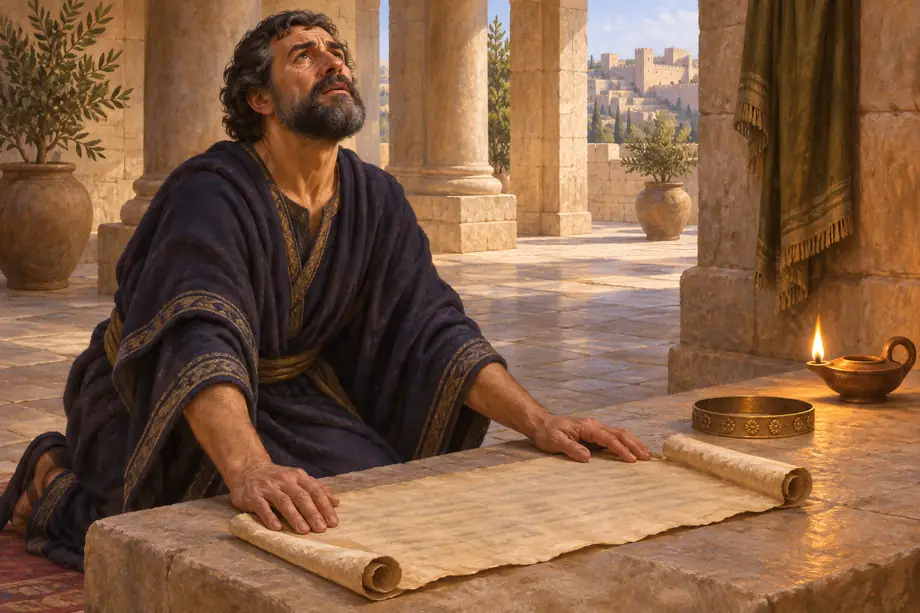
A second message soon arrives, this time written. Hezekiah receives the document, reads it, and spreads it before the LORD (19:14). That small movement carries the chapter's controlling image. A letter announces the enemy's intentions; prayer brings those intentions before the God who governs history. Hezekiah does not pretend the letter is harmless. The king refuses to let the letter become the final interpretation of Jerusalem's future.
The chapter is about faith that names the danger without surrendering ultimate authority to danger. God's answer includes the defeat of Assyria's designs, but Isaiah also promises renewed fields, deep roots, and fresh fruit. Deliverance is not simply an enemy's departure. Deliverance opens the possibility of communal life after fear has nearly consumed the city.
Historical and Literary Setting — Assyria Confronts the Promise to David
Kings measures royal leadership by covenant fidelity, not military reputation. Deuteronomy places the king under God's instruction rather than above it (Deut 17:14–20). Solomon's dedication prayer anticipated the day when war, famine, or exile might drive the people to seek the LORD (1 Kgs 8:33–51). Hezekiah now does what the temple was meant to invite: the king approaches the God who cannot be contained by a building.
Chapter 17 explained Samaria's fall. Chapter 18 introduced Hezekiah as a ruler who removed false objects of worship, held fast to the LORD, and confronted the expanding Assyrian empire (2 Kgs 17:6–23; 18:1–37). Sennacherib's campaign against Judah is generally dated to 701 BCE. Assyrian royal inscriptions celebrate the conquest of Judean strongholds and portray Hezekiah as confined within Jerusalem like a bird in a cage. They do not claim that Jerusalem was captured. The biblical narrative frames the confrontation around the LORD's fidelity and the limits of imperial power. These sources reflect different perspectives, and their details should not be flattened into an invented agreement (Provan 2012, 255–62; Brueggemann 2000, 505–16).
Isaiah 36–37 contains a closely related account of the same crisis. An earlier memory from Isaiah sharpens the narrative: Isaiah met Hezekiah's father Ahaz near the upper pool when Jerusalem feared a northern military coalition (Isa 7:3–9). Ahaz had sought protection from Assyria, even paying for assistance with temple wealth (2 Kgs 16:7–9). The son now faces Assyria's threats at that same landmark (18:17). What the father welcomed as security has become the son's danger.
In the ancient Near Eastern world, conquering monarchs frequently presented victory over foreign cities as proof of their gods' superiority. The Assyrian spokesman uses a similar claim in 18:33–35 and 19:10–13. Hezekiah's prayer challenges the logic. The LORD is not merely the strongest local deity among competing territorial gods. The LORD is the Creator of heaven and earth and the ruler of all kingdoms (19:15–18).
The narrator also grounds the promise of preservation in God's commitment to David (2 Sam 7:12–16; 2 Kgs 19:34). But the rescue of Jerusalem should not be confused with an unconditional guarantee that Judah could never fall. Later chapters will show the kingdom drifting toward Babylonian exile. Grace gives the people another opportunity to live faithfully; grace is never permission to forget the covenant.
Walking through the Text — From Sackcloth to the Roots of a Remnant
When a King Tears His Clothes and Seeks a Word (19:1–7)
When Hezekiah hears the report, the king tears his clothing, puts on sackcloth, and enters the temple. Royal officials and senior priests, also dressed in mourning clothes, are sent to Isaiah son of Amoz. The king's message describes a day of distress, rebuke, and disgrace. The image of children reaching the moment of birth when their mother has no strength to deliver captures the danger of standing at the edge of hope with no power to cross over (19:3).
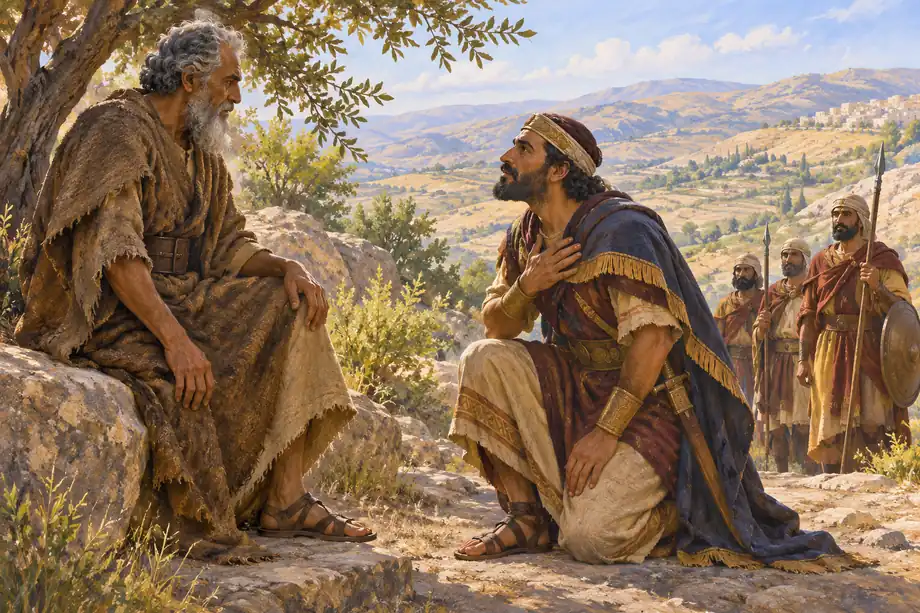
Hezekiah's request is not simply for a military plan. The king asks Isaiah to pray for the remnant that still survives (19:4). Even a ruler praised for faith needs a prophet's counsel and the prayers of others. The contrast with the northern king who threatened Elisha during Samaria's famine is striking: that king sought the prophet's death; Hezekiah seeks the prophet's intercession (2 Kgs 6:30–31; Provan 2012, 257).
Isaiah's response is plain. The people need not fear the servants' blasphemous words. The LORD will cause Sennacherib to hear a report, return to Assyria, and eventually fall by the sword in the king's own land (19:6–7). The reference to a spirit or impulse coming upon Sennacherib signals God's providential direction of events; the passage is not describing the Assyrian king receiving the Holy Spirit in the New Testament sense.
The first answer to fear is a word that refuses to make the threat sovereign. Yet the siege has not ended. God's promise must be trusted while the surrounding circumstances remain unresolved.
When the Threat Returns in Writing (19:8–13)
The Assyrian commander returns to Sennacherib and discovers that the king has left Lachish and is fighting against Libnah. News arrives that Tirhakah of Cush is approaching for battle. Instead of abandoning intimidation, Sennacherib sends another message to Hezekiah. The letter warns the Judean king against being deceived by trust in God (19:9–10).
The threatening text lists cities and nations already subdued by Assyria. It asks why Jerusalem should imagine a different outcome. The argument has moved beyond mocking Judah's military resources to calling the reliability of God into question. The empire's earlier victories are real enough; the conclusion that the LORD is therefore powerless is not.
The reference to Tirhakah as king of Cush raises a chronological question, because Tirhakah's commonly reconstructed dates as king are later than the campaign of 701 BCE. The narrative may use the title by which Tirhakah later became known, or the historical sequence may be more complex. The text does not justify pretending that this question is settled beyond discussion.
Fear often arrives dressed in the language of facts. Wise faith does not have to reject every fact quoted by the opposing side. Wise faith distinguishes reliable information from the false conclusion that an empire's success gives an empire divine authority.
When the Letter Is Spread Before the LORD (19:14–19)
This is the chapter's central scene. Hezekiah receives the letters, reads them, goes up to the house of the LORD, and spreads them before God. The threatening words are not concealed, destroyed, or edited to make the danger seem smaller. The crisis is named in the presence of the living God.
Hezekiah's prayer begins by confessing who God is: the God of Israel enthroned above the cherubim, God alone over the world's kingdoms, Maker of heaven and earth (19:15). The cherubim evoke the ark and the sanctuary (Exod 25:17–22), yet the prayer does not confine God to Jerusalem's sacred space. The king addresses the Creator of everything, not a religious object that the city happens to own.
Hezekiah asks God to listen and see the words sent by Sennacherib. The king then concedes something important: Assyrian rulers really have devastated many nations and thrown their gods into the fire. Those gods, however, were wood and stone made by human hands, not living gods (19:17–18; compare Isa 44:9–20).
The final request reaches beyond Hezekiah's private survival: save Jerusalem so that all the kingdoms of the earth may know the LORD alone is God (19:19). Immediate human need is brought into the larger purpose of revealing God's character to the nations. The prayer belongs with Moses' concern for the nations, Elijah's appeal at Carmel, and the early church's prayers under threat (Exod 9:16; 1 Kgs 18:36–37; Acts 4:24–31).
When God's Word Answers an Empire's Boasting (19:20–28)
Isaiah sends word that the LORD has heard Hezekiah's prayer. The prophetic poem addresses Sennacherib with a startling reversal: the daughter of Zion will shake her head at the king who thought Jerusalem helpless. The central question is no longer which army commands the most chariots, but whom the Assyrian ruler has insulted. Isaiah names the Holy One of Israel (19:21–22).
Sennacherib had boasted of chariots, mountains ascended, forests cut down, wells opened, and streams dried up. The language is poetic imperial self-advertisement rather than a checklist of literal geographic accomplishments (19:23–24; Provan 2012, 260–61). In the empire's imagination, royal power has become the power to command creation itself.
The LORD's reply exposes the illusion. Assyria's victories did not take place outside God's governance of history (19:25–27; Isa 10:5–15). Being used within God's purposes is not permission to claim God's place or to excuse oppression. The image of a hook through the nose and a bit in the mouth reverses imperial pride: the conqueror who dragged captives away will be made to return by the road already traveled (19:28).
The passage challenges the worship of military force. It also warns believers against using claims of divine backing to justify cruelty. Even a power granted room to act in history remains answerable for arrogance and violence.
When the Promise Becomes Seed, Roots, and Harvest (19:29–34)
After the poem of judgment, Isaiah offers a sign grounded in ordinary agriculture. In the first year the people will eat what grows on its own; the second year they will eat a similar growth; in the third year they will sow, reap, and plant vineyards (19:29). War has disrupted agriculture. Recovery will not be instantaneous. God promises a future in which devastated fields can sustain life again.
The promise then turns from land to people. The surviving remnant of Judah will take root downward and bear fruit upward (19:30–31). This is the chapter's deepest image of hope. Deliverance cannot be measured only by the disappearance of hostile soldiers. It must also be measured by whether families live, farms are restored, and neighbors can work toward a just common life. The promise of harvest does not deny the wounds of war. It denies that those wounds possess the final word.
The LORD promises that the king of Assyria will not enter Jerusalem, shoot an arrow there, bring a shield against the city, or build a siege ramp (19:32–33). The reason is explicit: God will defend the city for God's own sake and for the sake of David, God's servant (19:34; 2 Sam 7:12–16). Hezekiah's devotion is not a payment that compels a miracle. Preservation rests upon divine mercy and covenant promise.
When the Army Withdraws and the King Goes Home (19:35–37)
The narrator reports that the angel of the LORD struck 185,000 in the Assyrian camp. Sennacherib withdrew to Nineveh and, later, while worshiping in the temple of Nisroch, was killed by his sons Adrammelech and Sharezer. Esarhaddon succeeded to the throne (19:35–37).
The figure of 185,000 is a claim within the biblical account; the precise number and cause of the deaths cannot be independently verified from surviving Assyrian records. Assyrian inscriptions do not claim Jerusalem's capture, but they tell the campaign from a very different vantage point. Sennacherib was assassinated in 681 BCE, many years after the campaign of 701 BCE. The closing verses compress the king's subsequent fate; they do not say the assassination happened the next morning (compare Isa 37:36–38).
The narrative finishes with a painful irony. The king who claimed that Jerusalem's God could offer no protection eventually died in a sanctuary dedicated to his own god. Yet the lesson is not an invitation to delight in mass death. God's deliverance is narrated within a history carrying real human grief. A faithful reading should produce humility, solidarity with victims, and reverence for God's judgment, not another appetite for violence.
Theological Reflection — The God Who Receives Letters and Protects Seeds
Prayer does not deny facts; prayer brings facts before God
Hezekiah does not hide Sennacherib's threats. The king acknowledges Assyria's previous victories but rejects the claim that conquest proves the LORD's weakness (19:17–19). Biblical prayer names the trouble without worshiping the trouble. Many psalms proceed in the same way (Pss 13; 46; 74). Jesus likewise brings anguish and obedience before the Father in Gethsemane (Mark 14:32–36). Faith does not require false reports to remain alive.
The God of the covenant is not a territorial idol
The Assyrian ruler treats international history as a competition between national deities and imperial armies. Hezekiah addresses the LORD as Creator of all kingdoms (19:15). Israel's confession is not that Jerusalem possesses a more powerful statue. The confession is that the Lord of Israel made heaven and earth (Gen 1:1; Ps 24:1). Every ruler, nation, and economy therefore lives under God's claim of justice and mercy.
The remnant witnesses to grace, not national superiority
The promise to take root and bear fruit (19:30) comes after enormous destruction. The remnant has no reason to boast over people who lost homes or loved ones. Judah survives by mercy and promise, not because every Judean is more righteous than the Israelites taken into exile (2 Kgs 17:19; 19:34). The prophets will return to the imagery of roots, shoots, and restored life (Isa 11:1–10; 37:31–32).
The story leads toward a King whose kingdom is not built by threats
Hezekiah lays a threatening letter before God. Jesus, the Son of David, confronts the powers of the world without turning God's kingdom into an army of revenge (John 18:36; Luke 22:49–53). Christ's victory runs through the cross and resurrection (Col 2:13–15). Hezekiah's experience is not a one-to-one prediction of every event in Jesus' ministry. Yet the long biblical storyline of Davidic promise, remnant hope, and salvation awakens a longing for the righteous King who will restore creation without becoming another Sennacherib (Isa 9:6–7; Luke 1:32–33).
Life Application — Spread the Letter, Then Practice Faithfulness
- Name the crisis before God. Write down the threat affecting a household, ministry, or community. Make room for honest prayer rather than pretending nothing is wrong (2 Kgs 19:14).
- Separate facts from the interpretation of fear. A financial shortfall, illness, or conflict may be real; the conclusion that God has no possible way to help is not established by the crisis (19:10–19).
- Seek counsel and shared prayer. Hezekiah approached Isaiah and involved temple leaders. Church leaders can consult trusted believers and responsible advisers instead of carrying every decision alone (19:2–4).
- Protect truth from intimidation. Verify claims, resist speech that humiliates vulnerable people, and refuse to use God's name to make a leader's assertions immune to questioning (18:28–35; 19:22).
- Measure recovery by the lives rebuilt afterward. Following a crisis, plan for food, family support, restored livelihoods, care for trauma, and the return of trust within the community (19:29–31).
- Do not make deliverance an excuse for complacency. Jerusalem was preserved but still needed obedience. Yesterday's rescue does not remove today's need for humility (19:34; 2 Kgs 20:12–19).
- Refuse to celebrate an enemy's suffering. Read the judgment upon Assyria in the shadow of actual human lives. Pray for justice, restraint, and protection for victims rather than revenge (Prov 24:17–18; Matt 5:44).
Reflection Questions
- Which threatening “letter”—a report, debt, illness, or dispute—has gained more practical authority than God's word in current decisions?
- Which elements of the Assyrian message were historically grounded, and which conclusion distorted the truth about God (2 Kgs 19:10–19)?
- How is Hezekiah's prayer different from a request that God merely help one side win (19:15–19)?
- How should a congregation measure God's help: only by the danger that disappears, or by the “roots and fruit” appearing in families and neighborhoods afterward (19:29–31)?
- What form of pride or self-reliance needs to be relinquished so that hope rests in the LORD rather than human control?
Response Prayer — The Letter before the LORD
LORD God of Israel, Creator of heaven and earth, receive the troubling news brought before the living God today. Remember families living with hunger, communities exhausted by threats, and leaders who can no longer see a safe road through disaster. Grant the courage of Hezekiah: courage to speak truthfully about danger and to kneel without surrendering to despair. Give attentive hearts to hear God's word above the shouting of worldly power.
Forgive every attempt to make wealth, pride, or human promises into a refuge while neglecting justice and mercy. Protect those exposed to violence. Restrain the hands of oppressors. Teach the people of God to pray for enemies and tend the wounds of war. Where hope has dried out, plant new seed. Where families are broken, begin healing. Let the roots of faithfulness grow deep and the fruit of love become visible in every ministry and home. Through Jesus Christ, the King of righteousness and peace. Amen.
Window into the Next Chapter — The City Is Saved, but the King Will Be Tested Again
Second Kings 19 closes with Jerusalem preserved and Sennacherib returned to his homeland. The threatening letter did not have the final word. Yet the rescue of a city does not mark the end of Hezekiah's testing.
Second Kings 20 will bring readers into the sickroom of the king. Isaiah will deliver a difficult word concerning death; Hezekiah will pray; God will grant additional years and a remarkable sign. Then envoys from Babylon will arrive. Hezekiah will display the treasures of palace and sanctuary. The outward threat of Assyria will give way to a quieter danger: how to live with extra time, receive admiration, and speak about prosperity in front of strangers.
Watch the next question emerge: Will a heart that sought God under threat remain faithful after recovery, honor, and renewed prosperity? The king who unfolded a letter before the LORD will also need to open a grateful heart before the LORD.
Bibliography
- BibleProject. n.d. The Books of 1 and 2 Kings: Guide with Key Information and Resources. BibleProject.
- Brueggemann, Walter. 2000. 1 & 2 Kings. Smyth & Helwys Bible Commentary. Macon, GA: Smyth & Helwys.
- Leithart, Peter J. 2006. 1 & 2 Kings. Brazos Theological Commentary on the Bible. Grand Rapids: Brazos Press.
- Provan, Iain W. 2012. 1 and 2 Kings. Understanding the Bible Commentary Series. Grand Rapids: Baker Books. First published 1995.
Be the first to leave a comment.