

Why can the temple and a fifty-five-year reign never establish Manasseh’s covenant faithfulness?
Study overview
Hezekiah left a conduit carrying water into the city; Manasseh fills that city with innocent blood. Where the Lord placed the divine name, the king raises altars to other powers. David's lamp has not yet gone out, but smoke from divided worship hides its glow. The prophets speak over the noise of the palace: Can a house stand when its foundation is denied? And when Jerusalem is wiped like an emptied dish, who will remember the promise still waiting beyond judgment?
- Primary text:
- 2 Kings 21:1–26.
- Guiding question:
- What happens when a generation inherits the buildings and blessings of faith but refuses the covenant loyalty that gave them meaning?
- Central thesis:
- Second Kings 21 tells the story of a faithful inheritance turned into an inheritance of rebellion: distorted worship becomes a public danger, innocent blood cries for justice, and God's prophetic word holds rulers accountable even as the future of David's house grows dark.
Introduction — Inheriting the House Without Inheriting the Heart
A family may hand down a house without handing down the habits that built it. One generation digs a well; the next forgets to protect the water. A mother plants a mango tree for children who have not yet been born; the children inherit the shade but cut down the roots. Property transfers through ownership. Fidelity must be learned, chosen, and practiced.
At the close of 2 Kings 20, Hezekiah was given fifteen additional years. The king who prayed during an Assyrian crisis also received a warning about treasures that would one day go to Babylon. Now Hezekiah has died. Manasseh, Hezekiah's son, assumes the throne at twelve years of age (2 Kgs 21:1). The new king inherits Jerusalem, the temple, the memory of answered prayers, and the covenant promises to David. But he does not continue his father's reforms.
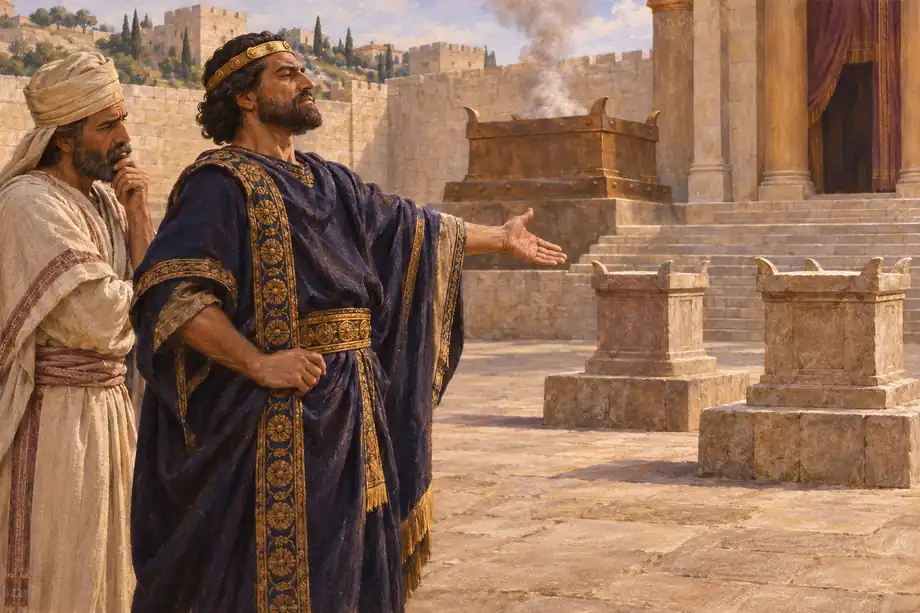
Instead, Manasseh rebuilds the shrines that Hezekiah removed. The king brings the worship of other powers into the very temple associated with the Lord's name. Then the narrator adds a devastating sentence: Manasseh sheds enough innocent blood to fill Jerusalem from one end to the other (21:16). The damage is not confined to a disagreement about ritual. It reaches the streets, homes, and bodies of the people.
God responds through the prophets. Jerusalem will be measured by the standard previously applied to Samaria and the house of Ahab. The city once rescued from Assyria now faces a judgment pronounced from within its own covenant history.
This chapter is about more than a notorious ruler. It asks whether a community can preserve religious architecture while losing the moral foundations of worship. It asks what becomes of national life when power stops listening to God and stops protecting neighbors.
Historical and Literary Context — From Hezekiah's Water to Manasseh's Altars
Kings is not simply a sequence of royal biographies. It is prophetic history that weighs public life against covenant loyalty. The length of a reign is not the measure of a king's faithfulness. Manasseh rules for fifty-five years (21:1), longer than the other kings of Judah, yet receives one of the most devastating evaluations in the book. Political endurance cannot excuse covenant betrayal.
Hezekiah removed the high places, smashed the pillars, cut down the Asherah, and even destroyed the bronze serpent once given in Moses' time because it had become an object of worship (18:4). Manasseh reverses the reforms: high places return, altars to Baal are rebuilt, and an Asherah image is made. Manasseh's conduct recalls both Ahaz, his grandfather, and Ahab, the northern king whose sponsorship of Baal worship led to prophetic confrontation (16:3–4; 1 Kgs 16:31–33).
The chapter also mentions worship of the host of heaven (21:3, 5). Here the expression concerns astral worship—heavenly bodies treated as objects of religious devotion. In the ancient Near East, celestial bodies were often associated with divine powers. But Israel's creation story treats sun, moon, and stars as created lights, not rival gods (Gen 1:14–19). The Torah expressly warns against bowing to the heavenly bodies (Deut 4:19; 17:3). The Creator of the heavens must not be reduced to one member of an imagined celestial pantheon (Provan 1995, §54).
The literary weight of 2 Kings 21 becomes clearer beside chapter 17. Northern Israel fell after repeatedly refusing the prophetic word. Judah's survival under Hezekiah might suggest that Jerusalem was immune to a similar fate. Manasseh destroys that illusion. The same covenant standard applies to both kingdoms (Brueggemann 2000, 531–39).
A parallel narrative is important. Second Chronicles 33:10–17 reports Manasseh's captivity, prayer, humbling, restoration, and later reforms. Second Kings 21 does not narrate those events. Chronicles highlights the possibility of personal repentance and restoration. Kings places the emphasis on the long public consequences of Manasseh's reign. A faithful reading hears both witnesses without pretending that one has said everything the other says.
Walking Through the Text — Altars, a Measuring Line, and Blood
A Son Reverses His Father's Reforms (21:1–4)
Manasseh becomes king at twelve and reigns fifty-five years. The narrator's judgment is immediate: the king does evil in the Lord's sight, following practices the covenant had forbidden Israel to adopt (Deut 12:29–31).
The first specific accusation is the reconstruction of high places that Hezekiah had destroyed. Manasseh builds altars for Baal and makes an Asherah, as Ahab had done. What one generation tried to dismantle, another generation rebuilds.
Altars are not neutral pieces of stone in this story. An altar tells a community where gratitude, security, fear, and allegiance are directed. By restoring the shrines, Manasseh rewrites Judah's account of who sustains life. The walls of Jerusalem remain visible. The spiritual meaning of what happens within those walls is being transformed.
The text does not describe every political or economic decision of this long reign. It focuses instead on the direction of public worship. That focus is deliberate: allegiance shapes the moral imagination of a community, and the imagination of leaders eventually touches the lives of those subject to their decisions.
The Lord's House Becomes a Home for Rival Allegiances (21:5–9)
Manasseh builds altars for the host of heaven in the two courts of the Lord's house. The king also places a carved Asherah image in the temple, despite the Lord's promise to place the divine name in Jerusalem (21:4–7; see 1 Kgs 8:27–30).
The indictment expands. Manasseh makes his son pass through fire, practices divination and sorcery, and consults mediums and spiritists (21:6). Passing a child through fire is associated with practices condemned by the Torah and is widely understood in connection with child sacrifice; this chapter does not explain every circumstance of the act (Lev 18:21; Deut 18:9–13). The seriousness is unmistakable: royal religion has become entangled with an act threatening a child and with attempts to gain hidden knowledge and power.
Amid these accusations, the Lord's earlier promise is recalled. Jerusalem was chosen for the divine name, and Israel could remain in the land if the people obeyed the commandments given through Moses (21:7–8). Possessing the temple is no substitute for listening to the Lord. God's presence cannot be used as a decorative endorsement of practices God has forbidden.
Verse 9 provides the chapter's devastating diagnosis: the people do not listen, and Manasseh leads Judah astray. Leadership has a communal effect. The king's responsibility is immense, but the narrator also recognizes that a people can participate in refusing the word they have heard.
Jerusalem Is Measured by Samaria's Standard (21:10–15)
The Lord speaks through unnamed prophetic servants. The silence of the palace has not silenced the prophetic witness. Manasseh's wrongdoing and Judah's participation lead to an announcement of disaster so severe that listeners will recoil at the news.
The prophecy introduces a builder's tools. The measuring line used against Samaria and the plumb line used against the house of Ahab will be applied to Jerusalem (21:13). What judged the northern kingdom now judges the southern capital. No royal genealogy places the king above the Torah. Samaria fell in chapter 17; Ahab's house fell in chapters 9–10. Jerusalem cannot assume that a Davidic throne makes the city immune to covenant accountability.
Then the language turns domestic and unsettling. The Lord will wipe Jerusalem as someone wipes a dish and turns it upside down. This is not an invitation for readers to enjoy violence. It is a prophetic image of a city emptied of the security and privileges it took for granted. The threatened abandonment of the remaining inheritance (21:14) points toward defeat, dispossession, and exile.
Verse 15 pushes the problem backward to the exodus. Judah's rebellion is part of a longer history of resisting the God who delivered Israel from Egypt. Manasseh is not the sole origin of covenant infidelity; Manasseh brings longstanding patterns to a fearful climax. The prophecy therefore addresses an entire public history, not simply the morality of one man (Brueggemann 2000, 533–34; Provan 1995, §54).
Innocent Blood Stains the Streets (21:16–18)
After the description of corrupted worship and divine warning, the narrator adds a charge of violence: Manasseh sheds innocent blood in extraordinary measure, filling Jerusalem from end to end (21:16). The language expresses the scale of the moral catastrophe; it is not a precise count of deaths.
The God who forbids other gods also forbids the shedding of innocent blood (Exod 20:3–13; Deut 19:10). Under Ahab, Naboth's blood exposed the alliance between royal greed and false worship (1 Kgs 21). Under Manasseh, Jerusalem—the city associated with the Lord's name—becomes a place where the vulnerable are not protected. The narrator does not name the individual victims. Later traditions associate Manasseh's reign with the persecution of prophets, but 2 Kings 21 does not explicitly report the death of Isaiah at Manasseh's hands.
Manasseh dies and is buried in the garden of his own house, the garden of Uzza (21:18). His long reign ends, but its consequences remain. A leader's burial does not bury the public damage created during that leader's years in office. The warnings about Manasseh's sins return in 2 Kings 23:26–27 and 24:3–4.
Amon Inherits Both the Throne and the Idols (21:19–22)
Amon becomes king at twenty-two and reigns for two years. The narrator says Amon follows the ways of his father, serves the same idols, and abandons the Lord. Manasseh inherited Hezekiah's reformed institutions and reversed them; Amon inherits a pattern of rebellion and continues it.
Here the narrative makes an important distinction between inheritance and choice. A family and its leaders shape what the next generation considers normal, but that influence does not erase personal responsibility. Amon receives a judgment for Amon's own conduct. Second Chronicles 33:23 adds that Amon did not humble himself as Manasseh later did. That particular contrast belongs to Chronicles, rather than to the wording of 2 Kings 21.
A throne can pass from father to son; covenant faithfulness cannot be transmitted without hearing and obedience. The chapter refuses to equate a respected family name with a faithful life.
A Palace Conspiracy and a Child on the Throne (21:23–26)
Amon's servants conspire against him and kill him in the palace. The “people of the land” then execute the conspirators and place Amon's son Josiah on the throne. The text does not give the full political motives of the assassins or a detailed account of the factions involved. Interpretations should not invent those missing details.
Violence has reached the royal household. Yet the Davidic succession continues. The promise to David is under fearful pressure, but the narrative has not yet closed the future (2 Sam 7:12–16; 2 Kgs 8:19). Chapter 22 will reveal that Josiah was only eight years old when he began to reign (22:1).
There is no national repentance reported at the end of chapter 21, and the announced judgment has not been canceled. Still, a child now sits on the throne. The narrative ends with a question that will take us into the next chapter: will a new generation listen to the word that its predecessors rejected?
Theological Reflection — The Lamp Behind the Smoke
Torah Measures Every Throne
The same measuring line reaches Samaria, Ahab's house, and Jerusalem (21:13). The monarch does not possess the authority to invent a separate moral standard for the crown. Deuteronomy 17:18–20 envisioned a king who would learn the law, fear the Lord, and refuse to lift his heart above fellow Israelites. Covenant loyalty concerns worship and public justice. A nation may possess sacred history and still betray the very purposes that history was meant to serve.
Idolatry and Innocent Blood Belong in the Same Indictment
Manasseh installs forbidden worship in the temple and sheds innocent blood in the city. The narrator does not separate these offenses. Worship that treats people as expendable cannot faithfully honor the Lord who liberated the oppressed (Exod 20:1–17). Churches and ministries therefore must connect theological integrity with protecting children, preventing abuse, paying workers fairly, resisting exploitation, and telling the truth when wrongdoing occurs. Worship and justice must meet in the treatment of neighbors.
Prophetic Warning Is Mercy That Refuses to Flatter
The prophetic word comes before Jerusalem's fall (21:10–15). This warning refuses to let the king confuse a long reign with moral approval. But the chapter must not become a weapon used to blame people who suffer modern tragedies. Kings interprets particular events within Israel and Judah's covenant history. Jesus rejects the simple equation that every victim of calamity is a worse sinner than other people (Luke 13:1–5; John 9:1–3). Faithful readers respond to suffering with truth, compassion, and humility, not confident accusations against victims.
From Manasseh to Jesus — Forgiveness and Public Repair
Second Chronicles 33:12–13 portrays Manasseh humbling himself and receiving mercy. Second Kings 21 insists that Judah still carries wounds. These are different theological emphases, not permission to erase either personal repentance or public consequence. Forgiveness is real; so are the responsibilities to confess wrongdoing, repair damage where possible, and protect those harmed.
The prophets promise a new covenant in which God's instruction will be written on human hearts, accompanied by forgiveness and a renewed spirit (Jer 31:31–34; Ezek 36:25–27). Jesus comes not to secure royal prestige but to give himself for others. He identifies his body with the true temple (John 2:19–22), condemns the shedding of innocent blood (Matt 23:35–37), and opens the proclamation of repentance and forgiveness through his death and resurrection (Luke 24:46–47). The hope of David's house is fulfilled not in another king untouched by temptation, but in Jesus, the King whose justice and mercy meet.
Life Application — Guarding the Lamp, Not Only the Building
- Examine the altars behind decisions. In a household, congregation, or organization, identify one loyalty competing with God's word: money, recognition, fear, or the desire to control. Choose a practical correction this week (Matt 6:24).
- Protect children from harm. In response to the terrible practices of 21:6, ensure that children can report concerns safely and that ministries have working safeguarding and abuse-reporting procedures (Deut 18:10; Matt 18:6).
- Join worship to justice. Ask whether a worker is unpaid, a neighbor has been mistreated, or a vulnerable person has been silenced. Make one concrete act of restitution or protection (Mic 6:8).
- Make room for prophetic questions. Create ways for members and colleagues to challenge decisions without intimidation. A leader's comfort is not the test of a message's truth (2 Kgs 21:10).
- Distinguish repentance from repair. Confession matters; returning what was taken, apologizing, changing unsafe systems, and caring for those harmed may also be necessary (Luke 19:8–9).
- Teach the next generation why faith matters. Read Scripture together, speak about the Lord's faithfulness, and demonstrate integrity in everyday choices. A family name cannot replace discipleship (Deut 6:6–9).
- Do not weaponize tragedy. When people face disaster, offer practical assistance and careful listening. Resist claims that victims must have earned suffering unless the text itself actually warrants such a judgment (Luke 13:1–5).
Reflection Questions
- What good practice from an earlier generation is being neglected in my household, congregation, or ministry?
- Which altar of status, money, fear, or control competes most strongly for loyalty to God?
- Who is most likely to be harmed when leaders protect an institution's reputation instead of protecting the vulnerable?
- After a wrongdoing has been confessed, what concrete act of repair still needs to happen?
- What must change today so that the next generation inherits more than buildings, titles, and stories of past success?
Response Prayer — Do Not Let the Lamp Be Hidden
Lord of the covenant and God of life,
You saw the innocent blood in Jerusalem, and your word continued to speak when kings refused to listen. Teach us to remember your saving acts, welcome correction, and seek justice for our neighbors.
Forgive the moments when worship has retained holy language but decisions have bowed before ambition, fear, or wealth. Protect children and vulnerable people whose voices have been pushed aside. Give churches and families courage to acknowledge wrong, repair damage, and change harmful habits rather than hide them behind religious appearances.
Create among us an inheritance of Scripture heard, mercy practiced, and truth spoken. As David's promise remained a small light in a dark season, keep our hope fixed on Jesus Christ, the King who protects instead of exploiting, who forgives sins and renews human hearts.
In Jesus' name, Amen.
Window into the Next Chapter — When a Child Hears a Forgotten Book
Second Kings 21 ends with Manasseh dead, Amon murdered, and Josiah placed on the throne. The rebuilt altars have exposed the danger of leadership that refuses to listen. The prophets have announced judgment; innocent blood still cries for justice. Yet the story is not finished. A child now occupies David's throne, and that child's later choices will open the way for a remarkable reform.
2 Kings 22 — A Book Is Found, and a King Tears His Robes. Josiah will begin repairing the Lord's house. During the work, the Book of the Law will be found in the temple. Hearing its words will awaken the king to Judah's unfaithfulness. Huldah the prophet will deliver a difficult message containing both judgment and mercy.
Watch the difference between repairing a building and allowing God's word to repair the heart of a leader. Will the forgotten book open the ears that earlier kings refused to use?
Bibliography
- Brueggemann, Walter. 2000. 1 & 2 Kings. Smyth & Helwys Bible Commentary. Macon, GA: Smyth & Helwys.
- Leithart, Peter J. 2006. 1 & 2 Kings. Brazos Theological Commentary on the Bible. Grand Rapids: Brazos Press.
- Provan, Iain W. 1995. 1 and 2 Kings. New International Biblical Commentary 7. Peabody, MA: Hendrickson. (Also reissued in the Understanding the Bible Commentary Series.)
- Wright, Christopher J. H. 2004. Old Testament Ethics for the People of God. Downers Grove, IL: InterVarsity Press.
Reading note
Editorial note: The interpretation of 2 Kings 21 draws especially upon Brueggemann (2000, 531–41), Provan (1995, §54), and Leithart (2006, discussion of 2 Kgs 21). The repentance account in 2 Chronicles 33 is clearly identified as a separate canonical witness. The text's covenant explanation of Judah's history must not be used to declare every modern tragedy divine punishment for its victims.
Be the first to leave a comment.