

How does the recovered scroll turn a temple renovation into an examination of the king’s conscience?
Study overview
The temple walls need repairing. Carpenters arrive with timber; masons measure stone. But the nation's deeper cracks run beneath the surface. An old book comes into the light. Words neglected begin speaking again. A king hears, and the royal robe is torn. Huldah speaks without softening the message: Judgment is real. Mercy is real. The walls may be repaired, but will the heart of the nation listen?
- Primary text:
- 2 Kings 22:1–20.
- Guiding question:
- What happens when leaders begin restoring a place of worship, only to discover that the word of God exposes a deeper disorder in the lives of the people?
- Central thesis:
- Second Kings 22 tells of a book recovered during temple repairs—and of a king who allows that book to examine the throne. Covenant faithfulness requires more than preserving sacred buildings. It begins with listening, humility, and a readiness to obey.
Introduction — When the Wall Is Not the Only Thing Cracking
After a heavy rainy season, a homeowner may discover a crack running across the wall. Workers arrive with ladders, cement, and tools. The damaged plaster is removed. The wall receives a fresh coat. Yet sometimes the greater problem is underneath. The foundation has shifted. A fresh coat of paint cannot make the house secure.
Second Kings 22 begins with that kind of tension. The temple in Jerusalem needs attention, but the nation's spiritual foundations have been shaking for generations. Chapter 21 described Manasseh and Amon returning Judah to idolatry. Altars to other gods occupied the Lord's house; innocent blood stained Jerusalem (2 Kgs 21:3–9, 16). Amon died in a palace conspiracy. The people of the land placed eight-year-old Josiah on David's throne (21:23–26; 22:1).
Years pass, and Josiah orders the temple repaired. The work is responsible and significant. Yet the narrator gradually moves the spotlight away from timber, stone, and the payment of laborers. During the repairs, Hilkiah the priest finds the Book of the Law. The scroll travels from priest to secretary and from secretary to king. When the words are read aloud, Josiah tears his clothes.
The temple needs repairs, but the book has revealed a far deeper need: Judah has been living without faithfully listening to the Lord.
Then Huldah, a prophetess in Jerusalem, gives an unwelcome answer. The damage caused by prolonged covenant disloyalty will not vanish simply because a new king wants to do better. Nevertheless, the Lord has seen the tenderness of Josiah's heart. God hears the king's humility.
Here judgment and mercy do not cancel each other. Both belong to the story. The chapter confronts every generation with a searching question: will Scripture remain a treasured object in a sacred building, or will God's word be allowed to change decisions, loyalties, and the treatment of neighbors?
Historical and Literary Context — A King Under the Book
The books of Kings are more than a succession of royal biographies. They interpret Israel's public history in the light of covenant obligations. Success is not measured merely by long reigns, military victories, or impressive construction. The decisive question is whether rulers and people honor the Lord, obey the Torah, and practice the justice fitting for a rescued people (Deut 17:18–20; 1 Kgs 9:6–9).
The northern kingdom has already fallen. Second Kings 17 explained Samaria's defeat and deportation through both the realities of Assyrian conquest and the narrator's account of Israel's persistent refusal to hear the prophets. In chapters 18–20, Hezekiah of Judah rejected idolatry, faced the Assyrian threat, prayed, and experienced deliverance. Chapter 21 then overturned that encouraging picture. Manasseh restored forbidden worship and shed innocent blood. Amon continued the rebellion. Judgment against Jerusalem was announced even before Josiah appeared in chapter 22 (2 Kgs 21:10–15).
Josiah begins his reign at eight years old and reigns thirty-one years (22:1). The narrator commends him as a king who follows the way of David without turning to the right or left (22:2). The wording recalls Deuteronomy's portrait of a king who reads the law and refuses to turn aside from its commands (Deut 17:18–20; cf. Josh 1:7–8). The ideal king does not own the word of God as a tool of royal power; the king allows that word to measure royal power.
In his eighteenth regnal year, Josiah sets the temple renovation in motion. The description resembles the earlier repairs ordered by Jehoash in 2 Kings 12:4–16: money is collected, supervisors receive responsibility, and workers are paid. Yet in Josiah's narrative the most important discovery is not a building material. It is the Book of the Law (22:8).
Which book was found? Many scholars see a particularly close relationship to Deuteronomy, given the covenant warnings and the later reforms concerning worship (Deut 12; 28–30). But 2 Kings 22 does not provide a complete table of contents. The precise extent of the scroll remains debated. The narrator also does not tell readers exactly when the book disappeared from public use, why it was absent, or how long it had been neglected. Those missing details should not be supplied as settled facts (Provan 1995, §55; Leithart 2006, discussion of 2 Kgs 22–23).
The prophetic word of Huldah confirms the book's authority and shows that discovering a sacred text is not the end of the work. The text must be heard and answered. Public covenant renewal and the major reforms will follow in chapter 23. Chapter 22 prepares the ground by revealing the kind of heart required to begin.
Walking through the Text — When a Book Reaches the Throne
The Child King Becomes a King Who Listens (22:1–2)
Josiah takes the throne at eight. The reader remembers the palace violence that preceded his accession: Amon was murdered, the assassins were punished, and the people of the land placed a child on the throne. Second Kings does not describe every stage of Josiah's upbringing. Instead, the narrator offers an overarching theological assessment: Josiah does what is right before the Lord and walks in David's way.
The description of not turning to the right or left echoes the language used of obedience to the Torah (Deut 17:20; 28:14). It points toward an uncommon kind of royal leadership. The throne must stand beneath the covenant rather than requiring the covenant to bow before the throne.
Amon followed the idols of Manasseh (2 Kgs 21:20–22). Josiah opens a different possibility. Yet the narrator's commendation is not a claim that everything in Judah has already been put right. The reading of the book will soon reveal the nation's profound trouble. A faithful leader can begin doing right and still need the word of God to expose what has been missed.
Workers Repair the House of the Lord (22:3–7)
In the eighteenth year of Josiah's reign, the king sends Shaphan, a royal secretary, to Hilkiah the high priest. Money brought into the Lord's house is to be counted and entrusted to those supervising the work. Carpenters, builders, and masons are to be paid, and timber and dressed stone are to be purchased for the repairs.
The passage notes that the supervisors were not required to give a further accounting because the workers acted faithfully (22:7; cf. 2 Kgs 12:15). This is praise for the trustworthiness of those particular people. It is not a standing command for modern churches or ministries to dispense with financial records, independent review, or accountability. In the story itself, funds have been collected, assignments made, and the work organized.
The renovation matters. Care for a house dedicated to worship is not dismissed as unnecessary. Yet a troubling question remains: what if the building is repaired while the worship practiced inside the building remains disordered? Timber cannot repair a corrupted conscience. The narrator allows the workers to continue their labor while directing readers toward a more searching discovery.
The Book Is Found in the Middle of the Work (22:8–10)
Hilkiah tells Shaphan that the Book of the Law has been found in the Lord's house. He hands over the scroll, and Shaphan reads it. The secretary returns to the king and first reports on the money and the work. Then Shaphan announces that Hilkiah has given him a book, and he reads it before Josiah.
The narrative sequence is deliberate. The ordinary business of renovation brings the king to a moment of encounter with the covenant word. A document that should have shaped the nation's public life is now allowed to address its highest official.
The Book of the Law is not merely an antique to be placed behind glass. Torah teaches Israel how to worship, how to deal honestly with neighbors, how to protect vulnerable people, and how to remember the Lord's rescue from slavery (Deut 6:4–9; 10:18–19; 16:18–20). The extraordinary feature of this scene is not simply the discovery of old writing. The crisis begins when the writing is heard.
Israel's king is confronted by an authority higher than the speeches of the court and more enduring than the reputation of the monarchy. The narrator invites readers to distinguish possessing a sacred book from submitting to its demands.
The King Tears His Robes, Not the Pages (22:11–13)
When Josiah hears the words of the book, he tears his garments. In the world of the biblical narrative, tearing clothing could express grief, alarm, or deep distress (Gen 37:34; 2 Kgs 19:1). The royal robe—a sign of honor—becomes a visible confession that the king has encountered a judgment that cannot be managed by status.
Josiah orders an inquiry of the Lord on behalf of the king, the people, and all Judah. The king recognizes the seriousness of the warning: the ancestors did not obey the words written in the book, and the Lord's wrath is great (22:13). Josiah does not merely blame the failings of Manasseh or Amon and congratulate himself for being different. The king recognizes the depth of the nation's shared predicament.
A crucial step in repentance is the possibility of admitting that Scripture is right and that a respected institution has been wrong. Josiah refuses to let his building program serve as proof that everything is well. Instead of demanding a soothing answer from the palace, he seeks the Lord's word.
The chapter's central question becomes practical: what happens after a leader hears something that overturns the comforting story a community has been telling about itself?
Huldah Speaks a Judgment the Palace Would Rather Avoid (22:14–17)
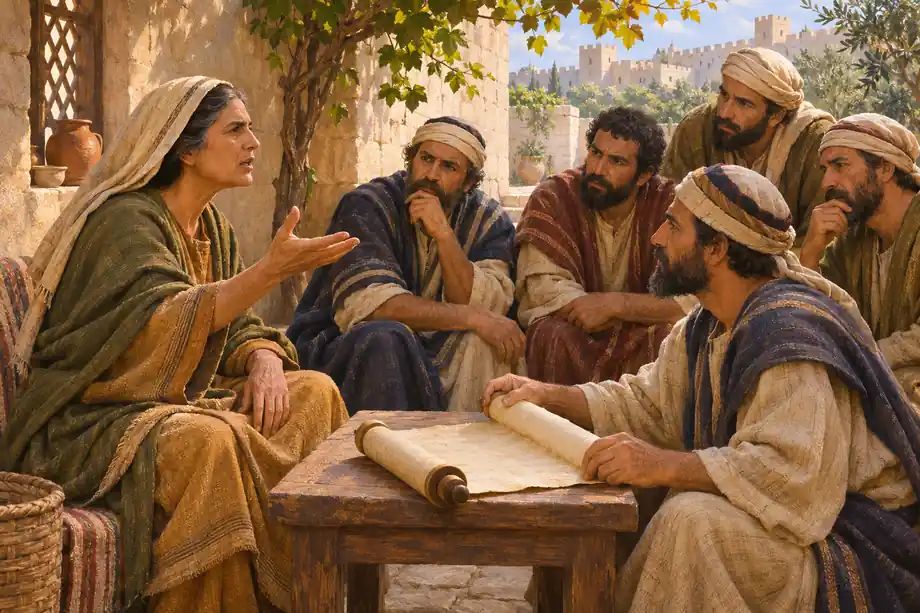
Five delegates consult Huldah, a prophetess living in Jerusalem's Second Quarter. The narrator locates her through a household and an urban neighborhood, but offers no apology for the choice of a female prophet. The royal delegation receives the Lord's answer through Huldah. Other prophets were active during Josiah's reign, but Kings gives this moment to Huldah (cf. Jer 1:2; Zeph 1:1).
Her first message is severe. The Lord will bring disaster on the place and its inhabitants according to the book's warnings. Judah has forsaken the Lord and burned offerings to other gods (22:16–17). The condemnation already announced in 2 Kings 21:10–15 is not withdrawn because the king has commissioned respectable repairs.
Huldah does not convert prophecy into a public-relations service for royal comfort. The prophetic word does not exist to protect a ruler's reputation. It tells rulers truths that power often prefers not to hear.
The words must, however, be understood within the specific covenant narrative of Judah. The text is not a general license to declare that every modern disaster has fallen on victims because of their moral failure. Jesus rejects such simplistic conclusions about those who suffer catastrophe (Luke 13:1–5; cf. John 9:1–3).
A Tender Heart Is Heard, but the Warning Remains (22:18–20)
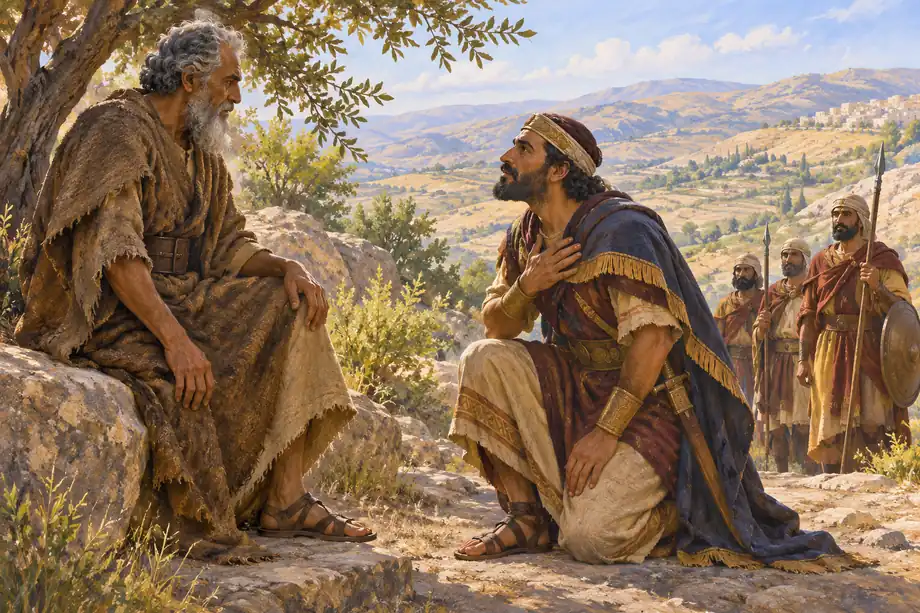
Huldah's second message concerns Josiah personally. When the king heard the warning, Josiah's heart was tender. He humbled himself, tore his robes, and wept. The Lord declares that the king has been heard. Josiah will not witness all the disaster that will come upon Jerusalem in the king's lifetime (22:19–20).
The promise that Josiah will be gathered to his ancestors “in peace” requires careful reading. Second Kings 23:29–30 reports that Josiah dies in connection with an encounter with Pharaoh Neco at Megiddo; 2 Chronicles 35:20–24 tells the episode in greater detail. The promise in 22:20 therefore cannot be flattened into an assurance that Josiah will die painlessly or without armed conflict. In the immediate context, peace is closely linked to not seeing the announced catastrophe that will overwhelm Jerusalem. Even so, the tension between the promise and the circumstances of Josiah's death deserves acknowledgment rather than a forced solution (Provan 1995, §55; Brueggemann 2000, 543–50).
The two dimensions of Huldah's prophecy are vital. Judgment upon Judah remains; the king's humble response matters. God takes covenant wrong seriously, and God also sees the tears of a repentant heart. Yet the humility of one good king does not erase all the consequences of generations of public disobedience.
Josiah will still pursue reform. The announcement of a difficult future will not become an excuse to stop doing what is right.
Theological Reflection — The King's Heart Under the Word
Torah Is Not Temple Decoration; It Measures the Kingdom
The scroll is found inside the temple, but its reading places the king and the nation under examination. Deuteronomy 17:18–20 envisioned a king who would learn God's instruction, refuse arrogance, and avoid turning aside from the law. Josiah allows the written word to question the exercise of royal power. This is the difference between owning a Bible and living beneath its teaching. A repaired sanctuary is good. A repaired conscience is indispensable.
True Hearing Requires Humility and Action
Tearing clothing is not enough by itself. The gesture matters because Josiah moves toward inquiry, confession, and obedience. In the language of Deuteronomy, hearing the Lord includes the responsibility to act upon what has been heard (Deut 6:4–5). Chapter 23 will show the next steps: public reading, covenant renewal, and the removal of corrupt worship. Faithful Bible study must do more than produce informed listeners. It must produce communities whose decisions become answerable to God's word.
Huldah Shows That Truth Is Not a Royal Possession
The men sent from the palace receive the Lord's answer from a woman whose message offers no easy escape. Huldah's authority lies in the word proclaimed, not in proximity to the throne. Healthy leadership welcomes people who can ask difficult questions about finances, religious practice, abuse of power, and care for the vulnerable. The prophet's calling is not to flatter the king but to help the king hear the Lord.
Judgment and Mercy Point beyond Josiah to Jesus
The chapter insists that Judah has broken covenant and that the king's repentance is genuinely heard. The history is not tidily repaired. Instead, readers are led to hope for a king whose obedience will not be temporary, whose faithfulness will reach the depths of human need.
In Jesus Christ, the divine Word does more than confront people through a rediscovered document: the Word comes to dwell among them (John 1:14). Jesus comes to fulfill rather than abolish the law (Matt 5:17–20). Reading Scripture in the synagogue, Jesus announces good news for the poor, freedom for the oppressed, and the Lord's favor (Luke 4:16–21). Jesus calls hearers to put divine instruction into practice (Matt 7:24–27; cf. Jas 1:22).
Josiah mourns the covenant that Judah has violated. Jesus bears the cost of human unfaithfulness at the cross and opens the promise of the new covenant through his life, death, and resurrection (Jer 31:31–34; Luke 22:20; 24:44–47). Josiah provides a remarkable portrait of a listening king. Jesus is the true King who fulfills the covenant and brings forgiveness, obedience, and new creation together.
Life Application — Repairing More Than Buildings
- Read Scripture with an actionable question. Set aside twenty minutes this week for 2 Kings 22 and Deuteronomy 17:18–20. Identify one decision at home, work, or church that needs to change (Jas 1:22).
- Handle ministry money with transparent responsibility. For a building or outreach project, make financial records, assigned duties, spending reports, and independent review clear. The trust noted in 22:7 must not become an excuse to neglect accountability today (2 Cor 8:20–21).
- Listen to an uncomfortable truth before defending yourself. Invite two trustworthy people to name a concern about a leadership decision. Ask what can be corrected, then report one practical step taken (Prov 12:15).
- Compare visible success with treatment of people. Before investing in another attractive improvement, examine whether workers are treated fairly and whether children, sick people, prisoners, and vulnerable neighbors are receiving necessary care (Isa 1:16–17).
- Make room for courageous voices. The royal delegation listens to Huldah. Ensure women, younger members, and people without titles can raise concerns safely and contribute biblical insight (2 Kgs 22:14–20).
- Own institutional wrong without blaming victims. Josiah acknowledges Judah's collective failures. Begin with honest responsibility and repair, not by treating those harmed by tragedy as morally inferior (Luke 13:1–5).
- Keep doing right when results are uncertain. Josiah hears that judgment remains, yet chapter 23 will show serious reform. Pursue one concrete act of justice, reconciliation, or mercy even when quick success is unlikely (Gal 6:9).
Reflection Questions
- Which part of my household, congregation, or ministry looks repaired on the outside while hiding serious problems within?
- What biblical command have I understood for some time but repeatedly postponed obeying?
- Are there people in the community who can speak uncomfortable truths like Huldah, or only advisers who agree with the leader?
- Which past failure requires practical repair even after apologies and prayers have been offered?
- How could hearing God's word this week change the use of money, the treatment of neighbors, or the protection of the vulnerable?
Response Prayer — Let the Word Begin with the Heart
Lord of the covenant and giver of life,
The temple of Jerusalem needed repairs, but the deeper wounds were carried in the habits of the nation. When Josiah heard your word, royal clothing gave way to humility. Teach us to listen with hearts willing to change.
Do not allow Scripture to become decoration for a sanctuary, a collection of respected books, or words repeated without obedience. Reveal where wealth conceals greed, where tradition conceals injustice, and where the reputation of a ministry silences the pain of a neighbor. Grant courage to confess, make restitution, protect the vulnerable, and listen to truth even when truth is uncomfortable.
Give wisdom to those entrusted with money, to Bible teachers, and to family and church leaders. Protect children and all who suffer at the hands of the powerful. As Huldah spoke faithfully and Josiah humbled himself, make our communities places where your word is heard and practiced.
Through Jesus Christ, the obedient King and mediator of the new covenant, we pray. Amen.
Window into the Next Chapter — The Book Will Be Read, the Covenant Renewed
Second Kings 22 closes with two truths that must remain together. Judgment against Jerusalem has not been canceled. Yet Josiah's humility and tears have been heard. The book has been recovered, the king has listened, and a prophetess has refused to dilute the warning. But within this chapter the scroll has not yet been read before the whole nation.
2 Kings 23 — The Covenant Is Read Aloud, the Altars Come Down, but Will the Nation Be Changed? Josiah will summon leaders and people, read the book of the covenant publicly, and launch reforms affecting the temple, the countryside, and longstanding patterns of worship. The Passover will be observed in a remarkable way.
Watch the difference between removing the outward signs of rebellion and allowing the Lord to restore covenant faithfulness within. A king can demolish stone idols. But will Judah allow God's word to expose the hidden altars of ambition and fear? And can even Josiah's faithful reforms stop the disaster already announced?
Bibliography
- Brueggemann, Walter. 2000. 1 & 2 Kings. Smyth & Helwys Bible Commentary. Macon, GA: Smyth & Helwys.
- Leithart, Peter J. 2006. 1 & 2 Kings. Brazos Theological Commentary on the Bible. Grand Rapids: Brazos Press.
- Provan, Iain W. 1995. 1 and 2 Kings. New International Biblical Commentary 7. Peabody, MA: Hendrickson. (Also reissued in the Understanding the Bible Commentary Series.)
- Wright, Christopher J. H. 2004. Old Testament Ethics for the People of God. Downers Grove, IL: InterVarsity Press.
Reading note
Editorial note: The analysis is grounded primarily in 2 Kings 22, with Brueggemann (2000, 543–50), Provan (1995, §55), and Leithart (2006, discussion of 2 Kgs 22–23) informing the literary and theological interpretation. The precise contents and history of the discovered book are not fully specified by 2 Kings 22; Deuteronomy is a well-supported scholarly connection, not a title supplied verbatim in verse 8. The promise of Josiah's being gathered “in peace” is considered alongside the death account in 2 Kings 23 without concealing the textual tension.
Be the first to leave a comment.