

Why do Josiah’s reforms and Passover retain meaning when judgment remains and the faithful king dies?
Study overview
The recovered book does not return to a shelf. The king reads it before the people. Altars honored for generations come crashing down. Ashes are carried beyond the temple walls. The Passover calls a people back to the night of deliverance. But beyond Jerusalem's gates, armies are redrawing the map. Josiah obeys; Judah still carries old wounds. And on the plain of Megiddo, the crown of a faithful king falls into the dust. Can seeds of faithfulness be worth planting today, even when their harvest may be seen by another generation?
- Primary text:
- 2 Kings 23:1–37.
- Guiding question:
- What happens when a nation publicly returns to the Lord, while the accumulated damage of covenant rebellion and the pressure of foreign powers continue to shape its future?
- Central thesis:
- Second Kings 23 tells of a covenant read aloud, distorted worship dismantled, and the Passover restored. Yet it also shows the limits of one king's reform in reversing generations of covenant unfaithfulness. Josiah models obedience to God's word; the tragedy of his death deepens the longing for a greater King.
Introduction — Removing the Weeds, Reaching the Roots
A farmer may clear a field covered with weeds before the planting season. The grass is cut, the thorns are carried away, and the land looks ready for seed. But a change of appearance is not the same as a change beneath the soil. If the roots remain, the first heavy rains will bring the weeds back. The field needs deeper cultivation and patient care.
That is the tension at the heart of 2 Kings 23.
Chapter 22 told of a temple renovation that became an encounter with God's word. Hilkiah found the Book of the Law; Shaphan read it to Josiah; the king tore his robes. Huldah then announced a message with two edges. Judah's long rebellion had consequences that would not simply disappear, yet the Lord had heard the humility of Josiah (2 Kgs 22:11–20).
Chapter 23 begins where hearing must become action. Josiah does not close the book and return to business as usual. The king gathers the people, reads the covenant publicly, removes the instruments of false worship, tears down shrines, reaches as far as Bethel, and orders the Passover to be observed.
For a moment, the field looks newly cleared. Then the narrator introduces a disturbing sentence: God's judgment against Judah has not been withdrawn (23:26–27). Worse still, Josiah dies at Megiddo. The king who sought to bring Judah back to covenant faithfulness is buried, and his successors find their thrones increasingly subject to Egypt.
This is not a story arguing that obedience is pointless. It is a story about the worth of obedience even when one faithful leader cannot immediately undo the injuries of a whole society. The chapter asks whether the removal of visible idols has reached the inward loyalties of the people—and whether the work of renewal can outlast the reformer.
Historical and Literary Context — Torah, Temple, and the Movement of Empires
Kings is not merely a record of who held the throne. It is theological interpretation of Israel's public life. Its governing question is whether rulers and people live faithfully under the covenant, worship the Lord, practice justice, and listen to the prophets (Deut 17:18–20; 1 Kgs 9:6–9). Military power and architectural achievements are never adequate measures of covenant faithfulness.
The trouble has deep roots. Solomon permitted rival worship; Jeroboam institutionalized new northern shrines; successive kings treated the worship of God as an instrument of royal security (1 Kgs 11–12). Samaria eventually fell to Assyria (2 Kgs 17). Hezekiah offered Judah a different direction, but Manasseh reversed many reforms, brought rival worship into the Lord's house, and shed innocent blood (2 Kgs 21:3–16). Josiah inherits not an empty field but a nation shaped by the decisions of earlier generations.
The international stage is changing as well. Assyrian power is weakening, Babylon is rising, and Egypt seeks to influence events to the north. This context helps explain the opportunities for Josiah to act in areas once belonging to the northern kingdom, and the significance of Pharaoh Neco's military movement. Second Kings 23, however, offers only limited information about Josiah's private geopolitical calculations. Plausible reconstructions must not be confused with details that the narrator actually states (Brueggemann 2000, 553–64).
The literary structure tells its own story. The nation hears and enters the covenant (23:1–3). Josiah removes the symbols and institutions of rival worship (23:4–20). The Passover restores the memory of liberation (23:21–23). The narrator evaluates the king and announces that judgment still stands (23:24–27). The chapter closes with a fatal encounter at Megiddo and the political subjection of Josiah's successors (23:28–37). Leithart notes how the covenant ceremony and the Passover frame the main account of reform (Leithart 2006, discussion of 2 Kgs 22–23).
One further distinction is necessary. The chapter contains harsh actions, including killings in the northern shrines. A narrative description of ancient royal enforcement is not a command for contemporary Christians to use violence against religious opponents. Jesus teaches love for enemies and refuses to establish his kingdom through the coercive power of the sword (Luke 6:27–36; John 18:36). The theological question is how worship, power, and justice are related—not how modern believers might imitate ancient punishments.
Walking through the Text — From an Open Scroll to a Captive Throne
The Covenant Is Read to Everyone (23:1–3)
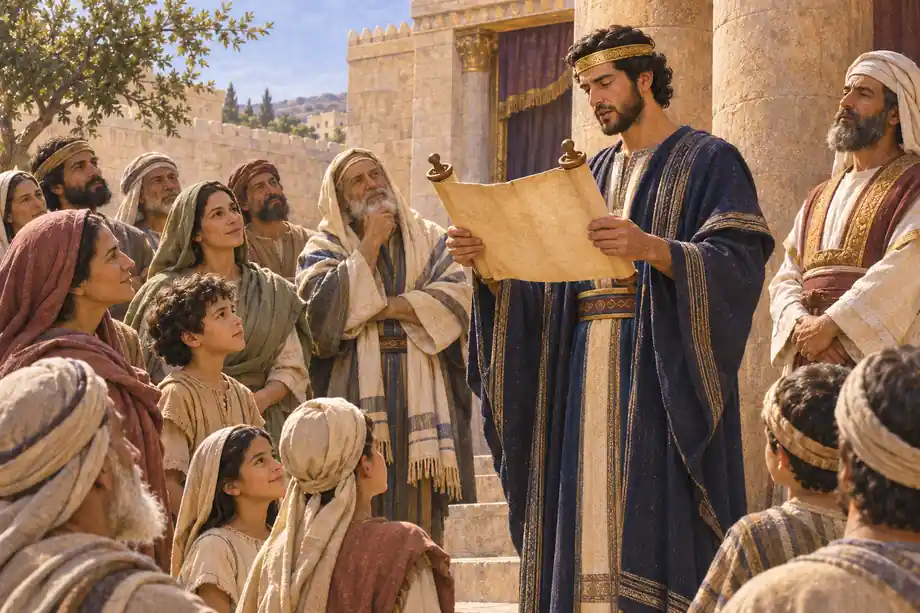
Josiah summons Judah's and Jerusalem's elders. Priests, prophets, and people, both great and small, gather at the Lord's house. The king reads the words of the Book of the Covenant before the assembled community. Standing by the pillar, Josiah commits himself to follow the Lord with heart and soul and to keep the divine commands. The people join in that commitment.
The book that disturbed the royal household in chapter 22 now speaks to the whole nation. Covenant obedience is not a private project for palace officials. The scene recalls Israel gathered at Sinai (Exod 24:3–8), the instruction to read the Torah before the entire community (Deut 31:10–13), and the covenant renewal under Jehoiada in 2 Kings 11:17.
Lasting reform cannot rest upon the religious enthusiasm of one ruler. The community must hear the word that stands over every ruler. Still, a public commitment and a sustained life of obedience are not identical. The remainder of the chapter tests the depth and durability of this remarkable beginning.
The Temple Is Cleared, and Ancient Altars Are Torn Down (23:4–14)
Josiah commands the removal of objects connected with Baal, Asherah, and the heavenly bodies from the temple. Cultic vessels are taken out and burned. Shrines are dismantled. The sacred pole is removed, destroyed, and ground to powder. The account mentions facilities connected with cultic sexual practices (23:7), the horses and chariots dedicated to the sun (23:11), and altars associated with the policies of Solomon, Ahaz, and Manasseh (23:12–13).
These are not merely decorative objects being rearranged. An altar is a declaration about ultimate loyalty. It reveals where a community looks for safety, fertility, victory, and blessing. The temple dedicated to the Lord had become a place where competing loyalties were given a home. Josiah's reforms expose that contradiction.
Topheth in the Valley of Ben-Hinnom receives particular attention. Josiah desecrates the site so that children will no longer be passed through fire in worship associated with Molech (23:10; cf. Lev 18:21; Jer 7:31). The violence inflicted on the vulnerable is not separate from the question of worship. A religious system capable of sacrificing children for power or blessing reveals how profoundly worship can become corrupted.
Yet the narrator's language of desecration and the coercive practices of the ancient monarchy require care. The church must not transform this ancient account into a warrant to assault people of other faiths. Christian obedience involves renouncing idols and protecting those exposed to abuse, while refusing to sanctify violence against religious neighbors (Matt 26:52; 1 Pet 3:15–16).
Bethel Hears an Old Prophecy Again (23:15–20)
Josiah's reforms move into territory formerly associated with Israel's northern kingdom. At Bethel, Jeroboam had established an alternative center of worship after the division of the monarchy (1 Kgs 12:26–33). Now Josiah dismantles the altar and high place, burns the objects associated with the shrine, and defiles the altar with bones taken from nearby tombs.
The account reaches back to one of the earliest prophetic confrontations in the divided kingdom. A man of God from Judah had condemned Jeroboam's altar and announced a future king by the name of Josiah (1 Kgs 13:1–3). The name echoes across generations as the narrative reaches 2 Kings 23. The word of the Lord has outlived the kings, their monuments, and the religious system built to protect their power.
Josiah notices the grave of the prophet who had spoken against the altar. The king orders that the prophet's bones remain undisturbed, along with the bones of the other prophet buried there (2 Kgs 23:17–18; 1 Kgs 13:29–32).
Verses 19–20 then report the removal of northern shrines and the killing of their priests. This is among the chapter's most difficult details. Readers should neither erase the violence nor celebrate it as the ordinary means of religious reform. The narrator describes ancient covenant judgment within a particular royal setting. The way of Jesus calls the church to witness, persuasion, mercy, and truth rather than armed religious enforcement (Luke 9:54–56; John 18:36).
The Passover Restores the Memory of Deliverance (23:21–25)
Having removed the signs of rival worship, Josiah commands the observance of the Passover in accordance with the Book of the Covenant. The narrator calls the celebration exceptional, unlike any Passover observed since the days of the judges through the reigns of the kings (23:22–23). The statement highlights the special character of this festival in relation to covenant obedience. It should not be taken without qualification to mean no Passover celebrations whatsoever occurred during those centuries, especially since 2 Chronicles 30 recounts a Passover under Hezekiah.
Passover brings the community back to its founding deliverance from Egyptian slavery (Exod 12:1–14; Deut 16:1–8). Josiah's program does not consist only of saying no to false gods. The people are also invited to say yes to the God who brought a captive people into freedom. A purified sanctuary without a remembered story of deliverance would remain an empty accomplishment.
Faithful worship requires more than removing what is wrong. Worship must be formed by gratitude for God's rescue and expressed in the life of the rescued community. Israel's calendar becomes a school of memory, teaching each generation that the people exist because of grace, not because of the throne's achievements.
Verses 24–25 add the removal of household idols and practices associated with divination. Then comes the extraordinary royal verdict: no king before or after Josiah turned to the Lord with such wholehearted devotion, according to the Law of Moses (cf. Deut 6:5). Hezekiah had received a comparable but differently focused commendation for trusting the Lord (2 Kgs 18:5). The two evaluations highlight distinct aspects of fidelity rather than establishing an uncomplicated contest between the kings.
For Christians, the Passover opens a canonical path to Jesus, who shared the Passover meal and interpreted his approaching death in relation to the new covenant (Luke 22:14–20; 1 Cor 5:7–8). Josiah's Passover renews the memory of liberation; the ministry, death, and resurrection of Jesus open the way into the covenant life that God's Spirit sustains.
Judah's Judgment Remains, and the Faithful King Dies (23:26–30)
Suddenly the narrative turns dark. The Lord's judgment against Judah is not withdrawn because of the long-standing provocations associated with Manasseh. Even Jerusalem and the temple are now described as subject to impending rejection (23:26–27). This is one of the chapter's painful tensions: Josiah's obedience is genuine, but the accumulated injuries of generations do not disappear at a king's command.
Pharaoh Neco of Egypt then advances toward the Euphrates region. Josiah meets the Egyptian force at Megiddo and is killed. The king's servants bring his body back to Jerusalem for burial (23:28–30). Second Chronicles 35:20–27 offers a fuller and differently developed account of the encounter and the mourning that followed. Second Kings 23 does not explain every motive for Josiah's decision to confront Neco. Historical speculation should remain speculation.
What, then, of Huldah's promise that Josiah would be gathered to his ancestors “in peace” (22:20)? Provan argues that the phrase points to Josiah's death occurring before Jerusalem's coming devastation, not necessarily to a painless death (Provan 1995, §55). Brueggemann emphasizes the unresolved shock of a faithful king dying violently (Brueggemann 2000, 559–61). The chronological reading offers a reasonable way forward, but the pastoral force of the tragedy should not be explained away.
Faithfulness is not a contract guaranteeing immunity from suffering. Josiah stands as a king who responded wholeheartedly to God's word yet whose personal obedience did not rescue an entire political order from its long history of wrong. The narrative is both a testimony to faithful action and a lament for the limits of human kingship.
After Josiah, Egypt Decides Who Wears the Crown (23:31–37)
The people of the land appoint Josiah's son Jehoahaz as king. His reign lasts only three months. Pharaoh Neco imprisons him at Riblah, takes him to Egypt, and demands silver and gold from Judah. The Egyptian ruler chooses another son of Josiah, Eliakim, changes his name to Jehoiakim, and places him on the throne. Jehoiakim raises the required tribute by assessing the people of the land (23:31–35).
The contrast is sharp. Josiah had stood before the people to proclaim the covenant of the Lord. Now a foreign king names Judah's ruler and exacts payment from ordinary households. Imperial domination is not merely a humiliation for a palace; its price is collected from the people.
The chapter closes by reporting Jehoiakim's eleven-year reign and his evil in the eyes of the Lord (23:36–37). Judah's great Passover does not provide the last word of the chapter. Instead, another troubled reign begins, while Babylon's shadow lengthens. The promise to David has not vanished from the larger biblical story, but the institutions that should have embodied covenant loyalty are collapsing.
Theological Reflection — Four Roots beneath the Story
God's covenant demands a hearing from the whole community
Josiah reads the scroll to priests, leaders, and ordinary citizens. Torah cannot belong exclusively to the palace or to a small circle of experts. Its claims reach families, worship, finances, and the treatment of neighbors (Deut 31:10–13). Reading the Bible publicly is therefore not merely a ceremonial act; the community must ask what the words mean for the poor, the vulnerable, and those whose testimony has been ignored.
Removing idols is only a beginning; justice must grow in the cleared soil
The torn-down altars expose how religion, political authority, and everyday habits can become entangled. The Torah rejects rival worship and also forbids the oppression of vulnerable neighbors (Deut 10:18–19; 16:18–20). A community may remove a visible idol while cultivating the invisible idols of status, money, or control. Reformation that does not protect children, honor truth, and uphold financial integrity remains incomplete (Isa 1:11–17; Mic 6:6–8).
Passover joins memory, table, and mission
The Passover reminds Israel that the Lord first rescued a people from slavery (Exod 20:2). Worship begins in received grace, not in the righteousness of a ruler. Jesus gives this memory a new center in the shared bread and cup of the new covenant (Luke 22:14–20). The church's table must never become a place for boasting; it should form a community marked by mercy, repentance, and concern for those in need (1 Cor 11:23–29).
A good king cannot heal every wound of a nation
Josiah's reform is sincere, but judgment remains. The narrator does not teach that obedience is futile; rather, covenant justice takes the history of accumulated harm seriously. A king can demolish an altar, but royal decrees cannot restore all the lives lost to violence or give every heart a new allegiance. The longing of Kings therefore reaches beyond Josiah toward Jesus, the King who bears evil without becoming its servant, rises from death, and gives the Spirit to form a renewed people (Jer 31:31–34; Ezek 36:25–27; Luke 24:44–49).
Life Application — Reform That Takes Root
- Read Scripture in the hearing of the community. Organize four weeks of shared reading in a family, small group, or congregation. End each meeting with one concrete practice to change, not merely a point to remember (2 Kgs 23:2–3).
- Identify the altars competing for loyalty. Examine the use of money, time, and authority. If institutional reputation has become more important than truth, make one correction and invite an accountable colleague to follow up (Matt 6:21, 24).
- Protect children and people at risk. Josiah's action at Topheth confronts violence toward children. Churches and ministries should establish clear safeguarding and reporting procedures, support survivors, and refuse to conceal abuse in order to protect an organization's public image (2 Kgs 23:10; Matt 18:6).
- Correct false teaching without mistreating neighbors. The ancient king's destruction of shrines is not a mandate for intimidation or violence today. Teach, question, and disagree with gentleness and respect (1 Pet 3:15–16).
- Let the memory of deliverance become hospitality. At a church meal or community gathering, make sure widows, visitors, and families facing hunger find a place at the table (Deut 16:11–12).
- Recognize that repentance does not instantly undo harm. When a family or institution acknowledges wrongdoing, follow confession with safeguards, restitution where possible, and sustained support for affected people (Luke 19:8–9).
- Ask what the next generation will inherit. Before approving a costly project or policy, ask who benefits, who pays, and who will bear the consequences after present leaders have left office (2 Kgs 23:31–35; Prov 13:22).
Reflection Questions
- Which teachings of Scripture are read aloud in our community but rarely allowed to shape real decisions?
- What modern altar—power, reputation, wealth, or fear—might survive beneath a successful outward reform?
- Which vulnerable person needs a concrete change in safeguarding or justice rather than another reassuring speech?
- How does Josiah's death challenge the assumption that faithful obedience always leads to quick success and an easy life?
- Which costly act of faithfulness is needed today, even if the full harvest belongs to a later generation?
Response Prayer — Plant Faithfulness Deeply
Lord, God of the covenant,
When Josiah read your word before the people, the nation heard the summons to return. When the old altars fell, compromises long accepted were brought into the light. When the Passover was celebrated, the story of freedom returned to the table. Teach our communities not only to hear but to obey.
Expose hidden altars of fear, money, power, and pride. Guard children, families, and those carrying wounds inflicted by leaders. Give churches courage to confess wrongdoing, reform harmful practices, and establish trustworthy protection for those at risk. May the remembrance of your deliverance lead to generosity rather than self-congratulation.
As we remember Josiah's death, protect us from measuring your love by the absence of pain. Grant courage for faithful work when results are slow, incomplete, or unseen. Root our hope in Jesus Christ, the King whose victory comes through self-giving love and resurrection.
May your word take root and bear fruit in our common life. Amen.
Window into the Next Chapter — From Megiddo toward Exile
Second Kings 23 opened the doors of the temple so that the word of the Lord could be heard by all. Yet the chapter ends beneath the shadow of a throne controlled by Egypt. Jehoahaz has been carried away. Jehoiakim has received his crown at a foreign king's pleasure. The people are paying tribute. Josiah's reforms were real, but the accumulated damage of covenant unfaithfulness and the pressures of expanding empires have not disappeared.
2 Kings 24 — The Debt of Rebellion, Babylon's Hand, and a King Carried into Exile. Babylon will now move to the center of the story. Jehoiakim's political allegiance will become rebellion, invading forces will press upon Judah, and Jerusalem will begin to lose both treasures and people.
Watch the difference between protecting a throne at any cost and listening to God's word about the life of a nation. What happens when leaders cling to power while ordinary families carry the burden of earlier decisions? And where will the promise to David be found when a king is carried away from the land?
Bibliography
- Brueggemann, Walter. 2000. 1 & 2 Kings. Smyth & Helwys Bible Commentary. Macon, GA: Smyth & Helwys.
- Leithart, Peter J. 2006. 1 & 2 Kings. Brazos Theological Commentary on the Bible. Grand Rapids: Brazos Press.
- Provan, Iain W. 1995. 1 and 2 Kings. New International Biblical Commentary 7. Peabody, MA: Hendrickson. (Also reissued in the Understanding the Bible Commentary Series.)
- Wright, Christopher J. H. 2004. Old Testament Ethics for the People of God. Downers Grove, IL: InterVarsity Press.
Reading note
Editorial note: This article is grounded in 2 Kings 23:1–37, informed chiefly by Brueggemann (2000, 553–69), Provan (1995, §55 and the concluding discussion of Josiah), and Leithart (2006, discussion of 2 Kgs 22–23). Proposed motives for Josiah's foreign policy are distinguished from what the text directly states. Huldah's promise in 22:20 is read alongside Josiah's death in 23:29–30 and the parallel in 2 Chronicles 35, without dismissing the narrative's unresolved pastoral tension.
Be the first to leave a comment.