

Why does Kings recall innocent blood while Babylon begins carrying away Judah’s treasures and people?
Study overview
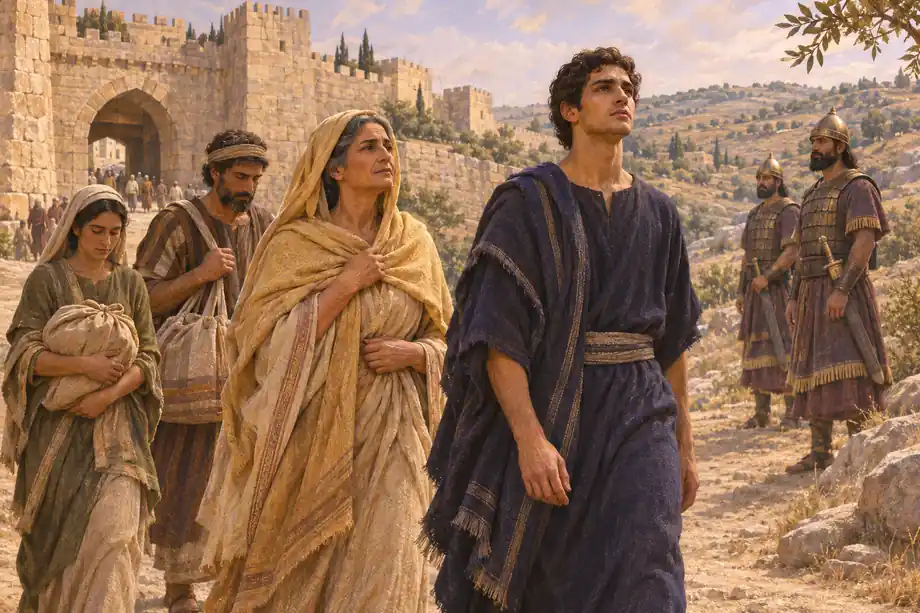
Megiddo lies behind the story. Josiah's crown has gone to the grave. Inside Jerusalem's palace, kings calculate tribute and allegiance. Beyond Jerusalem's borders, Babylon redraws the map. Soldiers arrive. The city gates close. The temple's treasures travel east. Craftsmen leave their workshops. Families begin journeys nobody chose. A throne remains in Jerusalem, but its freedom is slipping away. Where will a nation place its hope when its king belongs to another king?
- Primary text:
- 2 Kings 24:1–20.
- Leading question:
- What happens when rulers defend a throne without listening to God's word, while ordinary people bear the costs in property, security, and forced displacement?
- Central thesis:
- Second Kings 24 tells of a kingdom losing its freedom, a temple losing its treasures, and a people being carried into exile. Yet beneath Babylon's visible triumph, the narrator insists that God's justice cannot be purchased through tribute, and God's promise cannot simply be erased by imperial power.
Introduction — When the Palace's Decisions Reach the Family's Door
Some decisions are made around long tables in guarded rooms, but their consequences arrive at small tables in ordinary homes. A government signs an agreement. Families discover that taxes have increased. A king declares rebellion. Parents begin to wonder whether there will be food tomorrow, whether a child will be safe, or whether the family will have to leave home.
Second Kings 24 begins in precisely that uneasy space between royal calculation and public suffering. The previous chapter described Josiah reading the covenant, dismantling rival shrines, and restoring the Passover. Yet the reforms did not instantly heal the wounds left by earlier kings, nor did they prevent the great empires from contesting Judah's future. After Josiah's death at Megiddo, Pharaoh Neco of Egypt removed Jehoahaz and installed Jehoiakim upon Judah's throne (2 Kgs 23:29–37).
Now another empire takes the stage. Nebuchadnezzar of Babylon subdues Judah. Jehoiakim serves Babylon for three years and then rebels. Raiding forces attack. Jehoiakim dies, and Jehoiachin inherits a throne that he will hold for only three months. The young king, the queen mother, officials, soldiers, and skilled workers are carried away. Treasures leave the temple and palace. Zedekiah is placed on the throne, but the authority that selects Judah's king now resides far beyond Jerusalem.
The chapter offers no stirring defense of Jerusalem, no miraculous retreat of a foreign army, and no triumphant royal prayer comparable to Hezekiah's in chapter 19. Instead, there is an accounting of what is lost—and of who loses it.
The question is larger than why one king failed. What remains of a nation's vocation when rulers prize survival in office more than justice, covenant faithfulness, and the lives entrusted to their care?
Historical and Literary Context — From Josiah's Reform to the Road into Exile
Kings is not merely a succession of rulers. It is a prophetic interpretation of public history, evaluating the throne by the Torah rather than by military victories or royal construction projects. Israel's king was meant to live under God's instruction, not above it (Deut 17:14–20). Loyalty to the covenant required worship of the Lord, attention to the prophetic word, and justice for neighbors who could not defend themselves (Deut 6:4–5; Jer 7:5–7).
The long road toward disaster began generations earlier. Solomon allowed rival worship to flourish (1 Kgs 11). Jeroboam used alternative shrines to secure the northern kingdom (1 Kgs 12). Samaria eventually fell to Assyria, and the narrator interpreted that collapse as the outcome of sustained covenant rebellion (2 Kgs 17). Judah received the warning, yet under Manasseh idolatry, the violation of the temple, and the shedding of innocent blood became especially severe (2 Kgs 21:1–16). Josiah listened to the recovered book of the covenant and pursued reform, but Huldah's oracle made clear that judgment upon Judah had not simply been cancelled (2 Kgs 22:15–20; 23:26–27).
The political world was shifting too. Egyptian power reached northward as Assyria weakened. Babylon defeated Egypt at Carchemish in 605 BCE and became the dominant power in the region. Jerusalem's surrender and Jehoiachin's deportation, described in 2 Kings 24:10–16, are commonly dated to 597 BCE. The burning of the temple and the destruction of Jerusalem's walls belong to 2 Kings 25, not this chapter. The distinction matters: exile begins to tear apart the kingdom before its final physical destruction.
The narrator does two things at once. Babylon's expansion reflects recognizable imperial policy, including tribute, political control, and deportation. But Kings also interprets Judah's suffering through covenant warnings and prophetic testimony (2 Kgs 24:2–4; Brueggemann 2000, 569–77). Theological interpretation does not make Babylonian cruelty morally good. Nor does it mean that every exiled child, artisan, or widow was individually guilty of the king's actions. A nation's wrongdoing can produce consequences borne by those least able to influence public decisions (Jer 22:13–17; Ezek 18:1–4).
The literary movement is unmistakable: Jehoiakim submits and rebels (24:1–7); Jehoiachin surrenders and is deported (24:8–16); Zedekiah receives a throne from Babylon and also rebels (24:17–20). The royal names continue, but the freedom attached to the royal office steadily disappears (Provan 1995, §56).
Walking through the Text — When a Throne Moves Away from Home
A King's Calculated Rebellion (24:1–2)
Nebuchadnezzar, king of Babylon, comes against Judah. Jehoiakim becomes Babylon's servant for three years, then turns and rebels. The text does not reveal all the reasoning behind the decision. Historians may reasonably discuss tribute payments, Egyptian encouragement, or an assessment of Babylon's strength. Second Kings 24:1, however, does not identify a single definite motive, and a responsible interpretation should not present a reconstruction as though the verse stated it.
Raiding bands follow: Chaldeans, Arameans, Moabites, and Ammonites attack Judah. Former neighbors become participants in the kingdom's distress. The narrator frames their arrival through the word of the Lord spoken by the prophets. From the palace's point of view, the crisis may appear to be a failed foreign policy. From the narrator's perspective, a much longer history of disregarded warnings has finally come due.
The distinction matters. Not every courageous-sounding declaration is wise, and not every act of resistance is automatically faithful. A ruler can speak about national honor while leaving families to pay for political misjudgment. Covenant courage is not identical with military bravado. The chapter does not teach a simplistic rule that opposition to empire is always wrong; it asks whether public action is grounded in truth, justice, and careful attention to the people whose lives will bear the cost.
Innocent Blood Still Bears Witness (24:3–4)
The narrative interrupts the story of armies to recall Manasseh. The problem did not begin with a single unsuccessful diplomatic gamble. Manasseh corrupted worship, encouraged covenant disloyalty, and filled Jerusalem with innocent blood (2 Kgs 21:16; 24:4). This is among the chapter's most searching claims.
The prophets often connected bloodshed with the oppression of ordinary people, the manipulation of courts, and the abuse of power (Mic 3:9–11; Jer 7:5–6; 22:13–17). In the moral imagination of Kings, the cry of the vulnerable belongs in the same account as the advance of imperial armies. The actions of kings at home cannot be sealed off from the public disasters that later arrive from abroad.
Verse 4 declares that the Lord would no longer pardon the accumulated wrong in a way that prevented national judgment. That terrifying sentence should not be carelessly converted into the claim that no individual in exile could repent, receive mercy, or hope again. The point concerns the judgment now falling upon the kingdom after a history of resistance to God's word. Later prophetic promises will still invite the exiles to seek the Lord and anticipate renewal (Jer 29:10–14; Ezek 36:25–27).
The blood of Naboth and other innocent victims has not disappeared from God's accounting. A royal administration may rename cities, rewrite its slogans, and announce a fresh beginning, but the tears of those harmed cannot simply be declared irrelevant.
Egypt Retreats; Jehoiakim Leaves the Stage (24:5–7)
Jehoiakim's reign closes with the familiar royal formula: further acts are attributed to the chronicles of Judah's kings, and his son succeeds him. These verses do not give a detailed account of how Jehoiakim died. An interpreter need not invent a dramatic death scene to explain the chapter's force.
Verse 7 provides the larger geopolitical picture. Egypt no longer ventures out to recover territory that Babylon has taken, stretching from the Brook of Egypt toward the Euphrates. The geographical description invites a bitter comparison with Solomon's expansive dominion (1 Kgs 4:21; 10:23–25). In the earlier story, nations came to Solomon's court to encounter wisdom and wealth. Now Judah's rulers answer to a foreign court, and Judah's treasures are about to travel in the opposite direction (Provan 1995, §56).
A king's life ends; the consequences of a reign do not. Jehoiakim disappears from the narrative, but his rebellion and Judah's dependency remain for Jehoiachin and the citizens of Jerusalem. Decisions defended as necessities for one generation can become a burden that another generation must carry.
Three Months on the Throne, Then Captivity (24:8–12)
Jehoiachin comes to the throne at eighteen and reigns in Jerusalem for three months. His mother, Nehushta daughter of Elnathan, is named. Like his father, Jehoiachin receives the narrator's verdict that he did evil in the Lord's sight.
Babylonian troops surround Jerusalem. Nebuchadnezzar arrives while the siege is underway. Jehoiachin surrenders along with the queen mother, servants, officials, and palace personnel. The king of Babylon takes Jehoiachin captive in his eighth regnal year (24:12). This surrender is ordinarily associated with the capture of Jerusalem in 597 BCE.
There is no royal victory speech and no effortless happy ending. Yet the surrender should not become an excuse to despise those trying to keep others alive in a collapsing city. The narrative does not identify every captive as a coward or make every person who accepted deportation guilty of unbelief. The tragic scene resists simple divisions between heroic rulers and failed citizens.
For Jehoiachin, the palace gives way to a foreign land. But Kings does not finally close the account of the young king here. Near the end of the book, Jehoiachin will appear again in Babylon, granted a place at the royal table (2 Kgs 25:27–30). The Davidic promise has entered exile; the storyteller has not extinguished every sign of hope.
Temple Treasures and Human Treasures Are Taken (24:13–16)
Babylon removes treasures from the Lord's house and from the palace. Gold vessels associated with Solomon are cut up or carried away, fulfilling the direction of earlier warnings about Judah's future (2 Kgs 20:16–18; Isa 39:5–7). The temple—the place where Israel learned to pray toward the divine presence—can no longer be treated as an automatic guarantee of political security.
But the heavier loss is not merely the gold. The account names the king, royal household, officials, warriors, craftsmen, and metalworkers among the deportees. It gives a figure of ten thousand in the general account and also mentions seven thousand fighting men and one thousand skilled workers (24:14–16). Those descriptions should not automatically be added as though they were independent totals; the groupings can overlap. The text says that the poorest people remained in the land. The land was not emptied completely, and the people who remained did not become unimportant in God's eyes.
Deportation is a strategy of empire. Removing political leaders makes rebellion harder. Removing artisans and specialists weakens the captive state while increasing the resources of the conqueror. Behind that strategy stand human lives. Hands once shaping tools, doors, and household vessels now work under foreign control. Children leave familiar streets. Families carry memories that cannot be packed into a cart.
Among those associated with this deportation was Ezekiel, as the opening of the prophetic book indicates (Ezek 1:1–3). Ezekiel is not named in the deportation list in 2 Kings 24; the connection comes from the separate biblical witness. The people taken east were not merely pieces in an imperial policy. They carried skills, memory, and the continuing possibility of faithful community far from home.
The contrast is stark: Solomon had gathered precious materials and skilled workers to build a house for God's name. Babylon now gathers treasures and workers to enrich a different kingdom. The greatest damage is not only a diminished building but the tearing apart of a people.
A New Name on the Throne, Less Freedom in the Kingdom (24:17–20)
Nebuchadnezzar installs Mattaniah, Jehoiachin's uncle, in place of the exiled king and renames him Zedekiah. The change of name marks the political reality: Babylon has become the authority assigning Judah's throne. Zedekiah rules for eleven years, but Kings judges his conduct negatively, just as it judged Jehoiakim's.
The narrator names Zedekiah's mother, Hamutal daughter of Jeremiah of Libnah (24:18). The Jeremiah named as the king's maternal grandfather is not identified by the passage as Jeremiah the prophet. A shared name does not establish that two historical figures were the same person.
Verse 20 brings the chapter to its tense final line: Judah and Jerusalem stand under judgment, and Zedekiah rebels against Babylon. The pattern repeats. A king appointed within an imperial system reaches for an independence that the chapter does not depict as the fruit of covenant wisdom. Once again rebellion prepares the way for a devastating response.
Chapter 24 ends with a king still on the throne—but with Jerusalem standing at the edge of ruin. The city and temple have not yet been burned. That next, terrible scene belongs to chapter 25.
Theological Reflection — Covenant, Exile, and a Promise under Pressure
Torah Judges Kings; Innocent Blood Cannot Be Bought Off
Second Kings 24:3–4 joins distorted worship to the shedding of innocent blood. The Lord of the covenant did not ask for an impressive sanctuary standing beside a society of unprotected people. Jeremiah condemned Jehoiakim for building royal luxury through unpaid labor and contrasted the king with Josiah, who defended the cause of the poor and needy (Jer 22:13–17). Thus justice is not an optional addition to theology: care for vulnerable neighbors is part of what knowing the Lord means. Any appeal for spiritual renewal that ignores wages, abuse, corruption, and the silencing of victims has misunderstood the prophets.
Babylon May Hold the Crown without Becoming the Measure of Justice
The narrator speaks of God's judicial action through the political events of the period (24:2). This does not sanctify everything that Babylonian armies do. Jeremiah will also announce judgment against Babylon itself (Jer 25:12–14). God's sovereignty over history is not the same as approval of every decision made by a powerful nation. Nor does this ancient covenant judgment provide a formula for blaming today's refugees, disaster survivors, or victims of warfare for their suffering. Public sin and individual culpability must not be collapsed into a single judgment.
A Plundered Temple Cannot Confine the Living God
When Solomon's vessels leave Jerusalem, the promise of divine presence seems to pass under the hands of invaders. Yet Solomon's prayer had already contemplated a people praying from foreign lands and asking God in heaven to forgive and hear (1 Kgs 8:46–50). The temple could never be used as a protective charm for an unfaithful government (Jer 7:1–11). Even in Babylon, the people would be able to pray, repent, and listen for God's word (Ezek 1:1–3; Jer 29:4–14). Institutional survival and the faithfulness of God are not identical realities.
David's House Enters Exile; Hope Finds a Deeper Horizon
Jehoiachin leaves Judah, but the narrative has not erased the name of David. Kings does not end with the throne restored to its former glory. It ends more quietly: the captive Davidic king finds a place at a table in Babylon (2 Kgs 25:27–30). Matthew's Gospel explicitly places the Babylonian exile within its account of Jesus' ancestry (Matt 1:11–12, 17). Christian hope therefore does not leap over Israel's suffering. It passes through the wounds of exile toward Jesus, David's descendant, whose kingdom is revealed in self-giving service, death, and resurrection rather than deportation and imperial violence (Luke 1:32–33; 22:25–27; John 2:19–22).
Life Application — Faithfulness with a Real Cost
- Measure decisions by the cost to ordinary people. Before a church, business, or family approves an expensive commitment, write down who will pay, whose livelihood may be affected, and who has not yet been heard. Invite affected people into the discussion before announcing the decision (Prov 31:8–9).
- Refuse prosperity built upon injustice. Review compensation, financial decisions, safeguarding procedures, and complaint handling. Correct unfair payments and harmful practices, even when doing so reduces an institution's short-term profits or prestige (Jer 22:13).
- Welcome truthful counsel before a crisis. Establish a safe way for colleagues, young people, and community members to challenge plans with evidence and Scripture. Do not punish principled disagreement merely because a leader dislikes hearing it (Prov 15:22; Jer 26:12–15).
- Do not turn victims into defendants. Assist displaced families, refugees, and people who have lost work without claiming to know the personal moral cause of their suffering. Begin with protection and practical care (Luke 13:1–5).
- Preserve memory for the next generation. Record family histories, testimonies of those affected by injustice, and the lessons of institutional failures. Shared memory can help a community refuse the repetition of harmful habits (Ps 78:5–8).
- Care for those who leave and those who remain. Keep contact with families who move for safety or employment. Help newcomers find welcome and maintain relationships with communities left behind (Jer 29:4–7).
- Treat leadership as stewardship, not possession. Let authority be visible in honest accounts, protection of the weak, and willingness to repent. A crown can be removed and a treasury emptied; faithful service still bears witness to the character of God's kingdom (Luke 22:25–27).
Reflection Questions
- Which decision made by a powerful person or institution is now being paid for by people who had little voice in the decision?
- Why does the narrator return to the shedding of innocent blood instead of explaining Judah's downfall only through military mistakes?
- What do the plundering of the temple and the deportation of skilled workers reveal about the sources of security that we are tempted to trust?
- How can the exile narrative teach us to distinguish the judgment of a nation from the individual moral responsibility of the people suffering within it?
- If a present position, building, or source of income were suddenly lost, which concrete acts of justice, love, and faithfulness would remain as our witness?
Response Prayer — Keep Us from Selling Another Generation's Tomorrow
Lord, God of the covenant,
We hear the approaching steps of Babylon's armies at Jerusalem's gates. We see treasures taken, artisans leaving workshops, and families separated from homes built through years of labor. The chapter reveals how the decisions of rulers can wound people far from the palace. Teach our communities to hear your word before the cries of the injured fill the streets.
Guard leaders against pride, fear, and bargains that sell the future of others. Make us people of honest work, just wages, compassion for displaced families, and protection for those whose voices are ignored. Keep our churches from using the language of worship to hide oppression. When security seems fragile, teach us to trust your character rather than the glitter of wealth or the promise of force.
In the darkness of exile, we hold to the promise fulfilled in Jesus Christ, the Son of David. Give room for repentance, healing for wounded communities, and courage to serve a kingdom marked by truth, justice, and peace. Amen.
Window into the Next Chapter — The Walls Will Fall, but Will the Promise Die?
2 Kings 25 — Fire over the Temple, People on the Road to Exile, and a Small Lamp of Hope.
Chapter 24 closes with Zedekiah upon a throne assigned by Nebuchadnezzar. Jehoiachin is already in Babylon. Jerusalem has lost royal leaders, skilled workers, and much of its treasure. The city still has a king, but the king does not possess the old freedom of the Davidic throne.
Chapter 25 will show what follows Zedekiah's rebellion: siege, hunger, a broken wall, the burning of the temple, and a more devastating deportation. Yet the book does not end only with ashes. In its final scene, the king once taken captive receives a place at a table in Babylon.
Watch the difference between the collapse of a political structure and the extinction of God's promise. When the sanctuary burns, has the Lord ceased to reign? And when the door of a captive king's prison opens, what small flame of hope remains for God's people?
Bibliography
- Brueggemann, Walter. 2000. 1 & 2 Kings. Smyth & Helwys Bible Commentary. Macon, GA: Smyth & Helwys.
- Leithart, Peter J. 2006. 1 & 2 Kings. Brazos Theological Commentary on the Bible. Grand Rapids: Brazos Press.
- Provan, Iain W. 1995. 1 and 2 Kings. New International Biblical Commentary 7. Peabody, MA: Hendrickson. (Also reissued in the Understanding the Bible Commentary Series.)
- Wright, Christopher J. H. 2004. Old Testament Ethics for the People of God. Downers Grove, IL: InterVarsity Press.
Reading note
Editorial note: This article is based on 2 Kings 24:1–20, informed chiefly by Brueggemann (2000, 569–79), Provan (1995, §56), and Leithart (2006, discussion of 2 Kgs 23:31–25:30). References to Jeremiah, Isaiah, and Ezekiel are distinguished from details directly reported in chapter 24. The burning of the temple is reserved for 2 Kings 25.
Be the first to leave a comment.