

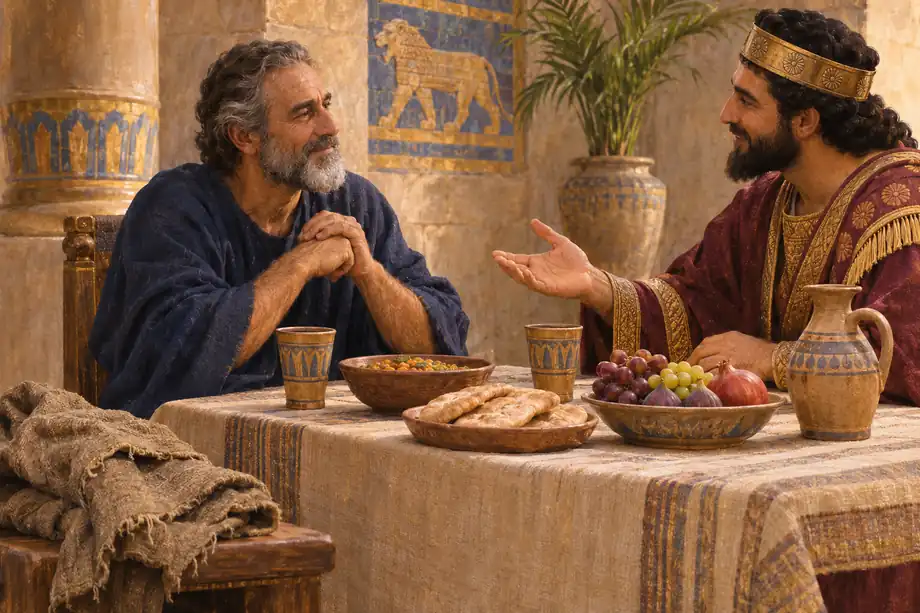
Why does Kings end with Jehoiachin at a Babylonian table rather than with Jerusalem’s temple rebuilt?
Study overview
Smoke climbs above Jerusalem. Hands that planted vineyards are bound. Temple pillars are broken like dead trees. A king is led away, unable to see the road. And the people ask: Has God departed with the smoke? Has the promise to David been buried in the ashes?
Yet at the end of the book, after many years behind prison doors, one door opens. A prisoner's clothes are taken away. And a place is made at a table.
It is not Jerusalem restored. It is not the temple rebuilt. It is a small light refusing to go out.
- Key passage:
- 2 Kings 25:1–30.
- Guiding question:
- What remains when the holy city falls, the temple burns, and David's throne is carried into exile?
- Central thesis:
- Second Kings 25 tells of a royal order collapsing under the accumulated weight of covenant unfaithfulness, yet God preserves a small sign of hope: Babylon's victory has not erased the promise to David, even though the fulfillment of that promise remains beyond the book's horizon.
Introduction — When Everything That Looked Permanent Falls
There are days when someone stands outside the remains of a burned house and discovers that locks, gates, and strong walls could not protect the life once held inside. Family photographs, schoolbooks, cooking pots, and cherished memories are scattered among the ashes. The first question is not what furniture to buy. The first question is: Where do we begin?
That is the question 2 Kings 25 places before the reader. The great narrative began with David growing old, Solomon receiving the kingdom, and a temple rising in Jerusalem. It now approaches its end with walls broken, the temple burned, and whole communities removed from their homes. A kingdom that appeared secure has come to a bitter end. The promise once spoken over David's household—that God would establish David's offspring within the divine purposes for Israel (2 Sam 7:12–16)—meets a question every displaced family can understand: Can a promise survive the destruction of the structure that seemed to carry it?
The narrator refuses an easy answer. First come the siege, hunger, the violence visited on Zedekiah's family, the dismantling of Solomon's temple, the killing of officials, and the flight to Egypt. None of these losses can be covered with a quick sentence about everything working out. The dead are not raised in these verses. The children driven from their homes are not brought back within this chapter.
Yet the narrative ends at an unexpected place: the king of Babylon's table. Jehoiachin, long imprisoned, receives a change of clothes, a place of honor, and daily provision. The scene does not restore Judah, but it prevents Babylon's destruction from becoming the book's final word. This chapter is about the end of a royal system that had become a false security—and about a hope that need not die with that system.
Historical and Literary Context — From God's House to a Foreign Land
Kings is not simply a royal register. It is prophetic history, weighing the conduct of rulers against the covenant: allegiance to the LORD, attention to God's word, protection of the vulnerable, and a kingship subject to rather than above Torah (Deut 6:4–5; 17:14–20). Solomon built the temple, but the LORD warned that even the chosen house would not protect a people who turned to other gods (1 Kgs 9:6–9). In Solomon's dedication prayer, exile already lay on the horizon, together with the possibility of repentance and forgiveness (1 Kgs 8:46–53).
The unraveling had a long history. The kingdom divided (1 Kgs 12). Samaria fell to Assyria (2 Kgs 17). Judah endured idolatry and the shedding of innocent blood, especially under Manasseh (2 Kgs 21:1–16). Josiah listened to the rediscovered book of the covenant and undertook sweeping reforms. But Huldah's warning that national judgment remained ahead had not been withdrawn (2 Kgs 22:15–20; 23:26–27). In chapter 24, Jehoiachin was deported in 597 BCE, Nebuchadnezzar installed Zedekiah, and Zedekiah eventually rebelled.
Chapter 25 narrates the final destruction of Jerusalem, commonly dated to 587/586 BCE. The difference of a year reflects complexities in ancient regnal and calendar reckoning. Kings dates Nebuzaradan’s arrival to the seventh day of the fifth month (25:8), while Jeremiah 52:12 gives the tenth day. Those are differences between the biblical accounts, and their precision should be respected rather than concealed by an invented explanation (Brueggemann 2000, 591–92; Provan 1995, §56).
The chapter moves through a carefully shaped descent: the king loses freedom (25:1–7); the city and temple lose their form (25:8–17); officials and people lose their place (25:18–21); the surviving community loses its fragile new government (25:22–26); then a captive member of David's line is granted a place at the table (25:27–30). The epilogue does not undo the calamity. It does, however, keep readers from mistaking Babylon's present supremacy for the ultimate meaning of history (Leithart 2006, commentary on 2 Kgs 23:31–25:30).
Walking Through the Text — From Broken Walls to an Open Table
When Hunger Enters Before the Enemy (25:1–7)
Nebuchadnezzar comes against Jerusalem in the ninth year of Zedekiah, on the tenth day of the tenth month. The siege stretches into the king's eleventh year. Walls may still be standing, but the most devastating enemy is already inside: the city's food supply has failed (25:3).
The scene recalls Deuteronomy's covenant warnings about siege and famine (Deut 28:52–57). A military map cannot convey what a parent feels when there is nothing left to place in a child's bowl. Lamentations 4:4–10 supplies a heartrending companion witness to the suffering of households, though those details come from another biblical text, not from 2 Kings 25 alone.
The wall is breached. Judah's soldiers flee by night through the route near the king's garden, but Zedekiah is pursued and captured in the plains of Jericho. The region associated with Israel's earliest victory in the land now becomes the setting of its last king's defeat (Josh 6; Provan 1995, §56). At Riblah, Zedekiah watches his sons being killed. The Babylonians then blind him, bind him in chains, and lead him away to Babylon (25:6–7).
The covenant framework must never become an endorsement of imperial cruelty. Kings interprets the disaster as judgment, but the killing of children and the torture of prisoners do not thereby become morally good. Judah's failure is real; Babylon's brutality is also real. Isaiah will later condemn Babylon for showing no mercy to those placed in its power (Isa 47:6). For contemporary readers who carry memories of warfare or forced displacement, this scene is not permission to blame every victim. It is a summons to mourn and to defend human dignity.
When the House Bearing God's Name Becomes Ashes (25:8–12)
In Nebuchadnezzar's nineteenth year, Nebuzaradan, the Babylonian commander, enters Jerusalem. He burns the house of the LORD, the king's palace, and the substantial houses of the city. The walls come down. More residents are taken away, while some of the poorest are left as agricultural workers, tending vineyards and fields (25:8–12).
This is the terrible reversal of 1 Kings 8. The people once gathered in joy at the temple's dedication. Now Solomon's great building is reduced to ashes. Yet the fire does not prove that Israel's God has been defeated by Babylon's gods. The warning was already there: the presence of a sacred building could never substitute for covenant allegiance and justice toward the neighbor (1 Kgs 9:6–9; Jer 7:1–11).
There is a difference between a house graciously given as a place of meeting with God and the assumption that God can be confined to that house. Solomon himself confessed that even heaven cannot contain the LORD (1 Kgs 8:27). The temple was a gift, not God's prison; a place of prayer, not an insurance policy against accountability. Its destruction exposes the false security of a system that relied upon sacred symbols while resisting the sacred word.
Not everyone was deported. Poor farmers and vineyard workers remained. The land was not literally empty, and ordinary labor continued amid the ruins. Their survival should not be romanticized, however. Remaining after an invasion can be another form of precarious life (Brueggemann 2000, 591–94).
When the Pillars Are Cut Apart, Memory Becomes Heavy (25:13–17)
The Babylonians break apart the great bronze pillars, the movable stands, and the bronze Sea. They gather bronze, gold, and silver utensils and carry away the materials of temple worship. The writer even preserves the dimensions and decorations of the pillars. Why describe measurements at the moment of destruction?
The details send the reader backward to the making of Solomon's temple (1 Kgs 7:15–45). What artisans had once fashioned with skill and reverence is now dismantled as the property of a conquering empire. Pillars that framed worship are reduced to transportable metal. The building account cataloged what was made; the destruction account catalogs what was taken away. The inventory itself becomes a lament.
The temple's imagery had evoked a garden, creation, and God's presence among human beings. The devastation invites a broader canonical comparison with Eden: humanity was given a place to live with God, but rebellion resulted in expulsion from a place of blessing (Gen 3:22–24). This is a theological and literary comparison, not a claim that 2 Kings 25 explicitly mentions Eden.
The question travels easily into the life of the church. What happens when money is spent on beautiful structures while people just outside their doors are exploited, ignored, or unprotected? A congregation's beauty is never a substitute for the truth and justice of its life.
People Are Removed Alongside the Temple Vessels (25:18–21)
Nebuzaradan takes Seraiah the chief priest, Zephaniah the second priest, three keepers of the threshold, a military official, members of the king's circle, an army secretary, and sixty people from the land. They are brought to Riblah, where the king of Babylon orders their deaths. The section closes with an unforgettable sentence: Judah went into exile, away from its land (25:21).
The list marks the collapse of the institutions that had organized the nation: temple leadership, government, military command, and civil life. The narrator does not invite applause for the executions. Imperial violence can sweep away both those who supported royal resistance and those who opposed it, making little distinction among the people crushed by war (Brueggemann 2000, 595–96).
Exile is more than a move across borders. It is the loss of ancestral graves, homes, fields, familiar streets, established forms of worship, and the ability to shape one's own future. Even here, however, God's presence was never confined to Judah's territory. The book of Ezekiel would locate divine revelation among the exiles themselves (Ezek 1:1–3; 11:16). That is a later scriptural opening of hope, not a reason to rush past the grief of verse 21.
After the City Falls, the Survivors Flee Again (25:22–26)
Nebuchadnezzar appoints Gedaliah, son of Ahikam and grandson of Shaphan, over the people left in Judah. Military commanders gather to Gedaliah, who urges the survivors not to fear serving the Babylonians. Staying and working the land offers a possible way forward (25:23–24). Gedaliah's family had connections with Josiah's discovery of the book of the law, and Ahikam had protected Jeremiah from a threat to the prophet's life (2 Kgs 22:8–12; Jer 26:24). This background shows that political questions and responsiveness to God's word were deeply intertwined.
Then, in the seventh month, Ishmael son of Nethaniah, a member of the royal family, arrives with ten men. Ishmael kills Gedaliah and the Judeans and Babylonians present with the governor. Terrified of Babylonian retaliation, the people—high and low, along with military commanders—flee to Egypt (25:25–26).
Even after the walls collapse, ambition and violence can destroy what remains. A contest for power creates a further displacement for an already wounded population. Jeremiah 40–44 supplies an expanded account of warnings, assassination, and the flight to Egypt. Second Kings 25 itself is more restrained: it tells us the people fled because they feared the Babylonians. We should not silently import every possible motive into the shorter account.
The final destination carries a painful irony. Israel's defining story involved deliverance from Egypt (Exod 12–15). Now some of Judah's survivors run toward Egypt as a refuge. A land associated with bondage has again become the place to which frightened people turn for safety. The narrator leaves the reader with unresolved sorrow, not an easy slogan about the people who fled.
When Prison Clothes Come Off and a Table Is Set (25:27–30)
Many years pass. In the thirty-seventh year of Jehoiachin's exile, in the twelfth month, Evil-merodach (Amel-Marduk), newly king of Babylon, releases Jehoiachin from prison. He speaks kindly to the captive king and places Jehoiachin's seat above those of other kings in Babylon. Jehoiachin puts aside prison garments, eats regularly at the royal table, and receives a daily allowance for the remainder of his life (25:27–30).
The text does not say that Judah has returned home, that the temple has been rebuilt, or that David's throne has been restored in Jerusalem. It reports a change in the circumstances of one captive royal descendant. But the writer has chosen to end the entire book with this small event. That choice is significant. David's line, assumed by many to have been erased, still has a living representative, a name, and a place at the table (Provan 1995, §56).
The scene faintly echoes Joseph being raised from prison to stand before Pharaoh (Gen 41:14, 39–44), although Jehoiachin is not made Egypt's ruler or presented as the famine-time deliverer. The analogy concerns a door opened and a change of clothing, not the erasure of real differences between the two stories.
Kings ends not with David's soldiers marching home, but with a captive receiving dignity and provision at the conqueror's table. Hope has not yet come home. But hope is not dead.
Theological Reflection — What Remains When the Temple Is Gone?
Covenant Judgment Never Makes Cruelty Righteous
The narrator has long insisted that idolatry, covenant rebellion, and innocent blood have consequences for public life (2 Kgs 17:7–23; 21:10–16; 24:3–4). Jerusalem's fall belongs to that interpretation. Yet Babylon is no model of righteousness. Isaiah 47:6 condemns the merciless treatment of people subjected to imperial power. The chapter therefore gives Christians no warrant to diagnose every war survivor or displaced family as personally guilty. Before suffering, the faithful response is to mourn, protect life, offer help, and resist oppression.
The Temple Is a Gift, Not a Substitute for Listening
The temple was a place of prayer, forgiveness, and encounter with God's presence (1 Kgs 8:27–30). From Solomon's day, however, God rejected the belief that sacred architecture could protect a disobedient nation (1 Kgs 9:6–9). The building burns, but God is not trapped beneath its ashes. God's people may turn to the LORD even in exile (1 Kgs 8:46–50; Ezek 11:16). In Jesus, the temple story reaches a startling new expression: Jesus speaks of the temple of his body being raised after death (John 2:19–22). Christian hope cannot make a new idol out of a building, denomination, institution, or cultural achievement.
The Promise to David Remains Like a Seed Beneath the Soil
God promised David an enduring purpose for his descendants (2 Sam 7:12–16). Yet 2 Kings 25 offers no fresh coronation in Jerusalem. Instead, it shows Jehoiachin, a former prisoner, living under Babylonian protection. The narrator does not identify Jehoiachin as the Messiah, nor does release from prison fulfill the Davidic promise in full. Rather, the closing scene keeps an urgent question alive: Has God another way of keeping the word spoken to David? Jeremiah 23:5–6 and Ezekiel 37:24–28 anticipate righteous shepherd-kingship, and Matthew 1:11–17 traces Jesus' genealogy through the exile. Christian readers see the promise leading to Jesus, the son of David whose reign is shaped by the cross and resurrection rather than imperial domination (Luke 1:32–33; 22:25–27).
Hope Does Not Erase History's Wounds
Jehoiachin's table does not bring Zedekiah's sons back to life, rebuild the temple, or return all the deportees. The story teaches readers not to celebrate one bright opening by forgetting the suffering that remains. Mercy may begin with a small restoration of dignity while a society still needs justice, healing, and rebuilding. The wider biblical story eventually points to a new creation in which God dwells with humanity and death and tears no longer have the final say (Rev 21:1–5). Such hope does not excuse neglect of neighbors in the present. It gives courage to serve them.
Life Application — Practicing Faithfulness Among the Ashes
- Never use a house of worship to hide wrongdoing. Review finances, child protection, fair wages, and complaint procedures. Repairs to the building should be matched by repairs to justice (Jer 7:5–11).
- Give disaster survivors room to grieve. Before offering a quick explanation of suffering, listen, provide food or shelter when possible, and refuse to demand that every victim name a personal sin behind the calamity (Rom 12:15; Luke 13:1–5).
- Preserve the difficult lessons of community history. Keep family testimony, ministry records, and honest accounts of decisions that harmed people. A truthful memory can help the next generation choose differently (Ps 78:5–8).
- Protect those who disappear from the headlines of war. Children, the sick, prisoners, refugees, and poor families are not statistics. Learn names, hear needs, and advocate for practical safeguards (Prov 31:8–9; Matt 25:35–40).
- Become a peacemaker in fractured communities. Refuse the plots, revenge, and rivalries embodied in Ishmael's attack. Create safe conversations in which truth, accountability, and peace can grow together (Matt 5:9; Jas 3:17–18).
- Offer a small but costly sign of hope. As a table was opened to Jehoiachin, offer someone a meal, a chance to work, a listening ear, or a path back into fellowship after shame. Dignity can begin with one open door (Luke 14:12–14).
- Measure success by the faithfulness that survives loss. Buildings, positions, and status can disappear. Cultivate justice, prayerful listening, and love for the neighbor—habits that remain valuable in every season (Mic 6:8; 1 Cor 13:13).
Reflection Questions
- What structure in family, church, or ministry has been treated as though it could never fail, even though it may need reform and accountability?
- Why does Kings describe famine, dismantled temple vessels, and displaced people instead of reporting only the outcome of a military campaign?
- Who in the community may be bearing the cost of decisions made by leaders without being invited to speak?
- What does Gedaliah's assassination teach about the danger of pursuing power in a society already wounded by violence?
- Whose dignity could you restore this week by opening a place at your own table—through work, food, friendship, or a practical act of mercy?
Response Prayer — O God, Guard the Seed Among the Ashes
LORD, God of David and of people living far from home,
We stand before broken walls and a temple turned to ashes. We hear the cry of hungry children, the footsteps of captives, and the sorrow of families uncertain whether another meeting will ever come. Give us hearts that do not rush to easy answers when others are suffering.
Deliver leaders and communities from pride that trusts buildings, titles, and power more than your word. Teach us to practice justice, defend the vulnerable, and confess public wrongdoing without concealing those who have been harmed. Where rivalry has destroyed peace, grant us courage to begin rebuilding trust.
And when doors appear closed, train our eyes to notice small signs of mercy. Open tables of welcome. Restore dignity to those who have been shamed. Make hope visible through costly acts of love. We hold to Jesus Christ, the son of David, whose death and resurrection open a future that the fires of history cannot consume.
Amen.
Window into the Next Journey — After the Ashes, the Names Begin Again
1 Chronicles 1 — From Adam to the Nations: God Does Not Forget Names.
Second Kings closes with an exiled king receiving a place at a table, but Jerusalem has not been rebuilt. The temple is in ashes, the people are scattered, and David's promise seems fragile beneath foreign rule. The reader is left asking: If the old royal world has collapsed, where do God's people begin again?
First Chronicles offers a surprising answer. Instead of starting with a new army or a triumphant king, the book starts with names—Adam, Seth, Enosh, and generations that follow (1 Chr 1:1–4). The memory reaches beyond Judah and David, back to the first human being and out among the nations. God's story did not begin with Solomon; it did not end with Nebuchadnezzar.
Watch the question ahead: Could naming generations after exile be a way of rebuilding identity—not by denying grief, not by romanticizing lost power, but by remembering that the purposes of God are older and wider than any single throne?
Bibliography
- Brueggemann, Walter. 2000. 1 & 2 Kings. Smyth & Helwys Bible Commentary. Macon, GA: Smyth & Helwys.
- Leithart, Peter J. 2006. 1 & 2 Kings. Brazos Theological Commentary on the Bible. Grand Rapids: Brazos Press.
- Provan, Iain W. 1995. 1 and 2 Kings. New International Biblical Commentary 7. Peabody, MA: Hendrickson. (Also reissued in the Understanding the Bible Commentary Series.)
- Wright, N. T. 1996. Jesus and the Victory of God. Christian Origins and the Question of God 2. Minneapolis: Fortress Press.
Reading note
Editorial note: This article is grounded primarily in 2 Kings 25:1–30, with attention to Brueggemann (2000, 591–608), Provan (1995, §56), and Leithart (2006, commentary on the closing chapters of Kings). References to Jeremiah, Ezekiel, Chronicles, the Gospels, and Revelation are identified as wider canonical connections, not as details explicitly narrated in 2 Kings 25.
Be the first to leave a comment.