

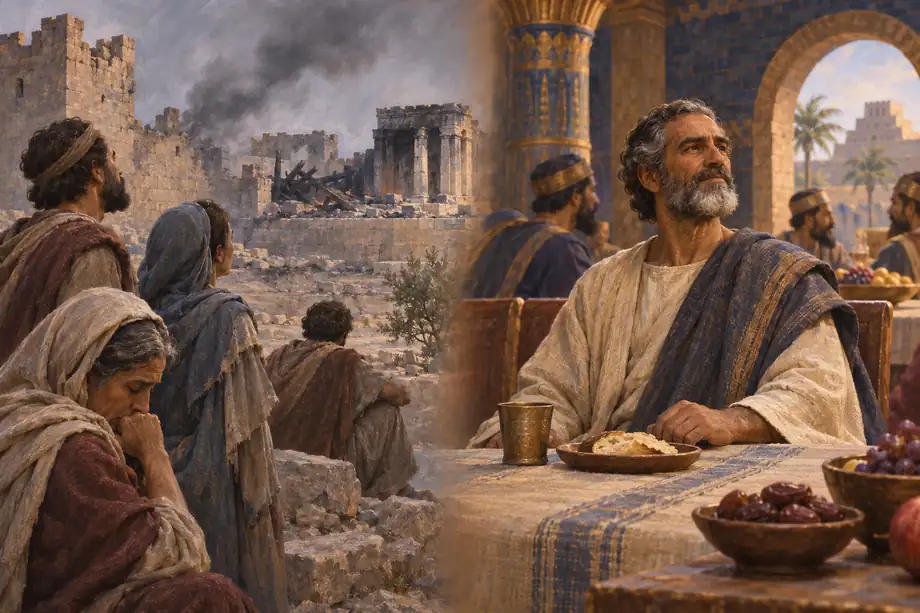
Why does Kings close with Jehoiachin’s table rather than a rebuilt temple, and how does the ending carry Christian hope toward Christ?
Reading guide
From Solomon's gold to Jehoiachin's table: judgment, mercy, and the hope of a faithful King
Solomon's gold once shimmered. The house of the LORD once rang with praise. But horses multiplied; burdens grew heavier. Shrines to other gods spread like thorns.
Prophets called from fields and mountains. Widows received bread. Some kings closed their ears. Samaria fell; Jerusalem burned.
Then, in Babylon, a prison door opened. A forgotten man found a place at a royal table. The promise was wounded, but the promise was not buried.
- Key passages:
- 1 Kings 8:27–53; 11:1–13; 21:1–29; 2 Kings 17:7–23; 23:25–27; 25:27–30.
- Guiding question:
- After walking with the kings of Israel and Judah from David's palace to Babylonian exile, what remains as the foundation of God's people's hope?
- Central claim:
- First and Second Kings teach that royal power, human wisdom, and the splendor of a sanctuary cannot save a society that abandons covenant faithfulness; yet the faithful God continues to speak, judge justly, and open a way toward hope fulfilled in Jesus Christ.
Introduction — When the Book Closes, Which Voice Remains?
At the end of a long journey, travelers look back for more than an accurate count of miles. They remember the places that changed their understanding of life. In First and Second Kings we have walked through wealthy palaces, smoke-filled shrines, confiscated fields, widows' kitchens, and roads leading into exile. We have met leaders who acted justly on one occasion and built oppressive arrangements on another, sometimes all while continuing to speak the language of faith.
We saw Solomon ask for wisdom and later allow divided loyalties to consume his heart (1 Kgs. 3; 11). We heard Elijah confront Ahab, and saw God attend to the hunger of a widow (1 Kgs. 17; 21). We stood beside Hezekiah as the king spread a threatening letter before the LORD (2 Kgs. 19), and beside Josiah as the king tore his robes on hearing Torah (2 Kgs. 22). At last we stood among the ashes of the temple (2 Kgs. 25).
Yet the narrative does not finish in the ashes. The final account places Jehoiachin, a king from David's line who possesses no power to rebuild his nation, at the table of Babylon's ruler (2 Kgs. 25:27–30). This is no inexpensive declaration of victory. Samaria has not returned, Jerusalem has not been rebuilt, and the displaced families have not come home. But a prisoner whose life seemed forgotten is seen and honored again.
Kings does not end by asking whether human beings ever found a flawless ruler. They did not. It asks whether God's word and God's promise can outlast the collapse of the systems people built. The larger biblical narrative will carry that question toward David's promised Son.
Reading the Ending in Context — History Remembered from Exile
Kings is one continuous story running from David's last days to Jehoiachin's altered circumstances in Babylon. Its ending invites readers to look backward from exile: Why was the LORD's temple burned? Why did Israel and Judah lose their land? Had their God been defeated by Assyria and Babylon? And what would become of the promise to David (2 Sam. 7:12–16)?
The narrator does not answer by listing military defeats alone. Kings places rulers under Torah's measure (Deut. 6; 12; 17; 28–30), exposes the public consequences of disordered worship, and records prophetic warnings given long before the final disasters (2 Kgs. 17:13–18). Brueggemann describes Kings as theological interpretation of public life, with temple, Torah, and the prophets shaping the narrative's judgment upon political power (Brueggemann 2000, 1–5).
But the story must not be converted into a simplistic formula: success proves righteousness, and suffering proves unusual guilt. Hezekiah trusts the LORD and still faces Assyria's army (2 Kgs. 18–19). Josiah, praised for remarkable covenant loyalty, dies in battle (2 Kgs. 23:25, 29–30). Ordinary families suffer under the consequences of royal decisions and imperial violence. These tensions remain. Modern tragedies cannot be automatically identified as particular acts of divine punishment.
There is another striking feature: Kings never offers one human monarch as an unqualified hero. David calls his son to heed the law; Solomon fails; Jeroboam fears political loss; Ahab steals a vineyard; Jehu removes Baal worship while preserving another corrupt cult; Josiah reforms worship but cannot reverse generations of damage by one decree. The reader is led away from confidence in a perfect human institution and toward the need for the God who gives life beyond judgment (Leithart 2006, introduction).
Looking Back across the Story — Five Markers Along the Road
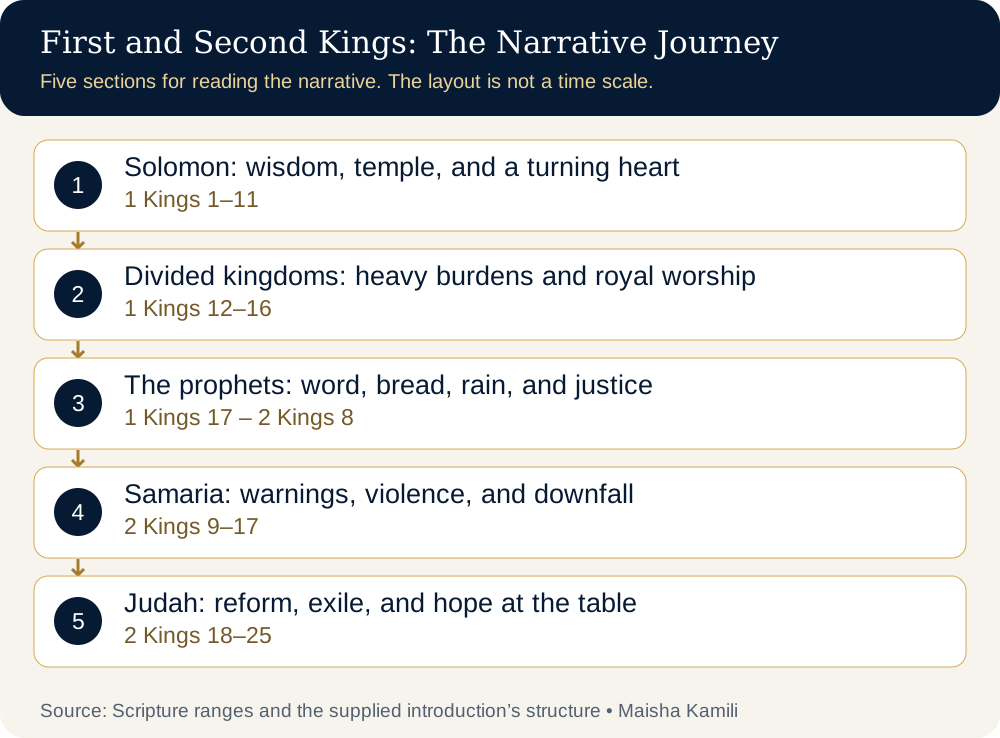
A Crown Begins with Wisdom and Becomes Burdened by Gold (1 Kings 1–11)
Solomon receives the crown amid family rivalry. He asks for wisdom to do justice, and the temple is established as a place where God's name may be honored among the people (1 Kgs. 1–8). In the dedication prayer, Solomon confesses that even heaven cannot contain the LORD (1 Kgs. 8:27). He asks God to hear the repentant, the foreigner, and those who may one day pray from exile (8:31–53).
Yet the gold of 1 Kings 10 sounds different once the reader remembers Deuteronomy 17:14–20 and its limits upon royal accumulation. Horses, silver, diplomatic marriages, and corrupt worship reveal an increasingly divided heart (1 Kgs. 11:1–13). Leadership was never meant to authorize endless acquisition.
What remains: A gift of wisdom is not enough without continued obedience. A person may build an extraordinary house of worship while also building practices that harm a community.
The People's Burden Becomes a Test of Power (1 Kings 12–16)
The people ask Rehoboam to ease the weight of royal service. He chooses harsh counsel rather than listening (1 Kgs. 12:1–14). The division of the kingdom fulfills a judgment connected to Solomon's unfaithfulness (1 Kgs. 11:29–39), but that judgment takes visible economic form: when burdens grow and voices are dismissed, communal bonds break.
Jeroboam establishes a rival worship system at Bethel and Dan to secure the northern kingdom's political future (1 Kgs. 12:26–33). Fear of losing the throne acquires its own altars. Subsequent rulers inherit habits that seem normal in their institutions but continue to lead the people away from the covenant.
What remains: Worship becomes distorted when used to shield a leader's position from scrutiny. Questions about spiritual policy must be asked alongside questions about the lives of the people who pay for it.
Prophetic Voices, a Widow's Bread, and Naboth's Vineyard (1 Kings 17–2 Kings 8)
Elijah and Elisha show that God is not confined to royal residences. God hears the widow of Zarephath (1 Kgs. 17:8–24), exposes Baal's impotence at Carmel (1 Kgs. 18), and meets Elijah again after exhaustion and fear (1 Kgs. 19). God heals Naaman, a military leader from another nation (2 Kgs. 5); provides for a widow trapped by debt, a grieving household, and people facing hunger (2 Kgs. 4).
Within this world of healing and provision, Naboth's vineyard becomes a test of public morality (1 Kgs. 21). Ahab wants another man's inheritance; Jezebel uses local institutions to make a lie look like lawful process. Elijah announces that the God of Israel sees the owner of a small field even when a powerful monarch prefers not to see him.
What remains: Covenant fidelity appears in bread, health, land, justice, and the hearing of vulnerable voices. Worship cannot be separated from the life of the community.
Samaria Is Removed from Its Land (2 Kings 9–17)
When Jehu brings Ahab's dynasty to an end, some forms of Baal worship are eliminated, but the practices associated with Jeroboam remain (2 Kgs. 10:28–31). Changes of leadership do not heal a nation when distorted structures of power and worship remain unchallenged.
Assyria conquers Samaria around 722/721 BCE (2 Kgs. 17:1–6). Kings gives the disaster a covenant interpretation: the people turned away from exclusive worship of the LORD and refused repeated prophetic warnings (17:7–23). The chapter also describes Assyria's policy of removing people and settling others in the region (17:24–41). The criticism concerns divided worship and covenant loyalty, not the ethnicity of people brought to the land. The later history and identity of the Samaritans cannot be reduced to a single episode of imperial resettlement.
What remains: God's covenant addresses collective history, but that conviction never permits contempt for displaced people, nor does it turn ethnic prejudice into faithfulness.
Jerusalem Burns and a Prisoner Finds a Table (2 Kings 18–25)
Hezekiah shows that prayer can be an act of courage in the face of imperial intimidation (2 Kgs. 18–19). Manasseh pollutes the sanctuary with rival worship and is associated with innocent bloodshed (2 Kgs. 21). Josiah hears the law, tears his robes, removes corrupt shrines, and celebrates Passover (2 Kgs. 22–23). Still, even Josiah's fidelity does not immediately erase the consequences of a long history of disobedience.
Babylon deports people from Judah in 2 Kings 24. In chapter 25, Jerusalem is besieged, its temple burned, and many residents taken away. Gedalia attempts to govern those who remain, but assassination and fear lead to further flight toward Egypt (25:22–26). There is no shortcut past this grief.
Then Jehoiachin is released from prison and given a place at a royal table (25:27–30). This is a narrow opening for hope, not the restoration of the kingdom. The promise to David is left unresolved within Kings. Readers must wait to learn how God will finally bring the promise to its intended fullness.
Four Enduring Truths — When Kings Fail, God Remains Faithful
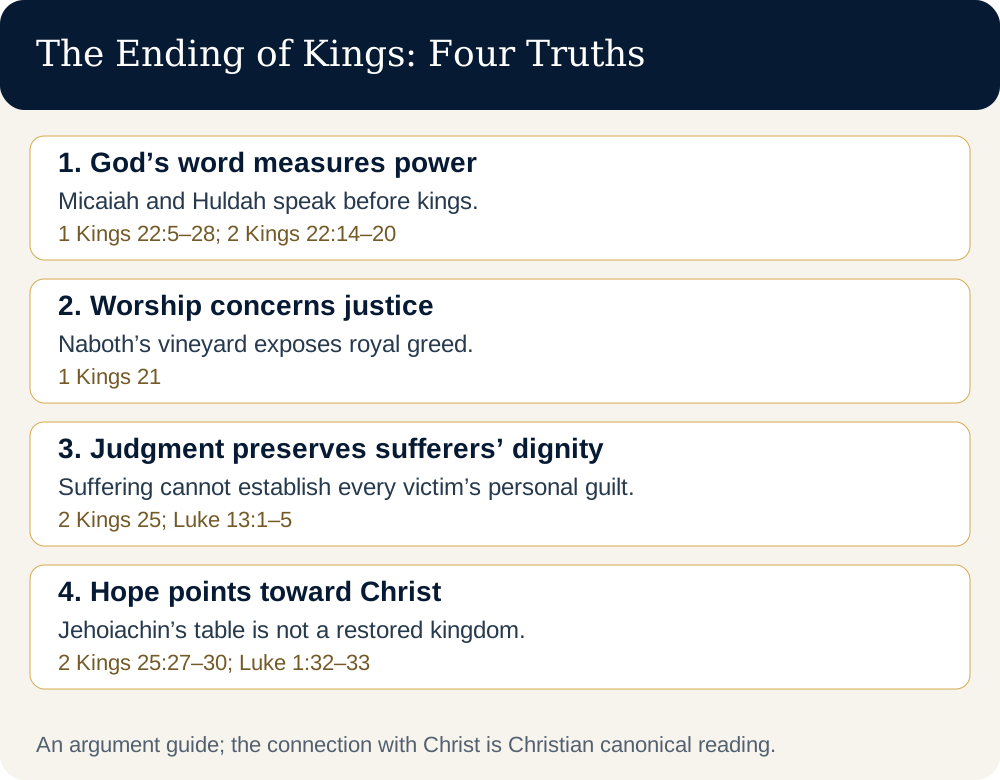
God's Word Measures Every Exercise of Power
David charges Solomon to keep the instruction of Moses (1 Kgs. 2:1–4). The narrator commends and condemns rulers by covenant fidelity rather than military ability alone. Micaiah refuses to promise victory simply because the palace wants reassurance (1 Kgs. 22:5–28). Huldah declares the word of the LORD even to a king who has begun to humble himself (2 Kgs. 22:14–20). Spiritual health requires communities brave enough to hear an unwelcome warning.
False Worship and Injustice Meet in People's Lives
Jeroboam invents a worship system to protect authority (1 Kgs. 12). Ahab seizes Naboth's vineyard (1 Kgs. 21). Manasseh defiles the temple and fills Jerusalem with blood (2 Kgs. 21). Each case has its own particulars, yet they press a shared question: Who suffers so that someone else's position can remain secure? In contemporary life, that question reaches financial decisions, fairness, religious leadership, and the treatment of people without institutional influence.
Exile Is a Severe Judgment, Not Permission to Accuse Every Victim
Kings interprets the fall of Israel and Judah through covenant violation and prophetic warnings (2 Kgs. 17:7–23; 24:2–4). At the same time, children, poor families, widows, and people who could not control palace policy bear the effects of war. Responsible reading recognizes collective failure without presuming every sufferer shares equal personal blame. Jesus rejects the easy equation of tragedy and extraordinary personal sin in Luke 13:1–5. Mercy does not conceal evil; judgment does not make devastation a spectacle to celebrate.
David's Promise Opens a Window toward Christ
God promised David an enduring place for his line within God's covenant purposes (2 Sam. 7:12–16). The kings of that line do not embody perfect fidelity. Even Josiah, whom Kings praises so highly (2 Kgs. 23:25), cannot keep Babylon's fire away. For Christian readers, the question of a faithful King leads toward Jesus Christ, the Son of David (Matt. 1:1; Luke 1:32–33).
Jesus refuses domination and teaches greatness through service (Mark 10:42–45). He speaks of his body in the imagery of a temple destroyed and raised again (John 2:19–22). The crucified Messiah rises: God's life crosses the boundary that royal institutions could not overcome (Acts 2:29–36). Thus, Kings is not transformed into an uncomplicated story of success. It becomes part of Scripture's journey toward a reign of justice, forgiveness, and new creation (Rev. 21:1–5; Leithart 2006, introduction).
Living the Lessons — Faithfulness Has a Cost
- Measure success by integrity, not by buildings. When reviewing a family, church, or institutional budget, ask whether vulnerable people receive care before resources are committed to outward prestige (1 Kgs. 8; 2 Kgs. 21).
- Do not turn fear into oppressive policy. Before taking a harsh decision to protect a position, listen to the people who will carry its consequences (1 Kgs. 12:1–14).
- Protect today's Naboth's vineyard. Resist the misuse of property, money, and authority, even when a powerful person offers rewards or threats (1 Kgs. 21).
- Make room for prophetic voices. Establish space in meetings for uncomfortable questions without punishing those who speak responsibly (1 Kgs. 22; 2 Kgs. 22).
- Hear victims before explaining tragedy. Visit people in grief, help those who have been displaced, and refuse to use Scripture to make unsupported accusations against sufferers (2 Kgs. 25).
- Let repentance change public practice. Confess wrongdoing, restore what was taken, change harmful procedures, and report corrective action where accountability requires it (2 Kgs. 22–23).
- Open a table of hope. Welcome someone whom poverty, imprisonment, shame, or exclusion has deprived of dignity. Offer meaningful belonging and participation, not pity alone (2 Kgs. 25:27–30; Luke 14:12–14).
Five Questions for Honest Reflection
- Which king in First and Second Kings most clearly reveals that outward success does not prove the faithfulness of the heart? Why?
- Which altars of fear, status, or self-preservation might lead a leader today to disregard the needs of a neighbor?
- Which truthful voices in a family, congregation, or community have been easy to ignore because the message is uncomfortable?
- What work of restoring justice should begin now, even when the consequences of past decisions cannot be undone immediately?
- What hope does Jehoiachin's place at the table awaken, and how does Jesus enlarge that hope without diminishing the suffering of the exiles?
Response Prayer — Rebuild Us upon the Truth
LORD, God of history and God of promise,
We have traveled the roads of kings, seen shining buildings, and heard the cries of those standing outside palace gates. We have read of wisdom that lost its way, altars that misled a people, and prophetic voices pushed aside. We stand before Jerusalem's ashes; keep us from hiding behind easy words.
Forgive us where we have valued position above justice, custom above your word, and the comfort of leaders above the safety of the people. Grant us courage to apologize, to repair what we have damaged, and to hear warning before grief grows deeper. Keep us from using ancient judgments to wound today's victims.
As we remember Jehoiachin's place at the table, teach us to welcome those left behind. As we look to Jesus Christ, David's Son, teach us the kingship of service, forgiveness, and justice. Make our communities fields rooted in faithfulness and fruitful in mercy.
In Jesus' name, Amen.
Window into the Next Journey — After the Ashes, Names Are Called
Read next: Introduction to 1 Chronicles and 2 Chronicles, followed by 1 Chronicles 1.
Kings ends with a prison door opening. Chronicles, instead of beginning with a new battle or building project, begins with names reaching back to Adam (1 Chr. 1:1–4). This is a way of reminding a displaced community that God's history did not begin with Solomon's throne, nor has it ended with Nebuchadnezzar's victory.
Chronicles will retell portions of the lives of David and Solomon with its own emphases: the identity of the covenant people, worship, inherited responsibility, and the hope of rebuilding. The books should not be forced to speak with identical narrative accents. Their different emphases invite richer attention to Scripture.
Carry this question forward: How can people who have lost land, sanctuary, and confidence in the future begin again without forgetting past failures—and without giving up trust in God's promise?
The close of First and Second Kings is not the end of God's story. Ashes remain in view, but the word still calls people toward life.
Bibliography
- BibleProject. n.d. The Books of Kings. BibleProject Guide.
- Brueggemann, Walter. 2000. 1 & 2 Kings. Smyth & Helwys Bible Commentary. Macon, GA: Smyth & Helwys.
- Leithart, Peter J. 2006. 1 & 2 Kings. Brazos Theological Commentary on the Bible. Grand Rapids: Brazos Press.
- Provan, Iain W. 1995. 1 and 2 Kings. New International Biblical Commentary 7. Peabody, MA: Hendrickson. Also issued in the Understanding the Bible Commentary Series.
- Wright, N. T. 1996. Jesus and the Victory of God. Christian Origins and the Question of God 2. Minneapolis: Fortress Press.
Reading note
Editorial note: The treatment of monarchy, temple, prophets, Torah, and exile is grounded in Kings and the supplied project scholarship. The connections to Jesus, the church, and new creation represent Christian canonical interpretation and are distinguished from details stated explicitly by First and Second Kings.
Be the first to leave a comment.