

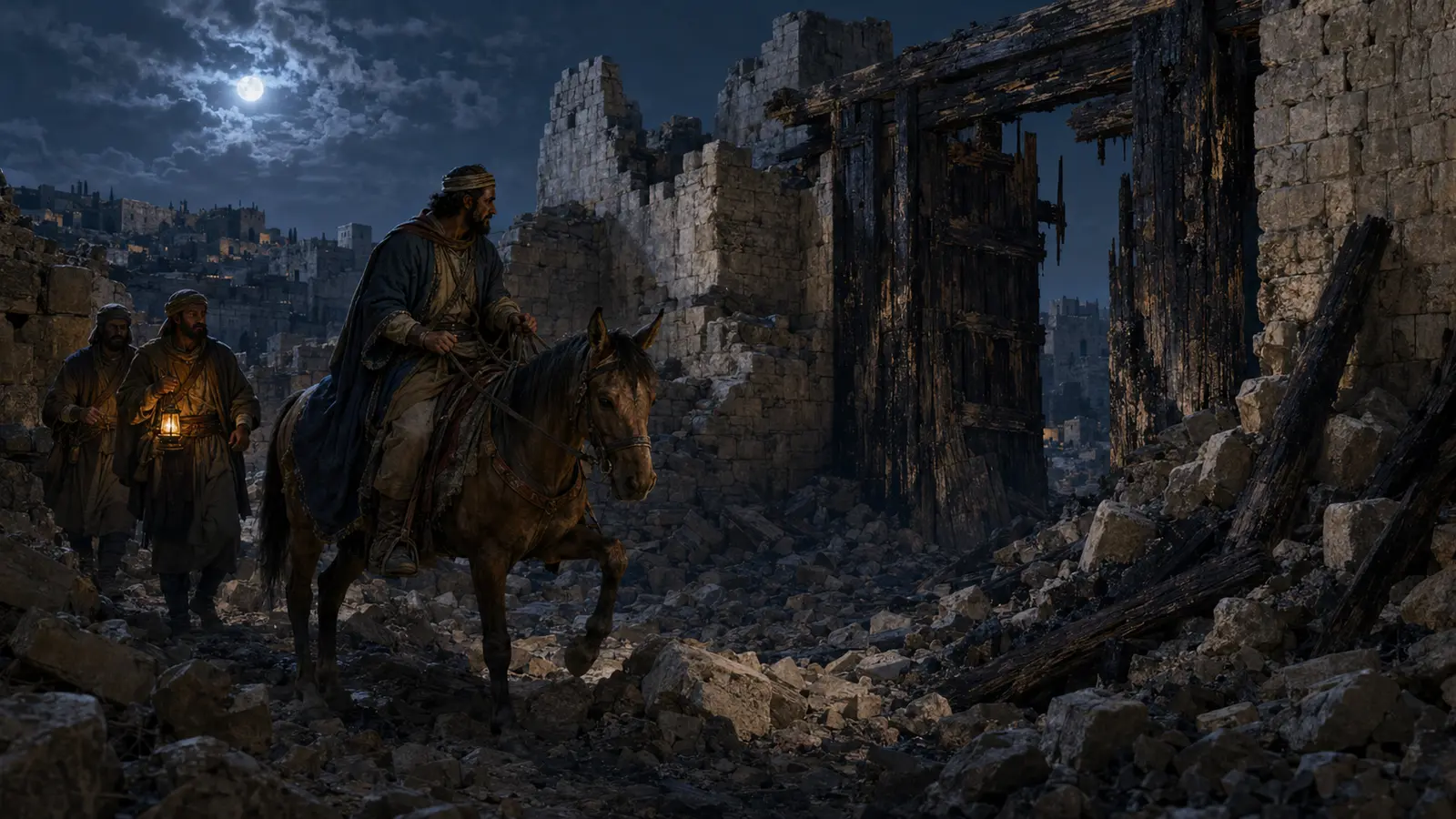
The prayer of Chislev becomes the courage of Nisan. The tears in Susa move toward the stones of Jerusalem. Nehemiah stands before a human king with fear in his bones, but the hand of the heavenly King is upon him. Before the wall rises in daylight, one servant walks through the ruins at night and learns where repair must begin.
01
Introduction
There is a season when prayer must become speech. There is a moment when sorrow, carried quietly before God for months, must stand up and ask for permission to move. Nehemiah 1 showed us a servant weeping over Jerusalem’s disgrace. Nehemiah 2 shows us that same servant stepping into risk.
This chapter is full of doors: the door into the king’s presence, the door of imperial permission, the door through hostile territory, the broken gates of Jerusalem, and the door into communal rebuilding. But every door opens under tension. Nehemiah is afraid. The king is powerful. The city is ruined. The enemies are watching. The people are discouraged. The walls are broken. The dream is fragile.
Yet the chapter whispers a steady truth: God often begins public renewal through hidden prayer, careful courage, and honest inspection of what is broken.
This text is about lament becoming courageous action, because prayer that truly carries the ruins will eventually ask what obedience requires.
Nehemiah does not rush. He waits. He prays. He speaks. He travels. He watches. He inspects. Then he calls the people to rise and build. His leadership is neither noisy ambition nor passive spirituality. It is prayer with feet, courage with tears, strategy with humility.
02
Historical and Literary Context
Nehemiah 2 continues the opening movement of the Nehemiah memoir. The story begins in the Persian court, where Nehemiah serves as cupbearer to Artaxerxes. In chapter 1, the report about Jerusalem’s broken walls and burned gates drove him into mourning, fasting, confession, and prayer. Chapter 2 shows the answer beginning to unfold.
The time marker is important. Nehemiah first heard the news in Chislev [Neh. 1:1], and now he acts in Nisan [Neh. 2:1]. Several months have passed. The delay is not emptiness. It is formation. Prayer has been doing hidden work in him. God’s timing has been shaping both the servant and the opportunity.
Within Ezra–Nehemiah, this chapter follows the repeated pattern of restoration leadership. A Persian king grants permission and resources; a Jewish leader returns to Jerusalem; opposition rises; the work begins under the claim that God’s hand is active in history. Zerubbabel’s temple mission, Ezra’s Torah mission, and Nehemiah’s wall mission each show that the God of Israel is not trapped by empire. He can stir kings, open roads, and provide timber through unlikely channels.
Yet the chapter also carries a tension. Jerusalem needs walls for protection and dignity, but the prophets had also imagined a restored Jerusalem surrounded by God’s presence and joined by many nations [Zech. 2:3–11; Isa. 2:2–4]. Nehemiah’s rebuilding is faithful and necessary, but the story keeps asking whether walls can ever be enough. The city may be protected by stone, but only God can heal the deeper exile of the heart.
Literarily, the chapter moves through six scenes: sadness before the king [2:1–3], bold request and royal permission [2:4–8], arrival and first opposition [2:9–10], night inspection [2:11–16], the call to rebuild [2:17–18], and opposition answered with confidence in God [2:19–20]. The repeated emphasis on “the good hand of my God” gives the chapter its theological pulse. The king may sign papers, but God is the one guiding the story.
03
Walking Through the Text
When Hidden Grief Appears Before the King [Nehemiah 2:1–3]
Nehemiah stands before Artaxerxes with wine in his hand and sorrow on his face. In the ancient court, sadness before the king could be dangerous. The king’s presence was not a place for uncontrolled emotion. Nehemiah knows this, and the text says, “I was very much afraid” [Neh. 2:2].
But grief has become visible. He can no longer carry Jerusalem’s wound as though nothing is wrong. The king asks, “Why is your face sad, seeing you are not sick?” [Neh. 2:2]. Nehemiah answers with wisdom: “Why should not my face be sad, when the city, the place of my fathers’ graves, lies in ruins, and its gates have been destroyed by fire?” [Neh. 2:3].
He does not begin with rebellion language. He speaks of ancestral graves, civic ruin, and honor. His words are truthful but carefully framed. This is courage clothed in wisdom.
Here we learn that faithful courage is not the absence of fear. It is obedience while fear is still present. Nehemiah trembles, but he speaks.
When Quick Prayer Meets Prepared Courage [Nehemiah 2:4–8]
The king asks, “What are you requesting?” [Neh. 2:4]. Between the king’s question and Nehemiah’s answer, there is a small altar: “So I prayed to the God of heaven.”
This is not the long prayer of chapter 1. This is a breath-prayer, a flash of dependence, a silent cry lifted in the dangerous gap between opportunity and answer. Nehemiah has spent months praying; now, in one trembling moment, prayer becomes instinct.
He asks to be sent to Judah to rebuild the city [Neh. 2:5]. When the king asks for a timeline, Nehemiah gives one. Then he asks for letters of safe passage and timber from the king’s forest for the gates, the wall, and the house he will occupy [Neh. 2:7–8]. This is not vague spirituality. Nehemiah has prayed deeply and planned carefully.
The king grants his requests. Nehemiah explains why: “the good hand of my God was upon me” [Neh. 2:8]. This phrase protects the story from two errors. It prevents us from thinking everything happened because of Nehemiah’s skill alone. It also prevents us from thinking prayer removes the need for planning. God’s hand works through courage, preparation, timing, and even royal favor.
When Favor Arrives with Opposition [Nehemiah 2:9–10]
Nehemiah travels with letters, army officers, and horsemen [Neh. 2:9]. The Persian empire has opened a road toward Jerusalem. But the road is not empty. Sanballat the Horonite and Tobiah the Ammonite servant hear of Nehemiah’s arrival and are “greatly displeased that someone had come to seek the welfare of the people of Israel” [Neh. 2:10].
This is the first shadow of opposition. The phrase “seek the welfare” is important. Nehemiah comes for shalom, for the good of God’s wounded people. Yet even seeking the welfare of others can provoke hostility when broken systems benefit from continued weakness.
Restoration often disturbs those who have grown comfortable with ruins. When God begins to repair dignity, opposition awakens.
When the Servant Walks the Ruins at Night [Nehemiah 2:11–16]
After arriving in Jerusalem, Nehemiah waits three days. Then he goes out by night with a few men. He tells no one what God has put into his heart [Neh. 2:12]. He inspects the Valley Gate, the Dragon Spring, the Dung Gate, the Fountain Gate, and the King’s Pool. The damage is so severe that at one point there is no room for the animal beneath him to pass [Neh. 2:14].
This night journey is one of the most powerful scenes in the chapter. Nehemiah does not announce a vision before he understands the wound. He does not gather people for a speech before he has walked among the stones. He lets the brokenness instruct him.
The secrecy is not manipulation. It is discernment. There is a time to speak and a time to see. There is a time to gather the community and a time to walk quietly with God through the ruins.
The wall becomes a mirror. Nehemiah sees not only damaged infrastructure but the exposed condition of the people. Gates burned. Stones fallen. Paths blocked. The city bears witness that return is incomplete.
When Shame Becomes Shared Work [Nehemiah 2:17–18]
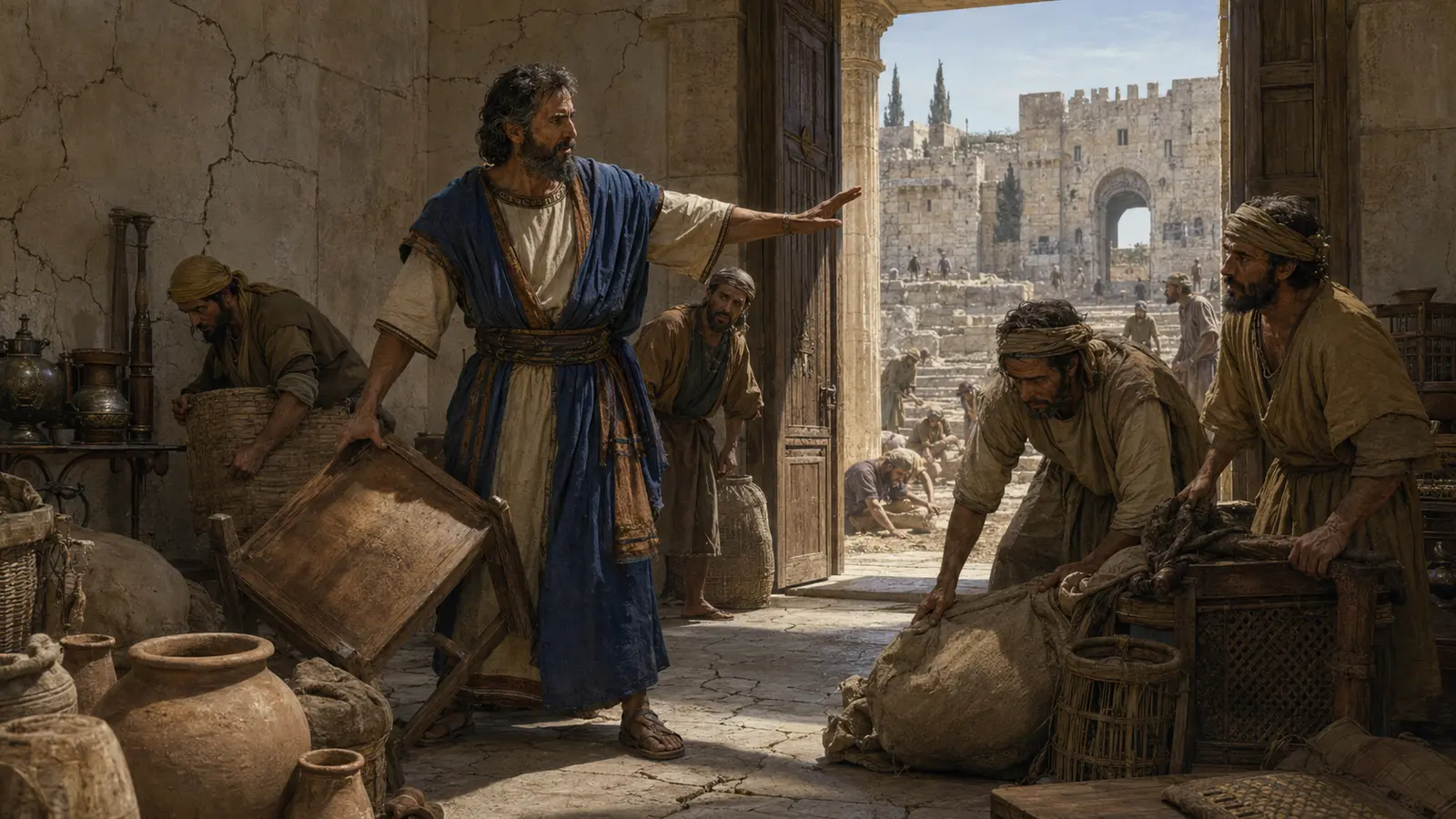
After inspection, Nehemiah speaks to the people: “You see the trouble we are in, how Jerusalem lies in ruins with its gates burned. Come, let us build the wall of Jerusalem, that we may no longer suffer derision” [Neh. 2:17].
He says, “we.” He does not say, “You have a problem.” He enters the shame of the people. He turns private burden into shared vocation.
Then he tells them about the hand of God and the words of the king [Neh. 2:18]. Notice the order again: God’s hand first, royal permission second. The people respond, “Let us rise up and build.” Their hands are strengthened for the good work.
This is leadership at its best: it names reality, shares the burden, testifies to God’s grace, and invites communal obedience. Nehemiah does not rebuild Jerusalem alone. The city’s repair will require many hands.
When Mockery Meets Confidence in God [Nehemiah 2:19–20]
Sanballat, Tobiah, and Geshem the Arab respond with mockery and accusation: “What is this thing that you are doing? Are you rebelling against the king?” [Neh. 2:19]. Opposition now wears political clothing. The rebuilders are portrayed as rebels.
Nehemiah answers: “The God of heaven will make us prosper, and we his servants will arise and build” [Neh. 2:20]. His confidence is not in imperial paperwork alone, but in God. Yet his final words are sharp: “You have no portion or right or claim in Jerusalem.”
This response protects the work, but it also leaves a tension in the wider story. The prophets had dreamed of nations streaming to Zion. Ezra–Nehemiah repeatedly wrestles with the boundary between holy identity and generous mission. Nehemiah’s refusal may be necessary in the face of hostile sabotage, but the story still aches for a day when Jerusalem’s restoration will become blessing for the nations rather than a city of suspicion and exclusion.
For now, the work must begin. God’s servants rise. The stones wait.
04
Theological Reflection
God’s Providence Works Through Human Courage
Nehemiah 2 is a chapter of providence, but not passive providence. God opens the king’s heart, but Nehemiah still speaks. God’s hand is upon him, but Nehemiah still asks for letters and timber. God grants favor, but Nehemiah still walks the ruins.
Biblical faith does not divide prayer from planning. It holds them together. The God who rules heaven also works through wise timing, prepared requests, administrative letters, safe passage, and courageous conversation.
The Good Hand of God Does Not Remove Opposition
The king says yes, but Sanballat and Tobiah are displeased. Divine favor does not mean an easy road. In Ezra–Nehemiah, every stage of restoration meets resistance. The altar rises amid fear. The temple faces accusations. The wall provokes mockery.
This reminds us that opposition is not always evidence that we are outside God’s will. Sometimes it is evidence that repair has begun to threaten disorder.
Wise Leadership Inspects Before It Announces
Nehemiah models slow, careful leadership. He does not confuse passion with readiness. He arrives, waits, watches, and examines. He studies the real condition of the wall before calling people to rebuild.
Faithful leadership needs both vision and diagnosis. Love must look closely. Repair requires truth. We cannot heal what we refuse to inspect.
Walls Can Protect, but They Cannot Complete Restoration
The wall matters. A vulnerable city needs protection. Shame must be addressed. The people need public dignity. Yet the wall is not salvation. Later chapters will show that the deeper problem remains the heart.
This is the unfinished ache of Ezra–Nehemiah. Jerusalem can gain gates and still need grace. A community can regain structure and still need inner renewal. The story points forward to the One who would gather the scattered, embody God’s presence, break down dividing walls of hostility, and build a people renewed by the Spirit [Eph. 2:14–22].
05
Life Application
Let prayer mature into obedient action. Do not use prayer as a hiding place from responsibility when God is opening a door for courage.
Speak truth with wisdom. Nehemiah’s words before the king were honest, careful, and timely. Courage does not need to be careless.
Plan as an act of faith. Letters, timber, timelines, and strategy can be holy when surrendered to God’s purpose.
Expect resistance when repair begins. When you seek the welfare of wounded people, not everyone will rejoice.
Inspect the ruins before making promises. Look honestly at the condition of your family, ministry, habits, finances, leadership, or community before announcing solutions.
Use “we” language in communal repair. Healing begins when leaders stop standing above the brokenness and begin sharing the burden.
Remember that structures need Spirit. Build needed walls, systems, disciplines, and safeguards, but ask God for renewal deeper than organization.
06
Reflection Questions
1. What prayer have you been carrying that may now require a courageous request or concrete step?
2. Where has fear kept you silent, even though God may be opening a door for wise speech?
3. What “letters and timber” do you need—practical resources, plans, permissions, or partnerships—to begin rebuilding faithfully?
4. What ruins in your life or community need honest inspection before public action?
5. Where are you tempted to build protective walls without seeking deeper heart renewal?
07
Response Prayer
God of heaven, whose good hand guides your servants, teach us to carry sorrow until it becomes courage.
Give us wisdom before kings, humility before communities, and honesty before broken walls.
Where fear closes our mouths, open them with grace. Where opportunity comes suddenly, make prayer rise quickly within us. Where ruins are hidden in darkness, give us courage to inspect them without despair.
Strengthen our hands for the good work. Protect us from pride when favor comes, and from discouragement when mockery rises.
Build in us more than walls. Build truth in our inward places. Build mercy in our speech. Build holiness in our habits. Build courage in our obedience. Build a people whose gates are open to your presence and whose life bears witness to your kingdom.
Through Jesus Christ, the true builder, the faithful servant, and the cornerstone of the renewed people of God, Amen.
08
Window into What Comes Next
Nehemiah 2 ends with the people strengthened for the good work. But a wall is not rebuilt by vision alone. In Nehemiah 3, names will appear, gates will be assigned, families will take their places, priests and merchants and craftsmen will stand side by side. The dream will become labor.
The movement continues: prayer becomes courage, courage becomes inspection, inspection becomes invitation, and invitation becomes shared work.
Next, the stones begin to move in many hands.
09
Bibliography
Boda, Mark J. Praying the Tradition: The Origin and Use of Tradition in Nehemiah 9. Berlin: de Gruyter, 1999.
Clines, David J. A. Ezra, Nehemiah, Esther. New Century Bible Commentary. Grand Rapids: Eerdmans, 1984.
Kidner, Derek. Ezra and Nehemiah. Tyndale Old Testament Commentaries. Downers Grove: InterVarsity Press, 1979.
Throntveit, Mark A. Ezra-Nehemiah. Interpretation. Louisville: John Knox Press, 1992.
Williamson, H. G. M. Ezra, Nehemiah. Word Biblical Commentary 16. Waco: Word Books, 1985.
Williamson, H. G. M. Ezra and Nehemiah. Old Testament Guides. Sheffield: JSOT Press, 1987.
Yamauchi, Edwin M. “Ezra-Nehemiah.” In The Expositor’s Bible Commentary, revised edition. Grand Rapids: Zondervan, 2010.
Be the first to leave a comment.