

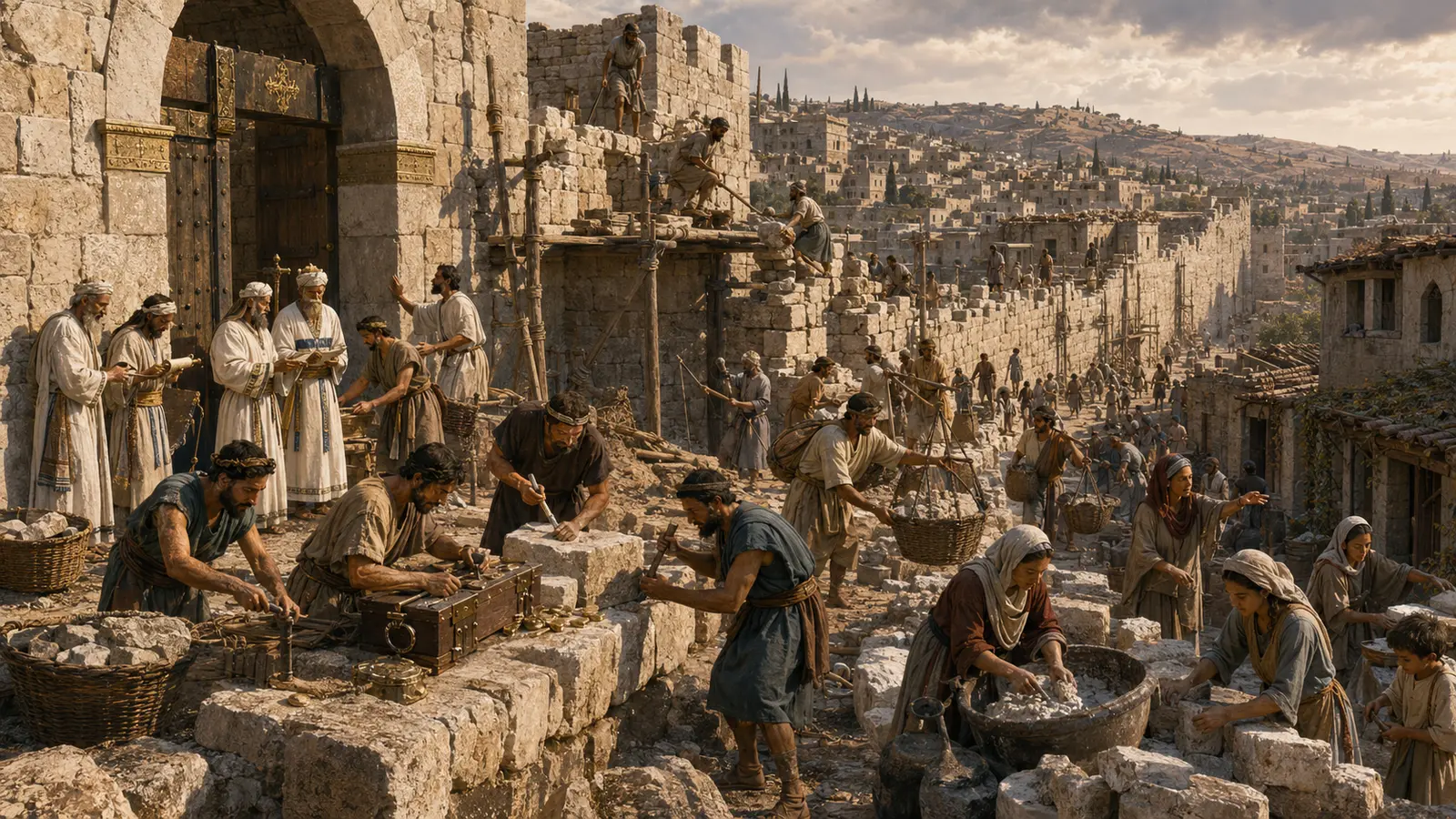
The wall rises one name at a time. Priests, goldsmiths, perfumers, rulers, daughters, Levites, gatekeepers, and neighbors take their place beside one another. The city is not healed by one heroic hand, but by many faithful hands. Stone by stone, gate by gate, the shame of Jerusalem begins to lose its voice.
01
Introduction
Some chapters in Scripture look, at first glance, like lists of names and places. We are tempted to pass over them quickly, as though they are only records for another time. But in Nehemiah 3, the list is the sermon. The names are the theology. The repeated phrase “next to him” becomes a song of communal faithfulness.
Nehemiah 1 gave us tears before God. Nehemiah 2 gave us courage before the king and inspection of the ruins. Nehemiah 3 gives us hands on the wall. The burden has moved from one heart into many shoulders. The vision is no longer only Nehemiah’s. It has become the work of a people.
This chapter asks a deeply practical question: What happens when the rebuilding of God’s people stops being one leader’s burden and becomes the shared obedience of the whole community?
This text is about private burden becoming communal repair, because God rebuilds broken places through ordinary people who take responsibility for the section in front of them.
Nehemiah 3 is not dramatic in the usual sense. There are no speeches, no miracles, no royal decrees, no open conflict. Yet the chapter is full of holy movement. The wall rises through cooperation. The city’s shame is answered by organized service. The ruined gates begin to recover their names. A broken community learns again that restoration is not a spectator sport.
02
Historical and Literary Context
Nehemiah 3 belongs to the wall-building section of the book [Neh. 3–7]. In chapter 2, Nehemiah arrived in Jerusalem, inspected the damaged walls by night, and called the people to rebuild. The people answered, “Let us rise up and build” [Neh. 2:18]. Chapter 3 shows that response becoming visible labor.
The chapter is arranged as a circuit around Jerusalem’s wall. It begins with the Sheep Gate [Neh. 3:1], moves around the city through gates, towers, and sections of wall, and eventually returns near the starting point [Neh. 3:32]. The structure gives the reader the sense of walking around Jerusalem, watching the city recover its outline. A place that had been fragmented by ruin is now being narrated as a whole.
The repeated language matters. Again and again we hear “next to him,” “after him,” “beside them,” and “opposite his house.” These phrases show coordination and proximity. No one is rebuilding the whole wall alone, but each person or group is responsible for a portion. The work is local, but the outcome is corporate.
The chapter also reveals social diversity. Priests work. Levites work. Rulers work. Merchants work. Goldsmiths and perfumers work. People from Jericho, Tekoa, Gibeon, Mizpah, Zanoah, Beth-haccherem, and other places join the effort. Even Shallum’s daughters are named among the builders [Neh. 3:12]. The wall becomes a meeting place for many kinds of hands.
Yet the chapter is honest. Not everyone participates faithfully. The nobles of Tekoa “would not stoop to serve their Lord” [Neh. 3:5]. In a chapter full of cooperation, that refusal stands out like a missing stone. Restoration exposes both willingness and resistance.
Within the wider Ezra–Nehemiah story, this chapter shows mercy becoming responsibility. The people have returned to the land, but return alone is not enough. They must rebuild what has been neglected. They must take responsibility for the public witness of the city. The wall, however, is not the final answer. It is a necessary structure, but not the deeper renewal. The book will later show that rebuilt walls cannot guarantee transformed hearts. Still, in Nehemiah 3, faithful hands begin where they can.
03
Walking Through the Text
When Priests Begin at the Sheep Gate [Nehemiah 3:1–2]
The first builders named are Eliashib the high priest and his fellow priests. They rise and rebuild the Sheep Gate. They consecrate it and set its doors [Neh. 3:1]. This is a meaningful beginning.
The Sheep Gate likely stood near the temple area and was associated with sacrificial animals brought for worship. By starting there, the chapter places rebuilding near the life of worship. The wall is civic architecture, but the first gate named reminds us that Jerusalem’s identity is not merely political. It is a city called to live before God.
The priests do not merely supervise. They build. Their hands touch the stones. This is important. In the work of restoration, spiritual leaders must not only speak about repair; they must participate in it. Holiness is not withdrawal from the needs of the city. True priestly service helps rebuild the place where God’s people live, worship, and bear witness.
The consecration of the gate also signals that this labor belongs to God. The wall is not simply a security project. It is an act of covenant stewardship. The city is being repaired as a place where God’s name, worship, and people are bound together.
When Many Places Send Their Hands [Nehemiah 3:3–12]
The list widens quickly. The sons of Hassenaah build the Fish Gate [Neh. 3:3]. Meremoth, Meshullam, Zadok, and others repair sections [Neh. 3:4]. Men of Tekoa join the work, though their nobles refuse to bend their necks [Neh. 3:5]. Joiada and Meshullam repair the Gate of Yeshanah [Neh. 3:6]. Men from Gibeon and Mizpah repair another section, connected in some way to the authority of the governor of the province Beyond the River [Neh. 3:7].
The work is not limited to Jerusalem’s residents. People from surrounding towns come to help. This shows that Jerusalem’s shame is not only Jerusalem’s problem. The city represents the identity and hope of the wider people. When the center is broken, the whole community is affected.
Then the chapter surprises us with the kinds of workers named. Uzziel, one of the goldsmiths, repairs. Hananiah, one of the perfumers, repairs [Neh. 3:8]. These are not professional wall-builders. Their normal work is delicate, skilled, and perhaps far removed from heavy stone labor. Yet they take their place.
This is one of the great beauties of the chapter: God’s repair work includes people whose gifts differ widely. Some hands that once shaped gold now lift stone. Some hands that once mixed fragrance now carry rubble. In seasons of communal crisis, love stretches vocation.
Verse 12 names Shallum and his daughters repairing another section. Their presence quietly but powerfully widens the picture. The rebuilding of Jerusalem is not only the work of men in official positions. Daughters stand in the story as participants in restoration. The wall rises through a community, not a caste.
When Refusal Stands Beside Faithfulness [Nehemiah 3:5]
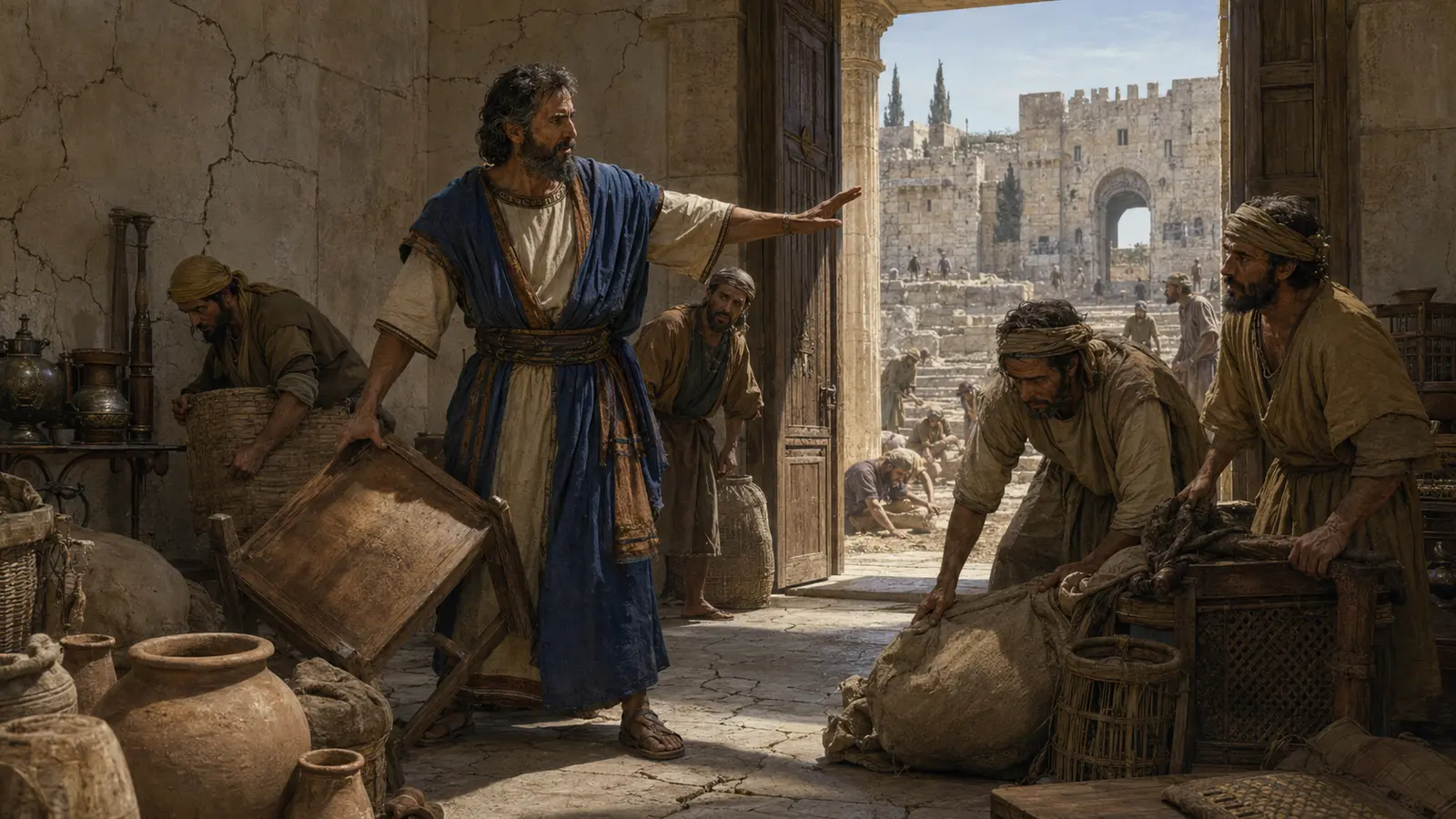
In the middle of the flow, one sentence interrupts the music: “But their nobles would not stoop to serve their Lord” [Neh. 3:5]. The men of Tekoa work; their nobles do not.
This refusal is deeply revealing. The phrase suggests pride, resistance, or unwillingness to submit to the burden of service. They may have had status, resources, or influence, but they lacked the humility of shared labor. Their title did not become obedience.
Nehemiah 3 does not pause to scold them at length. It simply records the refusal and moves on. The work continues without them. This is a sober warning. God’s rebuilding work is not stopped by proud refusal, but those who refuse to serve are remembered for their refusal.
The contrast becomes even sharper later: the Tekoites repair another section as well [Neh. 3:27]. The ordinary people of Tekoa do double work while their nobles do none. Sometimes the kingdom is carried not by the impressive, but by the willing.
When People Repair What Is Near Their Homes [Nehemiah 3:13–23]
As the chapter continues, the pattern becomes more specific. Hanun and the inhabitants of Zanoah repair the Valley Gate and a long stretch of wall [Neh. 3:13]. Malchijah repairs the Dung Gate [Neh. 3:14]. Shallun repairs the Fountain Gate and the wall by the Pool of Shelah near the king’s garden [Neh. 3:15]. Others repair near the tombs of David, the artificial pool, and the house of the mighty men [Neh. 3:16].
Then a repeated emphasis appears: people repair opposite their houses [Neh. 3:10, 23, 28–30]. This is practical wisdom. The work becomes personal because the section of wall is near their own life. They are not asked to care about an abstraction. They rebuild the place where their families sleep, where their children walk, where their neighbors pass.
There is a spiritual principle here. We may be overwhelmed by the whole wall, but God often begins by asking us to repair the portion in front of us. A family altar. A neglected relationship. A local congregation. A damaged habit. A wounded neighborhood. A ministry assignment. A gate near our own house.
Faithfulness becomes possible when obedience becomes local.
When Gates Recover Their Names [Nehemiah 3:24–32]
The final movement continues around the city: the Angle, the Tower of the Upper House, the court of the guard, the Water Gate, the Horse Gate, the East Gate, the Muster Gate, and finally back toward the Sheep Gate [Neh. 3:24–32].
The many gates are more than landmarks. Gates are places of movement, judgment, commerce, defense, and public life. When gates are burned, the rhythms of the city are broken. When gates are repaired, the city begins to breathe again.
Each gate hints at a restored aspect of communal life. The Sheep Gate points toward worship. The Fish Gate toward trade and provision. The Dung Gate toward cleansing and removal. The Fountain and Water Gates toward life and refreshment. The Horse Gate toward defense and readiness. The East Gate toward expectation. The Muster Gate toward accountability and gathering.
We should be careful not to over-allegorize every gate, yet the chapter’s detailed attention to them invites us to see that restoration is comprehensive. God’s people need repaired worship, repaired economy, repaired purity, repaired community, repaired readiness, repaired public life, and repaired identity.
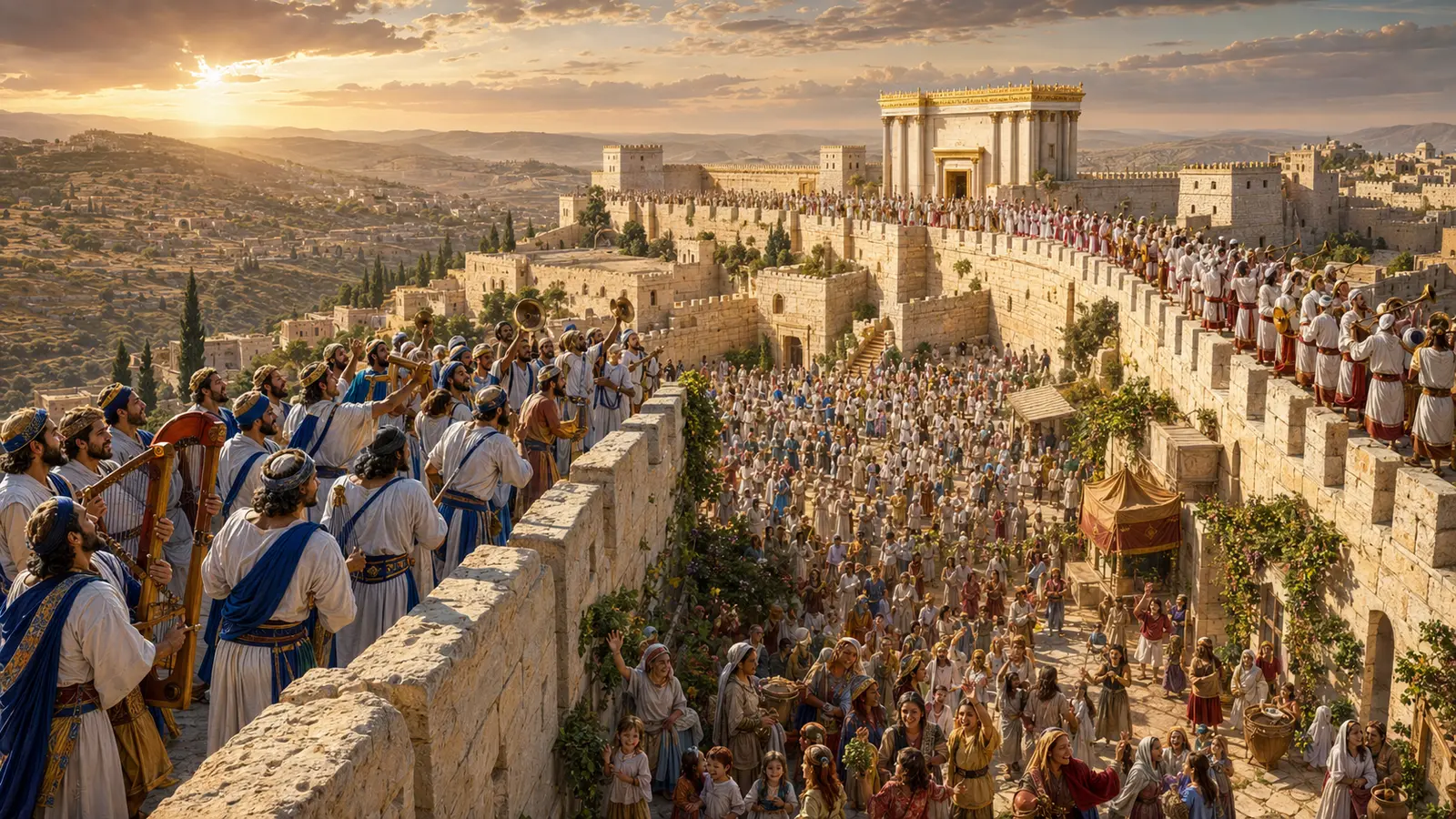
The wall is not only stone. It is the visible outline of a people learning again how to live together under God.
04
Theological Reflection
God Rebuilds Through the Many, Not Only the One
Nehemiah is the leader, but Nehemiah 3 barely mentions him. The chapter shifts attention from the heroic individual to the faithful community. This is the theology of shared vocation. God’s work is bigger than one gifted person.
In the biblical story, God calls individuals, but he forms a people. Moses leads, but Israel must walk. David prepares, but many build the temple. The apostles preach, but the whole body is gifted for ministry [1 Cor. 12:4–27; Eph. 4:11–16]. Nehemiah 3 shows this pattern in stones and names.
Ordinary Work Can Become Holy Service
Goldsmiths, perfumers, merchants, rulers, priests, and families all repair. Their normal professions do not disqualify them from sacred work. Their everyday skills are gathered into a larger calling.
This challenges the false division between “spiritual” and “ordinary.” When God is restoring his people, administration, craftsmanship, cleaning, carrying, planning, guarding, cooking, teaching, giving, and building can all become acts of worship when offered in faithfulness.
The Section Near Your House Matters
Several builders repair near their homes. This teaches us that large-scale renewal often begins with local responsibility. We do not love the whole city faithfully if we neglect the gate in front of us.
The family, the small group, the local church, the workplace, the classroom, the street, the ministry team—these may be our assigned portions of the wall. God does not ask everyone to do everything. He calls each servant to faithful responsibility.
Public Repair Still Needs Inner Renewal
Nehemiah 3 is beautiful, but it is not the end of the story. A coordinated workforce can rebuild a wall, but only God can rebuild the heart. The same community that says “Let us rise up and build” will later need to stand under the Word, confess sin, renew covenant, and confront relapse.
This chapter therefore gives hope without naivety. Structures matter. Shared labor matters. Public witness matters. But the deepest restoration must move from wall to worship, from gate to obedience, from visible repair to inward transformation.
05
Life Application
Take your place on the wall. Do not wait for a perfect assignment before serving. Ask what faithful repair is already in front of you.
Honor ordinary servants. God remembers names many people overlook. Celebrate those who do hidden, practical, and unglamorous work.
Repair near your house. Begin with the relationships, habits, responsibilities, and communities closest to you.
Do not let status keep you from service. The nobles of Tekoa are a warning that influence without humility becomes a missing stone in the wall.
Work beside others, not above them. The repeated “next to him” invites us into partnership, not isolated heroism.
Let worship shape rebuilding. The work begins near the Sheep Gate. Whatever you repair, keep God’s presence at the center.
Build structures, but seek heart renewal. Repair systems, schedules, walls, and ministries, but keep praying for the Spirit to rebuild what stone cannot touch.
06
Reflection Questions
1. What section of the wall has God placed in front of you right now?
2. Are you waiting for someone else to repair what God is asking you to touch?
3. Where might pride, comfort, or status be keeping you from humble service?
4. Who are the overlooked builders in your community that need encouragement and honor?
5. What visible repair in your life still needs deeper inward renewal?
07
Response Prayer
Lord God of heaven, Builder of your people, Keeper of covenant mercy, teach us to take our place along the wall.
Give us humble hands. Give us willing hearts. Give us eyes to see the gate near our house and courage to repair what we have long ignored.
Forgive us for the times we wanted honor without service, vision without labor, and restoration without responsibility.
Thank you for ordinary builders: for priests with dusty hands, for daughters carrying stones, for workers whose names are known to you, for servants who stand beside one another until shame begins to fall silent.
Rebuild our worship. Repair our homes. Restore our communities. Strengthen our hands for good work. And do not let us stop with walls. Rebuild our hearts by your Spirit, so that our visible obedience may become an outward sign of inward renewal.
Through Jesus Christ, the cornerstone, the true temple, and the Lord who builds his people into a dwelling place for God, Amen.
08
Window into What Comes Next
Nehemiah 3 shows the people united in labor. The wall begins to rise. But whenever restoration becomes visible, opposition grows louder. In Nehemiah 4, mockery, anger, intimidation, and threats will test the workers. The question will no longer be only whether they can build, but whether they can keep building when enemies laugh and danger approaches.
The movement continues: prayer becomes courage, courage becomes shared labor, and shared labor soon becomes tested perseverance.
The stones are rising—but so is resistance.
09
Bibliography
Boda, Mark J. Praying the Tradition: The Origin and Use of Tradition in Nehemiah 9. Berlin: de Gruyter, 1999.
Clines, David J. A. Ezra, Nehemiah, Esther. New Century Bible Commentary. Grand Rapids: Eerdmans, 1984.
Kidner, Derek. Ezra and Nehemiah. Tyndale Old Testament Commentaries. Downers Grove: InterVarsity Press, 1979.
Throntveit, Mark A. Ezra-Nehemiah. Interpretation. Louisville: John Knox Press, 1992.
Williamson, H. G. M. Ezra, Nehemiah. Word Biblical Commentary 16. Waco: Word Books, 1985.
Williamson, H. G. M. Ezra and Nehemiah. Old Testament Guides. Sheffield: JSOT Press, 1987.
Yamauchi, Edwin M. “Ezra-Nehemiah.” In The Expositor’s Bible Commentary, revised edition. Grand Rapids: Zondervan, 2010.
Be the first to leave a comment.