

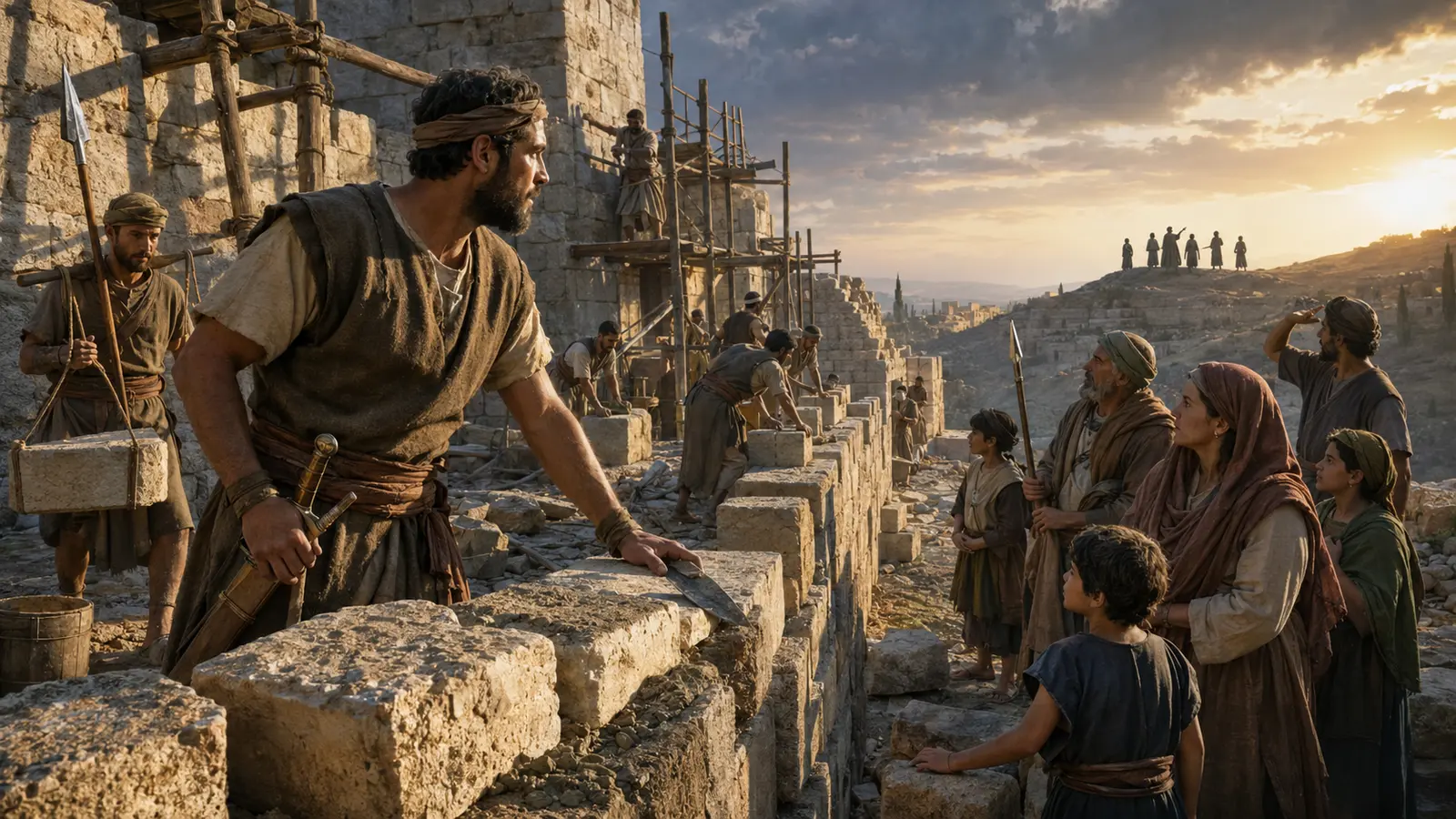
The wall begins to rise, and so does the laughter of the enemies. Stones are lifted from dust, but words are thrown like arrows. Jerusalem learns that rebuilding is never only masonry; it is warfare of hope against shame, prayer against fear, and steady hands against intimidation.
01
Introduction
Every true rebuilding eventually meets resistance. At first, the opposition may laugh. Then it may accuse. Then it may threaten. The enemy rarely begins by destroying the wall; often he begins by weakening the hands of the builders.
Nehemiah 4 brings us into the sound of that battle. In chapter 3, the people stood shoulder to shoulder. Priests, rulers, goldsmiths, perfumers, families, and daughters took their places along the wall. The broken city became a shared calling. But when the wall begins to rise, Sanballat and Tobiah become angry. They mock the builders. They insult the stones. They ridicule the hope.
This chapter asks a very practical question: How do God’s people keep building when opposition becomes loud, fear becomes contagious, and strength begins to fail?
This text is about shared labor becoming tested perseverance, because the work of restoration must learn to pray, watch, build, and stand firm under pressure.
Nehemiah 4 does not romanticize rebuilding. The work is hard. The rubble is much. The threats are real. The workers are tired. Yet the chapter also gives us one of Scripture’s strongest images of faithful endurance: one hand doing the work, the other hand holding a weapon [Neh. 4:17]. Prayer does not cancel vigilance. Trust does not cancel strategy. Courage is not noise; it is steady obedience when fear is near.
02
Historical and Literary Context
Nehemiah 4 belongs to the central wall-building narrative of Nehemiah [Neh. 3–7]. After Nehemiah’s prayer in Susa [Neh. 1], his courageous request before Artaxerxes [Neh. 2], and the communal labor of chapter 3, the project now faces intensified opposition.
The opponents are familiar: Sanballat the Horonite and Tobiah the Ammonite servant [Neh. 2:10, 19]. Geshem the Arab appeared in chapter 2, and in chapter 4 the opposition broadens to include Arabs, Ammonites, and Ashdodites [Neh. 4:7]. This suggests that the rebuilding of Jerusalem’s wall was not seen as a neutral construction project. A fortified Jerusalem would shift local power, restore Jewish dignity, and challenge those who benefited from Judah’s vulnerability.
The chapter unfolds in two major waves. First comes ridicule [4:1–6]. The enemies mock the weakness of the Jews, the fragility of the stones, and the apparent impossibility of the work. Nehemiah responds with prayer, and the people continue building. Second comes conspiracy and intimidation [4:7–23]. As the wall rises to half its height, the enemies plot attack. Nehemiah responds with prayer, watchfulness, armed readiness, and communal organization.
Literarily, the chapter is shaped by movement between external opposition and internal weakness. The enemies say, “They will not know or see till we come among them” [Neh. 4:11]. The people say, “The strength of those who bear the burdens is failing” [Neh. 4:10]. Judah is squeezed between hostile voices outside and weary voices inside. Nehemiah’s leadership must address both.
Within the theological flow of Ezra–Nehemiah, Nehemiah 4 shows that restoration is mercy under pressure. God has opened the door through the Persian king, but divine favor does not remove conflict. The good hand of God does not mean the absence of enemies; it means the courage to keep building while enemies rage.
The wider biblical story also stands behind this chapter. Israel’s vocation has always been contested: Pharaoh opposed the Exodus, wilderness enemies attacked the journey, surrounding nations threatened the land, and prophets warned that faithfulness would require endurance. Nehemiah 4 places returned exiles back into that old story: God is rebuilding his people, and opposition tests whether fear or faith will govern their hands.
03
Walking Through the Text
When Mockery Throws Stones at Hope [Nehemiah 4:1–3]
Sanballat hears that the wall is being rebuilt, and he becomes angry. His first weapon is ridicule. Before his brothers and the army of Samaria, he asks, “What are these feeble Jews doing?” [Neh. 4:2]. The insult is designed to shrink the builders in their own eyes.
He mocks their strength: “feeble Jews.” He mocks their worship: “Will they sacrifice?” He mocks their timeline: “Will they finish up in a day?” He mocks their materials: “Will they revive the stones out of the heaps of rubbish?” [Neh. 4:2]. Tobiah adds his own contempt: “Yes, what they are building—if a fox goes up on it he will break down their stone wall!” [Neh. 4:3].
Mockery is not harmless. It is psychological warfare. It tries to turn obedience into embarrassment. It tries to make faithful people ashamed of small beginnings. It whispers, “Your work is too weak, your stones are too burned, your people are too few, your hope is too foolish.”
But God has a long history of working through what looks weak. A barren couple becomes a covenant family. A shepherd boy faces a giant. A remnant returns from exile. A crucified Messiah becomes the cornerstone of new creation. Mockery often misreads the tools of God.
When Insult Becomes Prayer [Nehemiah 4:4–6]
Nehemiah does not answer Sanballat with a speech. He turns the insult into prayer: “Hear, O our God, for we are despised” [Neh. 4:4]. He asks God to deal with the enemies’ reproach and not cover their guilt [Neh. 4:4–5].
This prayer is difficult for modern readers because it is sharp and judgmental. Yet it belongs to the biblical world of lament and imprecation, where God’s servants bring injustice before the Judge rather than taking vengeance into their own hands. Nehemiah does not stop building to retaliate. He prays the pain upward.
Then comes a beautiful sentence: “So we built the wall” [Neh. 4:6]. The people keep working, and the wall is joined together to half its height, “for the people had a mind to work.”
This is holy resilience. Mockery does not get the final word. The builders answer ridicule not with endless argument but with faithful labor. Sometimes the most powerful reply to contempt is continued obedience.
When Progress Provokes Conspiracy [Nehemiah 4:7–9]
When Sanballat, Tobiah, the Arabs, the Ammonites, and the Ashdodites hear that the repair is going forward and the breaches are beginning to close, they become very angry [Neh. 4:7]. Opposition intensifies because progress is visible.
They plot together to come and fight against Jerusalem and cause confusion [Neh. 4:8]. The goal is not merely to damage stone. It is to create panic. Confusion can break a community before an enemy ever arrives.
Nehemiah’s response is balanced and wise: “And we prayed to our God and set a guard as a protection against them day and night” [Neh. 4:9]. Prayer and guard duty stand side by side. He does not say, “We prayed, so no guards are needed.” He does not say, “We set guards, so prayer is unnecessary.” He holds heaven and earth together.
This verse is a jewel of practical theology. Trust in God is not carelessness. Watchfulness is not unbelief. Faithful people pray as though everything depends on God and watch as though obedience matters.
When Weariness Speaks from Inside the Wall [Nehemiah 4:10–12]
The next threat comes from within. Judah says, “The strength of those who bear the burdens is failing. There is too much rubble. By ourselves we will not be able to rebuild the wall” [Neh. 4:10].
This is the voice of exhaustion. The rubble is not only outside them; it is beginning to fill their imagination. Their strength is failing, and the work feels impossible. Meanwhile, the enemies threaten surprise attack [Neh. 4:11], and nearby Jews repeatedly warn that danger is coming from every side [Neh. 4:12].
Nehemiah does not shame the tired workers. He does not pretend the threats are imaginary. He listens to the fear and reorganizes the work. Wise leadership takes discouragement seriously without surrendering to it.
The rubble matters. Every rebuilding project has it: old wounds, unfinished tasks, inherited damage, memories of failure, broken trust, limited resources, and the emotional weight of starting again. Sometimes the work becomes hardest at the halfway point—too far to go back, too much still ahead.
When Memory Arms the People [Nehemiah 4:13–14]
Nehemiah stations people by clans with swords, spears, and bows [Neh. 4:13]. Then he speaks to the nobles, officials, and the rest of the people: “Do not be afraid of them. Remember the Lord, who is great and awesome, and fight for your brothers, your sons, your daughters, your wives, and your homes” [Neh. 4:14].
The command is not merely “be brave.” It is “remember.” Fear often grows when memory shrinks. Nehemiah calls the people to remember the Lord—the same great and awesome God he addressed in his opening prayer [Neh. 1:5].
Memory becomes resistance. They are to remember God’s greatness and then fight for what love requires: brothers, sons, daughters, wives, and homes. The work is not abstract. They are defending a community, a future, a place where covenant life can be lived.
This does not glorify violence. It describes a threatened remnant defending vulnerable families from attack. In the larger biblical story, the deeper fulfillment of this struggle is not found in hatred of enemies but in the Messiah who defeats evil through self-giving love and forms a people who wrestle not against flesh and blood but against spiritual powers [Eph. 6:12]. Still, Nehemiah 4 teaches that love must sometimes stand guard.
When One Hand Builds and the Other Holds a Weapon [Nehemiah 4:15–23]
When the enemies realize their plot has been frustrated, the workers return to the wall [Neh. 4:15]. But the work now continues under new conditions. Half of Nehemiah’s servants work, while half hold spears, shields, bows, and armor [Neh. 4:16]. Those who carry burdens work with one hand and hold a weapon with the other [Neh. 4:17]. Builders wear swords at their sides [Neh. 4:18]. The trumpet stands ready to gather the people wherever danger appears [Neh. 4:18–20].
The image is unforgettable: trowel and sword, labor and vigilance, construction and defense. The people do not stop building because of danger. They do not ignore danger because they are building. They learn disciplined perseverance.
Nehemiah also reminds them, “Our God will fight for us” [Neh. 4:20]. This is the heart of the chapter. Their swords are real, but God is their defender. Their watch is necessary, but God is their protector. Their labor matters, but God is the one who gives the work its future.
The chapter ends with relentless commitment. They work from dawn until the stars come out [Neh. 4:21]. They stay inside Jerusalem at night [Neh. 4:22]. Nehemiah and his men do not even take off their clothes, each keeping his weapon at his right hand [Neh. 4:23]. The work of restoration has become costly, exhausting, and dangerous—but it continues.
04
Theological Reflection
Opposition Often Attacks Identity Before It Attacks Activity
Sanballat’s first words are not swords but insults: “feeble Jews.” He attacks who they are before attacking what they do. This is a common pattern. Shame tries to rename God’s people before fear tries to stop their work.
Scripture answers shame with covenant identity. The people are not defined by Sanballat’s mockery. They are the servants of the God of heaven [Neh. 2:20]. Their stones may be burned, but their calling is not dead.
Prayer and Practical Wisdom Belong Together
Nehemiah 4 refuses to separate spirituality from strategy. The people pray and set a guard. They remember God and hold weapons. They trust God and organize communication with a trumpet.
This is not double-mindedness. It is mature faith. God’s sovereignty does not make human responsibility unnecessary. Rather, God’s faithfulness empowers wise action.
Halfway Obedience Often Feels Like Failure
The wall reaches half its height, and the people begin to lose strength [Neh. 4:6, 10]. This is spiritually familiar. Many people grow discouraged not at the beginning, but in the middle. The excitement has faded, the rubble remains, and the finish line feels far away.
Nehemiah teaches us that the middle of the work requires renewed memory: “Remember the Lord.” Perseverance is sustained by worshipful memory, not by human enthusiasm alone.
The Wall Still Points Beyond Itself
Nehemiah 4 celebrates necessary defense, but Ezra–Nehemiah as a whole keeps us from making walls ultimate. The city needs protection, but the people need transformation. External enemies are real, but internal failure will later prove just as dangerous.
The chapter therefore teaches vigilance without triumphalism. We must guard what God is rebuilding, but we must also ask God to rebuild what no wall can protect: the heart, the conscience, the loves, the habits, the covenant imagination of his people.
05
Life Application
Do not let mockery name you. Let God’s covenant word define you more deeply than the laughter of those who despise your obedience.
Turn insult into prayer. Bring contempt, accusation, and discouragement before God instead of letting them poison your heart.
Keep building while you pray. Sometimes the faithful answer to opposition is not argument but steady obedience.
Set guards where threats are real. Prayer does not cancel wise boundaries, accountability, planning, protection, and vigilance.
Expect discouragement at the halfway point. When strength fails and rubble looks endless, remember the Lord who is great and awesome.
Build for people, not pride. Nehemiah calls the people to fight for families and homes. Restoration must be rooted in love, not ego.
Carry both trowel and sword. In spiritual terms, work faithfully and stay alert. Build what is good while resisting what destroys.
06
Reflection Questions
1. What words of mockery, shame, or accusation have been weakening your hands?
2. Where do you need to pray and set a guard at the same time?
3. What rubble is making the work of repair feel impossible right now?
4. At what halfway point are you tempted to quit, and what truth about God do you need to remember?
5. What has God called you to protect while you continue to build?
07
Response Prayer
Lord God of heaven, great and awesome, defender of your people, strengthen our hands for the work before us.
When mockery rises, keep shame from ruling our hearts. When fear spreads, teach us to remember you. When rubble feels endless, give us patience for the next stone. When enemies threaten confusion, make us watchful, prayerful, and steady.
Teach us to build with one hand and stand guard with the other. Not with bitterness, not with pride, not with violence in our souls, but with holy courage, clear wisdom, and love for those entrusted to our care.
Fight for us, O God, and form us into a people who do not abandon the wall when the laughter is loud or the night is long.
Rebuild our courage. Repair our unity. Restore our memory. And renew our hearts by your Spirit, so that the work of our hands may bear witness to the faithfulness of your name.
Through Jesus Christ, the rejected stone who became the cornerstone, Amen.
08
Window into What Comes Next
Nehemiah 4 shows the danger outside the wall: mockery, conspiracy, intimidation, and threat. But Nehemiah 5 will reveal another danger—one inside the community itself. While the enemies threaten from without, injustice and exploitation begin to cry out from within.
The movement deepens: shared labor meets external opposition, but true restoration must also confront internal injustice.
The wall can stand only if the community learns righteousness.
09
Bibliography
Boda, Mark J. Praying the Tradition: The Origin and Use of Tradition in Nehemiah 9. Berlin: de Gruyter, 1999.
Clines, David J. A. Ezra, Nehemiah, Esther. New Century Bible Commentary. Grand Rapids: Eerdmans, 1984.
Kidner, Derek. Ezra and Nehemiah. Tyndale Old Testament Commentaries. Downers Grove: InterVarsity Press, 1979.
Throntveit, Mark A. Ezra-Nehemiah. Interpretation. Louisville: John Knox Press, 1992.
Williamson, H. G. M. Ezra, Nehemiah. Word Biblical Commentary 16. Waco: Word Books, 1985.
Williamson, H. G. M. Ezra and Nehemiah. Old Testament Guides. Sheffield: JSOT Press, 1987.
Yamauchi, Edwin M. “Ezra-Nehemiah.” In The Expositor’s Bible Commentary, revised edition. Grand Rapids: Zondervan, 2010.
Be the first to leave a comment.