

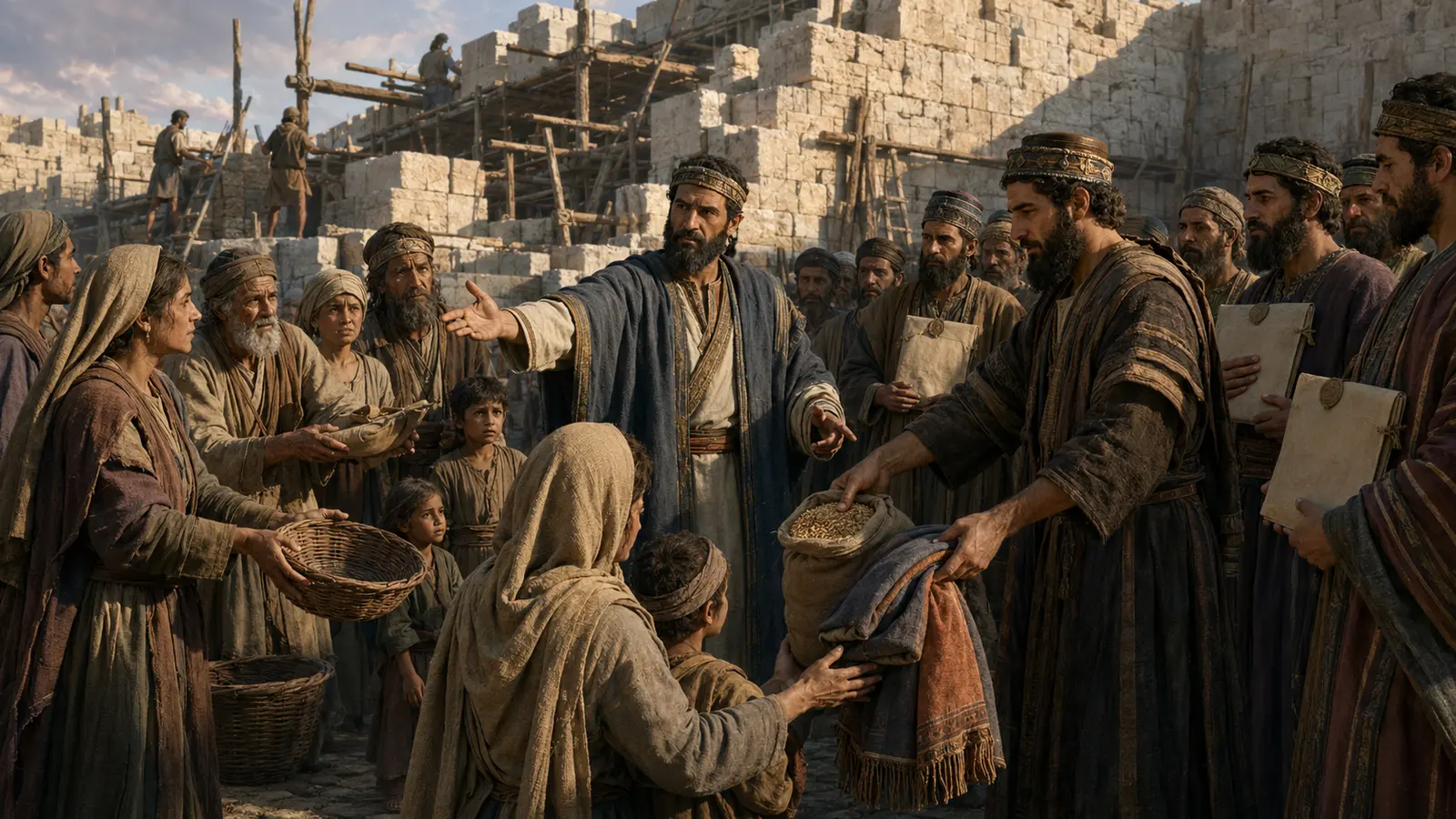
The enemies outside the wall threaten with swords, but hunger rises inside the city like a quieter fire. The stones are being repaired, yet families are being crushed. Jerusalem learns that a wall can protect a people from outsiders, but only justice can heal the house from within.
01
Introduction
Sometimes the greatest danger to God’s work is not the enemy outside, but the wound inside. Nehemiah 4 showed mockery, threats, and intimidation from surrounding opponents. Nehemiah 5 turns our eyes inward. While the people are rebuilding the wall, the poor are crying out for bread. While hands are lifting stones, families are losing fields, vineyards, homes, and even children to debt-slavery.
This chapter is a holy interruption. The wall matters, but the people matter more. The project is urgent, but justice is not optional. Nehemiah must stop looking only at the broken stones and begin looking at the broken economy of the community.
This text asks a piercing question: What kind of restoration is it if the wall is rising while the poor are being crushed beside it?
This text is about rebuilding becoming justice, because God’s people cannot repair public shame while ignoring private exploitation.
Nehemiah 5 teaches that covenant renewal must touch money, food, debt, power, leadership, and daily bread. God does not only care about walls, worship, prayers, and public ceremonies. He cares about whether the hungry eat, whether the poor are protected, whether leaders use power for service, and whether brothers treat one another as family rather than opportunity.
02
Historical and Literary Context
Nehemiah 5 stands within the wall-building narrative [Neh. 3–7], but it pauses the external conflict to expose an internal crisis. The people are under pressure from multiple sides. They are rebuilding under threat [Neh. 4], laboring intensely, and likely facing economic strain because ordinary agricultural work has been disrupted. A famine or food shortage makes the situation worse [Neh. 5:3].
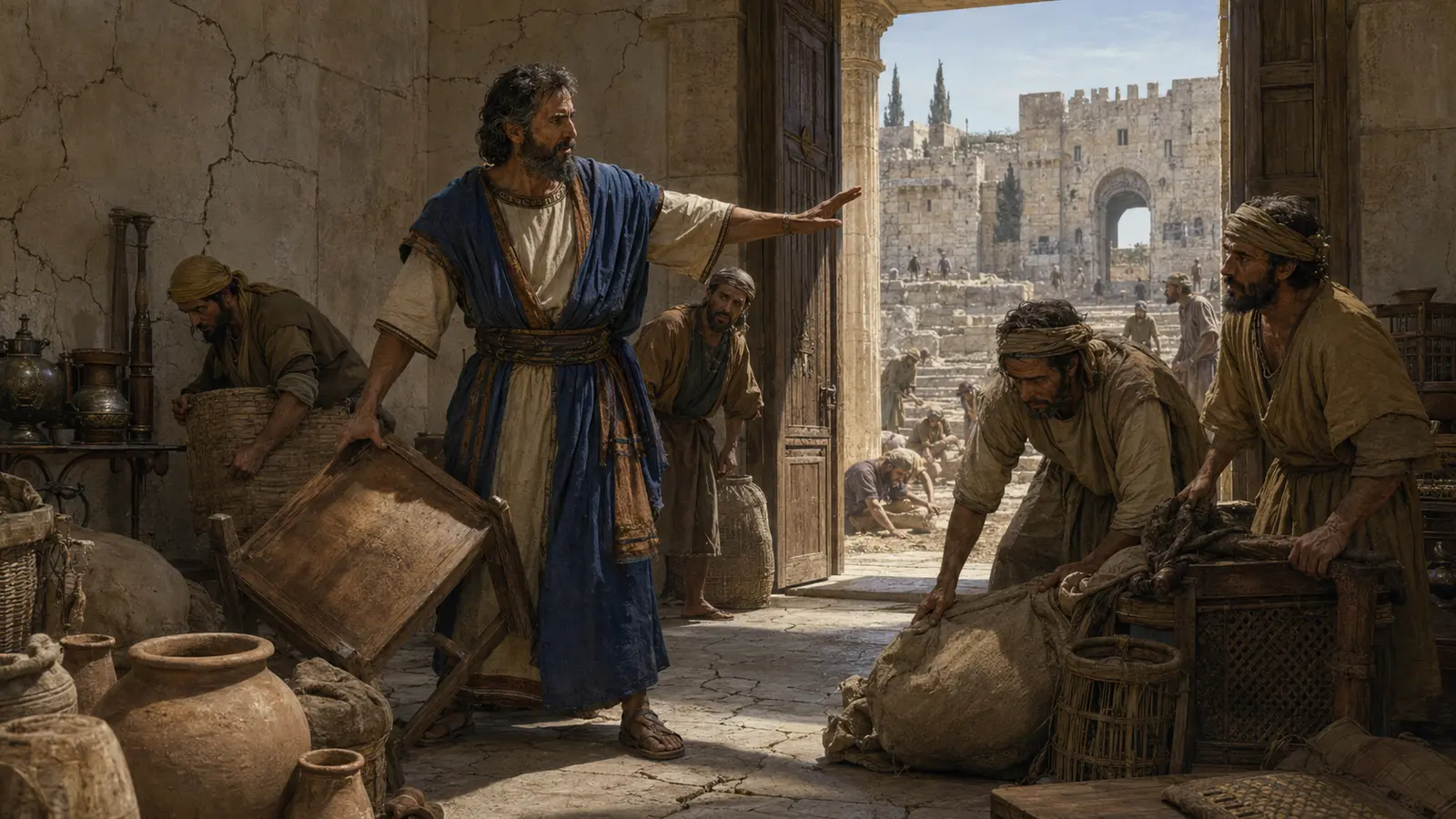
The chapter reveals several layers of suffering. Some families are large and lack grain [5:2]. Others have mortgaged fields, vineyards, and houses to buy food [5:3]. Others have borrowed money to pay the king’s tax [5:4]. Worst of all, some have given their sons and daughters into slavery because of debt [5:5].
This violates the covenant spirit of Israel’s law. The Torah allowed forms of lending, pledging, and debt-servitude in ancient economic life, but it placed strict limits around exploitation. Israelites were not to charge interest to poor brothers [Exod. 22:25; Lev. 25:35–38; Deut. 23:19–20]. They were to remember that they had been slaves in Egypt and redeemed by God [Deut. 15:12–15]. Economic life was meant to reflect redemption, not recreate bondage.
Literarily, the chapter moves from public outcry [5:1–5], to Nehemiah’s anger and confrontation [5:6–13], to Nehemiah’s personal example as governor [5:14–19]. The passage is not merely social commentary. It is covenant theology in economic form.
Within the larger Ezra–Nehemiah story, this chapter deepens the book’s central tension: return from exile does not automatically transform the heart. The people are back in the land. The wall is rising. Yet old patterns of oppression remain alive. A rebuilt city can still contain unredeemed habits. Without justice, restoration becomes a shell.
03
Walking Through the Text
When the Cry of the Poor Interrupts the Project [Nehemiah 5:1–5]
The chapter begins with “a great outcry of the people and of their wives against their Jewish brothers” [Neh. 5:1]. The word “outcry” is strong. It echoes the biblical language of suffering that rises to God, like Israel groaning in Egypt [Exod. 2:23–25]. This is not mere complaint. It is covenant pain crying for justice.
The mention of wives is significant. Women’s voices rise in the public crisis because the suffering has entered the household. This is not abstract economics. It is food on the table, children in danger, land slipping away, daughters being enslaved.
The people describe three levels of distress. Some need grain simply to eat and live [Neh. 5:2]. Others have mortgaged their fields, vineyards, and houses because of famine [5:3]. Others have borrowed money to pay the imperial tax and are losing children to slavery [5:4–5].
The bitter irony is that the oppressors are not foreign enemies. They are “our brothers” [5:1, 5]. While Sanballat and Tobiah threaten from outside, Jewish nobles and officials are exploiting from inside. The wall is meant to protect the people, but some of the people need protection from their own leaders.
The cry exposes the emptiness of restoration without righteousness. What good is a repaired gate if the poor cannot pass through it with dignity?
When Anger Becomes Holy Discernment [Nehemiah 5:6–7]
Nehemiah says, “I was very angry when I heard their outcry and these words” [Neh. 5:6]. His anger is not personal irritation. It is moral clarity. There is a kind of anger that is sinful, proud, and destructive. But there is also a holy anger that rises when the vulnerable are harmed and God’s covenant is dishonored.
Yet Nehemiah does not explode immediately. He says, “I took counsel with myself” [5:7]. This is wise leadership. He feels deeply, but he reflects before acting. He lets anger become discernment, not recklessness.
Then he brings charges against the nobles and officials: “You are exacting interest, each from his brother” [5:7]. He calls a great assembly. Private exploitation has become a public covenant issue. The whole community must face it.
Nehemiah’s anger teaches us that spiritual leadership must not be neutral when the poor are crushed. Silence in the face of exploitation becomes a shelter for injustice.
When Redemption Rebukes Exploitation [Nehemiah 5:8–9]
Nehemiah confronts the nobles with the language of redemption: “We, as far as we are able, have bought back our Jewish brothers who have been sold to the nations, but you even sell your brothers that they may be sold to us!” [Neh. 5:8].
This is devastating. Some Jews had been redeemed from foreign slavery, only for their own brothers to push them back into bondage through debt. The community is reversing the story of Exodus. God redeemed his people from slavery, but they are recreating slavery among themselves.
The nobles are silent. They cannot answer [5:8]. Truth has exposed them.
Nehemiah then says, “The thing that you are doing is not good. Ought you not to walk in the fear of our God to prevent the taunts of the nations our enemies?” [5:9]. In Ezra–Nehemiah, public witness matters. The surrounding nations are watching. If God’s people exploit one another, their enemies have reason to mock their worship, their rebuilding, and their claim to belong to the Lord.
Justice is evangelistic in the deepest sense. A community shaped by God’s mercy must display that mercy in its economic life. Otherwise, the wall becomes a monument to hypocrisy.
When Repentance Must Restore What Was Taken [Nehemiah 5:10–13]
Nehemiah includes himself and his associates in the call to reform: “Moreover, I and my brothers and my servants are lending them money and grain. Let us abandon this exacting of interest” [Neh. 5:10]. He does not stand as though untouched by the system. He calls for a shared turning.
Then he gives specific commands: restore fields, vineyards, olive orchards, houses, and the percentage of money, grain, wine, and oil that had been exacted [5:11]. This is crucial. Biblical repentance is not merely feeling sorry. It repairs where possible. It returns what was taken. It changes the structure that caused harm.
The nobles agree: “We will restore these and require nothing from them” [5:12]. Nehemiah then calls the priests and makes the leaders swear to do what they promised. The presence of priests shows that this is not just economic policy; it is covenant accountability before God.
Nehemiah performs a symbolic act: he shakes out the fold of his garment and says, “So may God shake out every man from his house and from his labor who does not keep this promise” [5:13]. The people answer, “Amen,” and praise the Lord. Then they do as promised.
The movement is beautiful: outcry, confrontation, confession, restitution, oath, worship, obedience. The poor are not merely comforted; the injustice is addressed.
When Leadership Refuses to Feed on the People [Nehemiah 5:14–18]
The final section shifts to Nehemiah’s personal example. For twelve years as governor, he and his brothers did not eat the governor’s food allowance [Neh. 5:14]. Previous governors had laid heavy burdens on the people, taking bread, wine, and silver; even their servants lorded it over the people [5:15]. But Nehemiah says, “I did not do so, because of the fear of God” [5:15].
This is leadership under the fear of God. Nehemiah had the right to receive support, but he refused to use his position to add weight to an already burdened people. He worked on the wall, acquired no land, and fed many at his table [5:16–18].
His example stands against exploitative leadership. He does not lead in order to consume the community. He leads in order to serve it. Power becomes stewardship, not appetite.
This does not mean all leaders must refuse all support. Scripture elsewhere affirms the legitimacy of supporting those who labor in ministry [1 Cor. 9:7–14; 1 Tim. 5:17–18]. But Nehemiah shows that love sometimes limits rights for the sake of the vulnerable. The question is not only “What am I allowed to receive?” but “What does love require in this season?”
When the Servant Asks God to Remember [Nehemiah 5:19]
The chapter ends with one of Nehemiah’s characteristic prayers: “Remember for my good, O my God, all that I have done for this people” [Neh. 5:19].
This prayer can sound uncomfortable to modern ears, but in context it is not empty boasting. Nehemiah brings his service before God, not as self-promotion before the people, but as appeal to the divine Judge who sees hidden sacrifice. He has refused privilege, carried burden, confronted injustice, and served the people at cost.
Still, this prayer also hints at the complexity of Nehemiah’s character in the book. He is courageous and faithful, yet his repeated “remember me” prayers also show a servant who longs for God to see his labor. Ezra–Nehemiah does not give us flawless heroes. It gives us real leaders doing real work in a broken world, pointing beyond themselves to the deeper grace God’s people still need.
04
Theological Reflection
Restoration Without Justice Is Unfinished Restoration
Nehemiah 5 makes clear that rebuilding is not only about walls. A city can be architecturally repaired and morally diseased. God’s restoration must reach the marketplace, household, table, field, loan agreement, wage, debt, and leadership culture.
The prophets had long insisted on this. Worship without justice is offensive to God [Isa. 1:11–17; Amos 5:21–24; Mic. 6:8]. Nehemiah stands in that prophetic stream. The poor must not be trampled while religious projects move forward.
God’s Redeemed People Must Not Recreate Bondage
The heart of the rebuke is Exodus-shaped. God redeemed Israel from slavery; therefore, Israelites must not enslave one another through greed. Redemption creates an ethic. Those who have been delivered must become deliverers, not oppressors.
This reaches forward to the gospel. In Christ, God redeems people from sin, death, and bondage. Therefore, the community of Christ must not become a place where power crushes the weak, where debt becomes a chain, or where leaders feed on the flock [Mark 10:42–45; 1 Pet. 5:2–3].
Repentance Must Become Restitution
The nobles do not merely say, “We are sorry.” They restore fields, vineyards, houses, and interest. Biblical repentance aims to repair damage where possible. Grace does not make restitution unnecessary; grace makes restitution joyful and truthful.
Where harm has been done, confession should ask: What was taken? Who was wounded? What can be restored? What must change so the harm does not continue?
Leadership Is Tested by How It Handles Power
Nehemiah’s example shows that leadership is not measured only by vision, courage, or productivity. It is measured by whether power is used to serve or to consume. The fear of God restrains appetite.
In a world where many leaders use position to extract, Nehemiah models costly restraint. He knows that the people are not a ladder for his ambition. They are God’s people, and leadership must make their burden lighter, not heavier.
05
Life Application
Listen to the cry before defending the project. When people are hurting, do not silence them in the name of progress.
Examine the economics of your obedience. Ask whether your money, lending, business, leadership, and household practices reflect God’s mercy.
Use anger wisely. Let righteous anger become prayerful discernment and courageous action, not destructive reaction.
Make repentance concrete. Where you have harmed someone, ask what can be restored, returned, repaired, or changed.
Do not build ministry on exploited people. God is not honored when church, family, or institutional success is carried by crushed workers.
Let power become service. Leadership is holy when it protects the vulnerable and refuses to feed on their weakness.
Remember that justice is part of witness. The world sees whether our rebuilt walls are matched by repaired relationships.
06
Reflection Questions
1. Who is crying out near the wall you are trying to build?
2. Where might progress in one area of your life be hiding injustice in another?
3. Have you benefited from a system, habit, or relationship that burdens others unfairly?
4. What would concrete repentance look like—not only words, but restoration?
5. How are you using the power, influence, money, or position God has entrusted to you?
07
Response Prayer
Lord God of heaven, Redeemer of slaves, Defender of the poor, open our ears to the cries we have ignored.
Do not let us build walls while our brothers and sisters hunger beside us. Do not let us celebrate progress while hidden burdens crush the weak. Do not let our worship rise while our justice sleeps.
Teach us to fear you more than profit, to love people more than privilege, and to restore what our hands have taken.
Give leaders clean hearts, open tables, and restrained appetites. Make our communities places where the poor are not ashamed, where debt does not become bondage, where power serves, and where repentance repairs.
Build in us a justice deeper than policy, a mercy stronger than self-interest, and a holiness that reaches the marketplace, the household, the field, the table, and the heart.
Through Jesus Christ, who became poor for our sake, who came not to be served but to serve, and who builds a people of mercy and truth, Amen.
08
Window into What Comes Next
Nehemiah 5 exposes the danger inside the wall. The community cannot rebuild faithfully while the poor are being exploited. But in Nehemiah 6, the opposition outside returns with new strategies: distraction, false invitation, intimidation, slander, and prophetic manipulation.
The movement continues: external threats test courage, internal injustice tests integrity, and now deception will test discernment.
The wall is nearing completion, but the battle for faithful leadership is not over.
09
Bibliography
Boda, Mark J. Praying the Tradition: The Origin and Use of Tradition in Nehemiah 9. Berlin: de Gruyter, 1999.
Clines, David J. A. Ezra, Nehemiah, Esther. New Century Bible Commentary. Grand Rapids: Eerdmans, 1984.
Kidner, Derek. Ezra and Nehemiah. Tyndale Old Testament Commentaries. Downers Grove: InterVarsity Press, 1979.
Throntveit, Mark A. Ezra-Nehemiah. Interpretation. Louisville: John Knox Press, 1992.
Williamson, H. G. M. Ezra, Nehemiah. Word Biblical Commentary 16. Waco: Word Books, 1985.
Williamson, H. G. M. Ezra and Nehemiah. Old Testament Guides. Sheffield: JSOT Press, 1987.
Yamauchi, Edwin M. “Ezra-Nehemiah.” In The Expositor’s Bible Commentary, revised edition. Grand Rapids: Zondervan, 2010.

Be the first to leave a comment.