

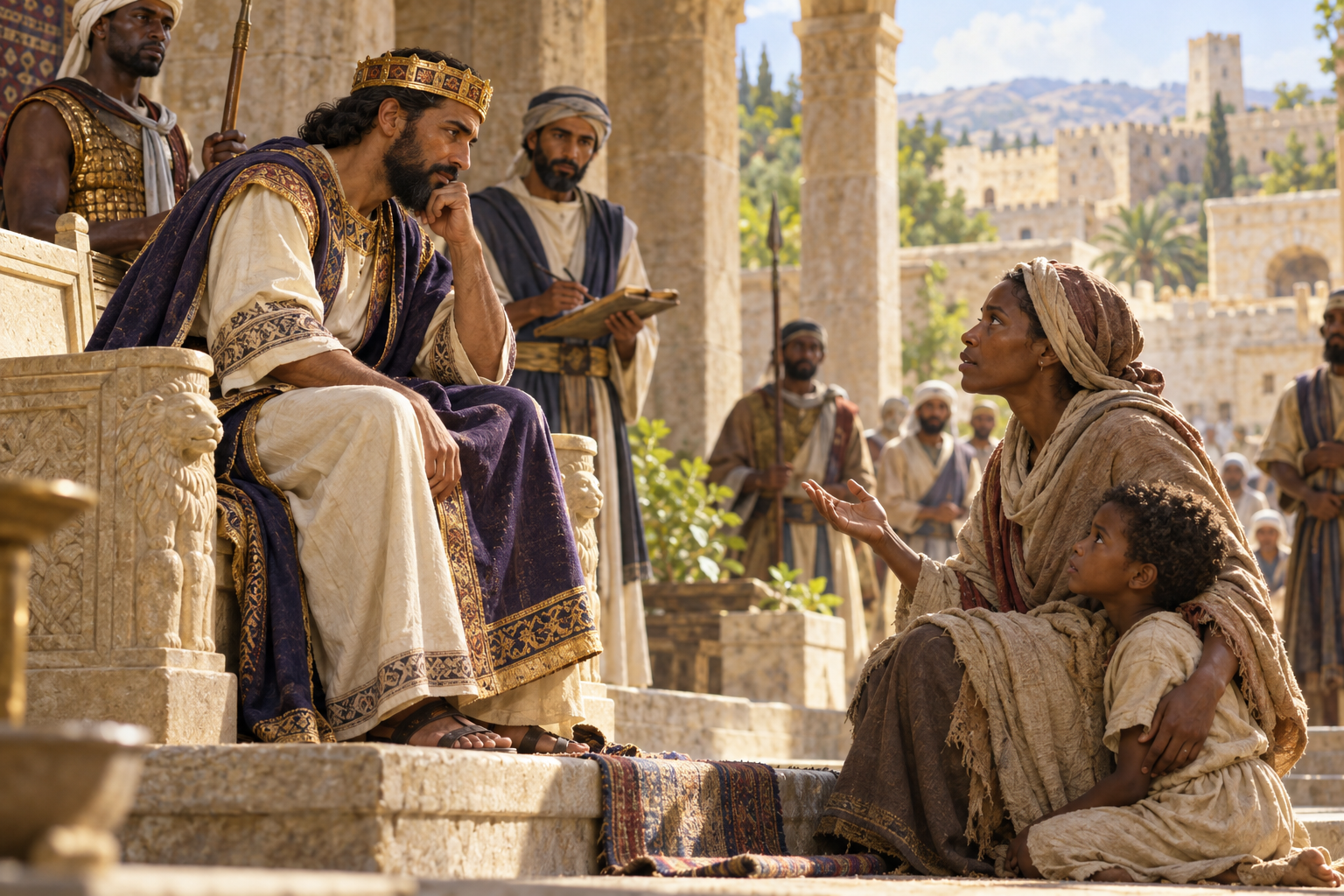
How does righteous leadership reveal itself in listening to and protecting the poor?
01
Overview
A prayer for righteous rule and a world filled with God’s glory
“He will redeem their soul from oppression and violence. Their blood will be precious in his sight.” Psalm 72:14, World English Bible
A person cries for help, but there is no influential friend to make others listen. Psalm 72 imagines a king who hears that cry and acts. The strength of his kingdom appears in the safety of people who would otherwise be forgotten.
02
1.0 Introduction
What should we ask God to give a leader? We often think of wisdom, strength, success, and a long life. Psalm 72 gathers these hopes around a searching concern: will the ruler protect those who have no helper?
The prayer looks toward a kingdom where justice brings peace, the land flourishes, and nations receive blessing. Its vision is expansive, yet it repeatedly returns to people threatened by poverty, violence, and exploitation. Royal greatness carries a responsibility to hear their cries.
The psalm asks God to shape the king’s rule by divine righteousness, so that vulnerable people receive protection and the whole earth shares in blessing. Its final praise directs our attention beyond the ruler to the God whose glory should fill the world. This prayer gives us a way to examine authority, intercede for leaders, and hope for a reign that human rulers have never fully achieved.
03
2.0 Historical and Literary Context
Psalm 72 is a royal prayer within Israel’s life under the monarchy. Its heading connects it with Solomon, but the Hebrew wording can identify a psalm by Solomon or one offered for him. A father’s prayer for his royal son is possible; the heading does not establish David’s authorship or a particular coronation ceremony (Kidner 2014, 273; Goldingay 2007, 381–83).
The opening addresses God and asks for the king’s ability to govern justly. Wishes for enduring rule, fruitful land, and international honor develop that request. The poem combines petition with confident expectation, using elevated royal language to picture the desired reign.
The final verses also belong to the arrangement of the Psalter. Verses 18–19 close Book Two, Psalms 42–72, with praise; verse 20 marks the end of a collection associated with David. Further Davidic psalms occur later, so this note does not claim that every prayer of David ends here (Goldingay 2007, 395–96).
Its place after Psalm 71 is suggestive. A worshiper has asked God for protection when strength fails; now the community asks for a king who protects vulnerable people. Personal dependence and public justice meet in prayer (BibleProject, n.d., 14–15).
04
3.0 Walking Through the Text
3.1 Authority begins with a gift from God
Psalm 72:1–4
The king needs God’s justice and righteousness before he can govern rightly. The people, including the poor, belong to God. Royal authority therefore carries accountability to the One whose people the king serves.
Justice reaches the places where power is most easily abused. The ruler must defend the poor, save needy children, and break the oppressor’s power. The force of verse 4 matters: kindness must be accompanied by action that stops exploitation.
Mountains and hills bearing peace suggest a whole land sharing in the effects of righteous rule. Biblical peace includes security and flourishing within right relationships. A person who can sleep safely, obtain fair treatment, and feed a family begins to experience the substance of this prayer (Kidner 2014, 274–75).
3.2 A reign that refreshes the land
Psalm 72:5–7
The sun and moon stretch the prayer across generations. Translations differ in verse 5: the Hebrew text speaks of reverence for God, while an ancient Greek reading emphasizes the king’s endurance. Both stand within a passage hoping for lasting righteous rule (Goldingay 2007, 379, 386).
Rain falling on cut grass and showers watering the earth make authority visible through its effects. A just ruler enables life to grow. The righteous flourish, and peace becomes abundant.
The enduring heavenly lights express the scale of the hope. They do not establish that an ordinary king will live forever. Nor does the image promise that every faithful community will escape drought or hardship. It portrays the life-giving character of the reign for which Israel prays.
3.3 Worldwide authority and its moral weight
Psalm 72:8–11
The horizon expands from Israel’s land toward the ends of the earth. The River in verse 8 is commonly understood as the Euphrates. Distant coastlands and the kingdoms of Tarshish, Sheba, and Seba widen the picture of royal recognition.
Kings bring tribute and bow; enemies submit. These images belong to ancient royal language and describe actual subordination. They carry a moral tension, because tribute demanded from subject nations can fall heavily on their poorest people (Goldingay 2007, 387–90, 394).
The next section supplies the poem’s reason for honoring this king: he delivers the needy. Claims to greatness must therefore be examined through the treatment of vulnerable lives. The psalm’s expansive vision calls us to seek righteous rule and worldwide blessing while taking the burdens of power seriously.
3.4 The life of the poor is precious
Psalm 72:12–14
Verse 12 connects the king’s greatness to a person’s cry for help. The sufferer has no helper. There is no social protection on which to rely, but the king listens and intervenes.
Compassion moves toward rescue. The ruler protects people from oppression and violence, treating their blood as precious. Their lives cannot be spent carelessly for someone else’s advantage.
The language of redeeming their soul concerns the living person, whose life is threatened. Rescue restores safety and the possibility of living freely. These verses form the moral center of the prayer: the ruler’s response to the powerless reveals the character of his reign.
3.5 Blessing spreads through land and nations
Psalm 72:15–17
The community prays for the king’s life, offers honor, and blesses him continually. Such intercession asks for the ruler described throughout the psalm to endure. It keeps his authority within the prayer’s demands for righteousness.
Verse 16 pictures extraordinary fruitfulness, even on mountain heights, and people flourishing in the cities. Kidner reads the grain as abundant harvest; Goldingay also explores a figurative connection with royal offspring and a flourishing dynasty. The shared emphasis is life spreading abundantly under the hoped-for reign (Kidner 2014, 276; Goldingay 2007, 392–93).
The blessing of the nations in verse 17 recalls God’s promise to Abraham that blessing would reach the families of the earth (Genesis 12:2–3). Israel’s king stands within that wider purpose. The prayer’s horizon keeps opening toward the well-being of others.
3.6 Royal hope becomes praise of God
Psalm 72:18–20
The closing blessing names the Lord, Israel’s God, as the One who does wondrous things. The ruler receives prayer, but God receives the final glory. The whole earth is invited into that glory.
The repeated amen seals the praise. Verse 20 then closes a collection of David’s prayers, providing an editorial boundary within the larger Psalter (Kidner 2014, 277; Goldingay 2007, 395–96).
The ending helps us read everything before it. Justice, rescue, peace, and fruitful life disclose God’s goodness. A king serves this purpose; the kingdom’s achievements belong within worship of the God who makes blessing possible.
05
4.0 Theological Reflection
4.1 God’s righteousness measures human authority
The first petition governs the entire poem. Leaders receive a responsibility that must be exercised in harmony with God’s justice. Recognition, wealth, and longevity have value within a reign that protects people. The condition of those with least influence becomes a searching measure of authority.
4.2 Compassion honors the whole person
The poor need someone to hear them, stop violence, and protect their lives. The prayer joins personal compassion with public responsibility. Human dignity becomes concrete when someone’s safety and fair treatment matter enough to change what powerful people do.
4.3 Blessing carries a worldwide purpose
The poem moves from needy children to nations and finally to the whole earth filled with God’s glory. These scales belong together. Care for one threatened person participates in a divine purpose whose horizon embraces creation. Worship gives that purpose its proper center in God.
06
5.0 Canonical and Christological Horizon
The original prayer concerns Israel’s king. Solomon’s story shows both the possibilities and failures of royal power: he asks for wisdom to judge rightly, while his reign leaves burdens that the people later ask his son to lighten (1 Kings 3:9; 12:4). Psalm 72 provides a standard by which Solomon and other rulers can be assessed.
Interpreters differ over how directly the poem points beyond its historical king. Kidner emphasizes the messianic significance of its boundless and enduring vision; Goldingay emphasizes its initial character as prayer for an actual ruler. Neither approach requires us to erase its original setting (Kidner 2014, 273; Goldingay 2007, 382).
The wider biblical story develops the hope. Isaiah pictures a Davidic ruler who judges fairly for the poor (Isaiah 11:1–5). Zechariah’s humble king announces peace to the nations and rules from sea to sea, echoing Psalm 72’s horizon (Zechariah 9:9–10).
Christians recognize this hope in Jesus. He teaches that authority must take the form of service and gives his own life for others (Mark 10:42–45). Immediately afterward, Bartimaeus cries to him as the Son of David, and Jesus stops to hear and heal him (Mark 10:46–52). This is a thematic connection with the king who hears the needy; the Gospel does not explicitly quote Psalm 72 here.
Jesus’ resurrection opens the hope toward new creation. Revelation pictures nations walking in God’s light and kings bringing their glory into the renewed city (Revelation 21:24–26). The prayer for righteous rule reaches toward a world where divine glory, human dignity, and peace belong together.
07
6.0 Life Application
1. Pray for leaders with the psalm’s priorities. Ask God to give them justice, compassion, and courage to stop exploitation. Name the people whose safety depends on their decisions. 2. Listen to a voice that is easily overlooked. Make room for someone who lacks influence to describe a real need. Hear the person before deciding what help would be useful. 3. Examine the authority entrusted to you. In family, church, or work, consider how your decisions affect those least able to challenge you. Change one practice that places an unfair burden on them. 4. Give compassion a practical form. Offer time, resources, accompaniment, or a fair hearing that strengthens someone’s safety and dignity. Let the person’s actual need guide your response. 5. Let worship widen your concern. Pray for communities beyond your own. Join a concrete act of service to the hope that God’s blessing will reach the nations.
08
7.0 Reflection Questions
1. Whose cry for help have I become accustomed to hearing without responding? 2. How does Psalm 72 reshape the qualities I admire in a leader? 3. Where does my use of authority make another person’s life safer, and where does it add to their burden? 4. What does Jesus’ attention to Bartimaeus teach me about receiving and practicing his rule? 5. How might hope for a world filled with God’s glory change one decision I make this week?
09
8.0 Response Prayer
God of righteousness, give wisdom and courage to those who lead. Teach them to hear the person who has no helper and to protect lives threatened by violence.
Let your justice refresh our communities as rain refreshes thirsty ground. Make our compassion patient, truthful, and practical.
Lord Jesus, Son of David, shape our use of power by your serving love. Open our hearts to the people you hear.
May your blessing reach the nations, and may the whole earth be filled with your glory. Amen.
10
9.0 Window into What Comes Next
Psalm 72 closes Book Two with a vision of righteous rule and worldwide blessing. Psalm 73 opens Book Three with Asaph’s distress over a world that seems to reward the wicked. The reader moves from praying for justice to facing its apparent absence.
This sequence makes room for both hope and struggle. A vision of God’s goodness can remain true while present experience raises painful questions. When those who exploit others appear to prosper, how will we keep bringing our doubts and our longing for justice into God’s presence?
11
10.0 Bibliography
Scripture: World English Bible. Psalm 72 and the biblical passages cited above. Psalm 72.
BibleProject. n.d. The Book of Psalms: Study Notes. Especially pages 2–3 and 14–15. Supplied study notes.
Goldingay, John. 2007. Psalms. Volume 2: Psalms 42–89. Baker Commentary on the Old Testament Wisdom and Psalms. Grand Rapids, MI: Baker Academic. Psalm 72, pages 379–96.
Kidner, Derek. 2014. Psalms 1–72. Kidner Classic Commentaries. Downers Grove, IL: InterVarsity Press. Originally published 1973. Psalm 72, pages 273–77.
Be the first to leave a comment.