

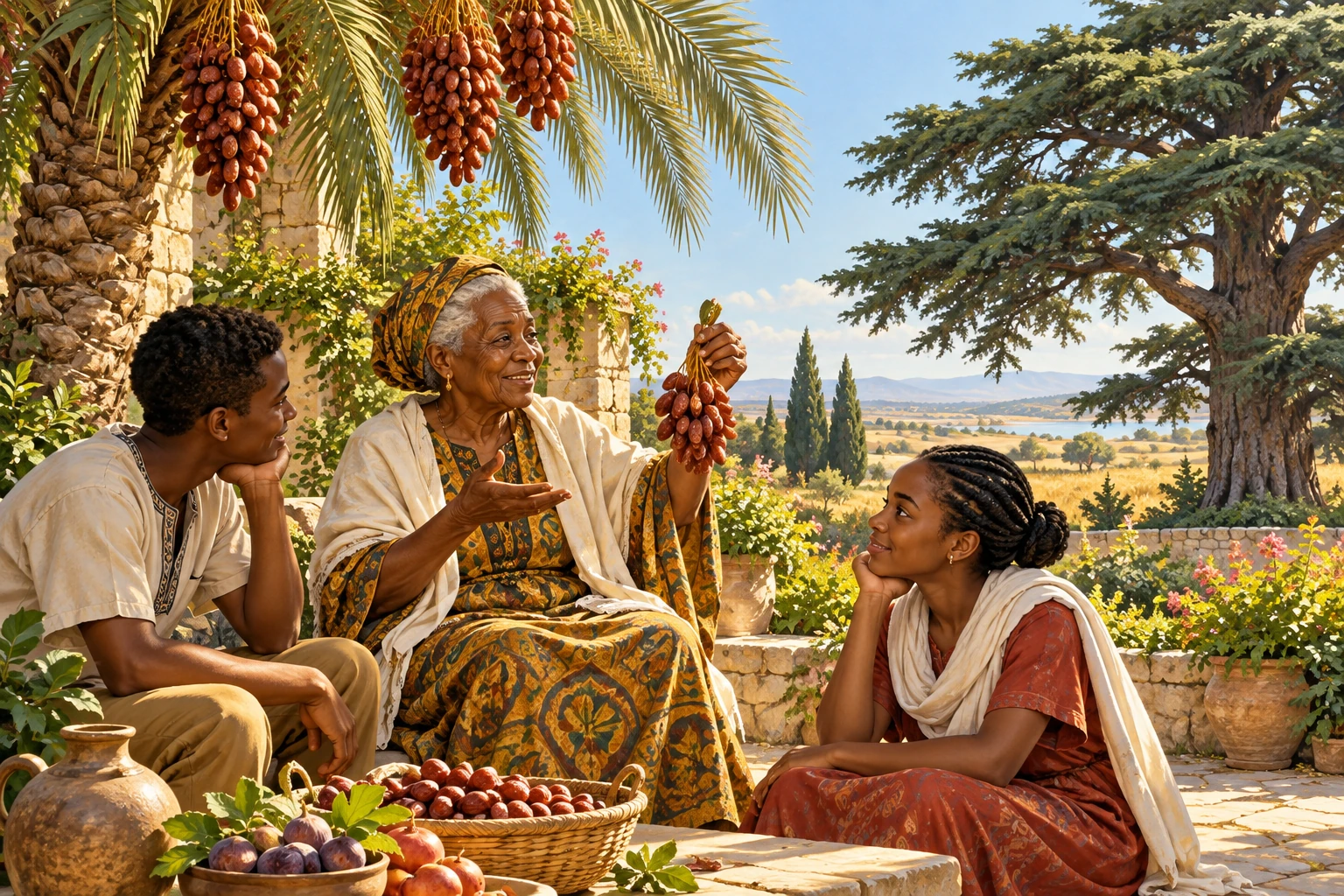
As the years pass, how can we keep bearing fruit and living with gratitude?
01
Overview
A Sabbath song about gratitude, the passing grass, and the life that takes root in God's presence
Key text — Psalm 92:14–15 (sense): Even in old age the righteous continue to bear fruit, proclaiming that the LORD is upright and faithful.
Grass can make a field look green overnight. A tall tree takes years to grow roots that hold when the weather changes. Both may look alive today, but the psalmist invites us to ask a different question: What kind of life will remain fruitful?
Psalm 92 gives this question a surprising setting—the Sabbath. A day set apart for rest becomes a school for recognizing God's deeds, refusing to mistake short-lived success for lasting goodness, and learning to grow old without losing the possibility of bearing fruit.
02
1.0 Introduction
Psalm 91 speaks of taking refuge under God's wings when danger approaches. Psalm 92 opens with a different response to the same trustworthy God: it is good to give thanks, sing, and tell of his love in the morning and his faithfulness at night. Trust becomes praise; protection becomes remembered testimony.
Yet the song is not detached from the real world. The wicked are prospering. The faithful know exhaustion, opposition, and the temptation to measure life by what seems to be working today. The singer does not deny the success of wrongdoers. Instead, he questions its durability. He contrasts grass that appears for a season with palms and cedars that continue to grow because they are established in God's presence.
The poem is therefore more than an attractive description of trees or a hymn to be sung at the end of the week. It teaches a way of seeing the world. The life worth cultivating is not necessarily the life that grows fastest. It is the life rooted in God's faithfulness, able to praise him and bear fruit across the seasons.
03
2.0 Historical and Literary Context
The Hebrew heading identifies Psalm 92 as a psalm, a song for the Sabbath day. It is the only psalm whose biblical title explicitly mentions the Sabbath. The heading does not name an author, give a date, or identify a particular event behind the song. A royal or public leader could have spoken its personal thanksgiving, but this remains a possibility rather than an established setting (Goldingay 2008, commentary on Psalm 92).
The Sabbath was part of Israel's covenant rhythm: rest rooted in the creation story (Exodus 20:8–11), remembrance of liberation from slavery (Deuteronomy 5:12–15), and time set apart as a holy gathering (Leviticus 23:3). The psalm does not rehearse all these commands. Instead, it shows what Sabbath can make room for: joyful thanksgiving, thoughtful attention to God's works, and a perspective wider than the urgency of the present moment.
Kidner describes the psalm as evidence that Sabbath is not merely a restriction on labor but an occasion for delighted worship (Psalms 73–150, 366–69). Goldingay places greater stress on its unusual combination of testimony, praise, and instruction. A worshiper recounts what God has done, declares what it reveals about God's character, and helps the community judge the meaning of the wicked's prosperity and the righteous person's endurance (Goldingay 2008, “Psalm 92: Testimony, Praise, and Teaching”). The two emphases complement each other.
The poem moves in a carefully shaped sequence: verses 1–3 invite continual praise; 4–5 celebrate God's great works and profound purposes; 6–9 expose the short horizon of those who ignore God; 10–11 testify to renewed strength amid hostile circumstances; and 12–15 portray the righteous as enduring, fruitful trees. The singer moves from “me” and “my” to the shared confession of “our God” (v. 13), allowing personal gratitude to become a lesson for the whole community.
04
3.0 Walking Through the Text
3.1 Psalm 92:1–3 — It is good to thank the LORD
The psalm begins not with a command but with a judgment about what is good: thanksgiving and music belong to a fitting, beautiful human life. Worship is not simply a duty that God extracts from reluctant people. The singer has discovered that remembering God's goodness is itself good for those who do it.
Morning and night form a poetic pair. God's steadfast love—Hebrew ḥesed, his dependable covenant commitment—is to be proclaimed when a new day begins. His faithfulness, or reliability, is to be named when darkness comes. Goldingay notes that the pair likely conveys ongoing proclamation rather than a precise requirement about two daily services. The instruments in verse 3 give the testimony an audible, shared form.
The words also teach a discipline of attention. A person can rehearse anxiety each morning and disappointment each evening. Psalm 92 invites another practice: tell the truth about God's love before the day's demands begin, and acknowledge his trustworthiness when the day is over. This does not forbid lament. The surrounding Psalms contain plenty of it. Rather, thanksgiving makes sure lament does not become the only story we remember.
3.2 Psalm 92:4–5 — The works are great; the purposes are deep
The singer's joy has a reason: God has made him glad through the works of his hands. These are not vague uplifting feelings. The psalmist knows something about God's action in history and, apparently, in his own experience. But he does not identify a specific rescue. The testimony leaves room for other worshipers to recall different ways they have experienced divine care.
The works are described as great; the thoughts or purposes behind them are deep. The difference matters. We may see an outcome without understanding every intention leading to it. God's wisdom exceeds the narrow explanations we can construct from a single event (compare Isaiah 55:8–9).
Depth is not an excuse for refusing to ask questions. It is a warning against claiming to have read the whole story from one chapter. The psalm's next verses show why this humility is necessary: wrongdoing can look remarkably successful for a time.
3.3 Psalm 92:6–9 — The wicked flourish like grass, but God remains forever
The blunt language in verse 6 describes a person who refuses to recognize what the psalm teaches. This is a problem of moral perception, not a claim that people with limited education or intellectual ability are lesser human beings. Someone may be clever enough to make money, win influence, and plan a campaign, yet remain profoundly unwise about the purposes of life.
The wicked really do flourish, at least for a while. Their success is not dismissed as imaginary. Yet the image changes the measure of success. Grass may spring up quickly, creating an impressive burst of green, but its life is comparatively brief. The wrongdoer's apparent permanence is an illusion.
By contrast, the LORD is exalted forever (v. 8). The whole comparison hinges on time: a season of visible success is not the same as an enduring future. Verse 9 insists that opposition to God's good purposes will not stand forever. The repetition gives force to the confession without identifying any present-day group as God's enemy merely because it opposes us.
These verses should be read alongside Psalm 73, which wrestles painfully with the prosperity of the wicked, and Psalm 88, which does not end with relief. Psalm 92 speaks from the confidence of testimony; it is not a calendar predicting exactly when every injustice will be corrected. Scripture does not authorize us to infer from wealth that a person is righteous, or from suffering that a person is wicked.
3.4 Psalm 92:10–11 — Strength renewed without self-glorification
The singer now describes his own experience of deliverance. His “horn” has been lifted like that of a wild ox. In biblical poetry the horn represents strength, security, and the ability to stand after being brought low. The image is not an invitation to dominate weaker people. It testifies that God has given the worshiper a new footing when hostile forces seemed overwhelming.
The image of fresh oil adds a sense of relief, welcome, and renewal. Oil could be used for celebration, care, or anointing. Kidner emphasizes renewed consecration for service, while Goldingay also considers the refreshment of someone who had become exhausted. The verse itself need not be restricted to one ceremony or to a claim of extraordinary spiritual status (Kidner, 368; Goldingay, Psalm 92, on v. 10).
Verse 11 speaks of seeing and hearing what became of adversaries. This is the testimony of someone who has lived through opposition and has seen its power broken. The moral guardrail comes from the larger song: God, not the singer's superiority, is the reason for praise. Personal rescue must not become a license to enjoy another person's humiliation or to name every critic an enemy of God.
3.5 Psalm 92:12–14 — Planted deeply enough to bear fruit in old age
The poem's most memorable picture now comes into view. Righteous people flourish like date palms and grow like cedars of Lebanon. The palm is associated with growth and fruitfulness; the cedar with height, strength, and enduring stature. Unlike grass in verse 7, these trees suggest a longer horizon.
The trees are “planted” in the house of the LORD and flourish in the courts of our God. This is poetic imagery: the singer is describing the life of people who dwell in God's presence and share in his worship, not insisting that literal cedars grow inside the sanctuary. The picture recalls Psalm 1:3, where the person attentive to God's instruction resembles a tree planted by streams of water.
The surprise comes in verse 14. Fruitfulness is not confined to youth. Those who are older may still have something nourishing to offer: patient judgment, hospitality, prayer, mentoring, steadfast witness, and wisdom gained through suffering. They may no longer do everything they once did, yet their lives can still matter profoundly.
This is an image of spiritual vitality, not a guarantee that faithful people will never develop illness, disability, fatigue, or dementia. Kidner explicitly acknowledges that bodily and mental ailments can severely limit what the image looks like in practice (Psalms 73–150, 369). A church faithful to this psalm honors its elders without placing on them the burden of proving their worth through constant productivity. Sometimes the fruit is in giving; sometimes it is in receiving care with dignity and allowing a community to learn love.
3.6 Psalm 92:15 — A fruitful life points beyond itself
The final verse reveals the purpose of the trees' long endurance: to declare that the LORD is upright. He is the singer's rock, without injustice or unfaithfulness. The ending recalls the description of God as the faithful Rock in Deuteronomy 32:4.
This turns the entire poem outward. The promise is not simply that good people live longer or feel stronger. It is that a life rooted in God can become testimony to God's own character. As praise began on the worshiper's lips (vv. 1–2), it concludes in a life that tells the truth about him (v. 15).
05
4.0 Theological Reflection
4.1 Sabbath gives us time to judge life by a different measure
The Sabbath heading is not incidental. A day of stopping interrupts the temptation to decide our worth by achievement, purchasing power, speed, or visible success. Israel remembered the Creator who rests and the Redeemer who frees slaves (Genesis 2:2–3; Exodus 20:8–11; Deuteronomy 5:12–15). Psalm 92 adds a practice of grateful attention. When work is set aside, we can ask what work means and whose goodness makes life possible.
4.2 Flourishing is not the same as prospering immediately
Both grass and trees can look green. They differ in rootedness and endurance. The psalm therefore challenges quick moral calculations: money does not establish righteousness, and difficulty does not establish failure. The psalm's confidence is about God's enduring character and purposes, not an automatic promise of visible success to the faithful this week.
4.3 Worship forms patient people, not passive people
Remembering God's works can help people resist the frantic imitation of those who succeed by exploitation. But trust is not an excuse to ignore injustice. To believe that God is upright (v. 15) is to care about what is right in our treatment of workers, neighbors, children, and the vulnerable. The Sabbath rhythms of rest and worship ought to make us more attentive to those denied rest, not less.
4.4 Old age is a season of belonging, not an expiration date
The trees stand in God's courts before they are described as fruitful. Belonging comes before productivity. This reverses a culture that measures the elderly mainly by what they can still accomplish. The congregation is called to receive their witness, make space for their gifts, and accompany them with compassion when limitations increase.
06
5.0 Canonical and Christological Horizon
Psalm 92 belongs within the wider biblical story of creation, covenant, and restored life. Its Sabbath title recalls creation's seventh day (Genesis 2:2–3), while Israel's Sabbath command also remembers release from slavery (Deuteronomy 5:12–15). Isaiah 58:13–14 similarly connects Sabbath delight with a life reordered before God. These passages do not reduce Sabbath to inactivity; they present time received as God's gift rather than treated as an endless resource to be exploited.
Jesus regularly worshiped on the Sabbath (Luke 4:16), called himself its Lord, and taught that it was made for humanity (Mark 2:27–28). His healings on the Sabbath show that the gift of holy time is compatible with acts that restore human life (Mark 3:1–6; Luke 13:10–17). Christian traditions differ about the continued observance of the seventh day and the significance of first-day worship. Psalm 92's heading establishes its original Sabbath setting; by itself it does not settle every later debate about Christian calendars. What remains clear is the call to delight in God, honor human dignity, and receive rest as a gift rather than a burden.
The image of the flourishing tree runs through the Scriptures. Psalm 1 and Jeremiah 17:7–8 describe a person rooted in trust. Jesus speaks of abiding in him as branches in a vine that bear fruit (John 15:1–8). The metaphors are not identical—Psalm 92 names palms and cedars, not vines—but their shared concern is life sustained by relationship with God rather than by self-generated strength.
The New Testament refuses to equate bodily weakness with spiritual failure. Paul can speak of an outward person wasting away while the inward person is being renewed (2 Corinthians 4:16–18). The resurrection of Jesus is the decisive reason Christian hope reaches beyond the apparent defeat of death (1 Corinthians 15:20–26). Revelation ends with the tree of life whose leaves are for the healing of the nations (Revelation 22:1–2). Read in that wider horizon, Psalm 92's enduring trees point toward a creation in which life is finally healed, without promising that present bodies will never age.
07
6.0 Life Application
- Begin and end the day with truthful gratitude. Each morning name one expression of God's steadfast love. Each evening remember one reason to trust his faithfulness—even if your day has also included grief.
- Practice meaningful Sabbath rest. Set aside a regular holy rhythm for worship, rest, remembering God's deeds, and acts of mercy. Let this interrupt the pressure to prove your worth through constant activity.
- Examine what you call success. When people prosper through dishonesty or domination, resist both envy and the temptation to imitate them. Ask instead what will remain good when a season of applause has passed.
- Make room for older people's fruit. Invite an older member to tell a story of God's faithfulness. Listen without rushing. Support those whose strength has diminished, without treating dependence as diminished dignity.
- Let praise become character. Choose one concrete action of fairness, generosity, or reconciliation through which someone might glimpse that the God you worship is upright.
08
7.0 Reflection Questions
- Which events in my life have made it difficult—or especially meaningful—to say that giving thanks to God is good?
- Where am I tempted to confuse fast growth, public recognition, or financial success with lasting fruitfulness?
- How could a Sabbath rhythm change the way I relate to work, the people who depend on me, and those who need rest?
- Who are the older people in my community whose wisdom I have overlooked? How can I honor them without demanding productivity?
- If my life is meant to proclaim that God is upright, which relationship or habit needs to change first?
09
8.0 Response Prayer
LORD, our faithful Rock, you see the grass that rises quickly and the trees that grow slowly through many seasons. Teach us not to mistake noise for joy or speed for a life that lasts.
Open our eyes to the greatness of your works and the depth of your wisdom. Give us time to stop, remember, and sing. Where we have made work our master, lead us into the freedom of your rest.
Renew those who are exhausted. Comfort those who have lost what they once could do. Make our communities places where children are nurtured, older people are honored, and no one must earn the right to belong.
Plant us more deeply in your love. Let our choices bear the fruit of justice and mercy, so that our words and our lives together may declare your faithfulness. Through Jesus Christ, the risen Lord, keep us fruitful in hope until creation is made new.
Amen.
10
9.0 Window into What Comes Next
Psalm 92 closes by declaring that the LORD is upright and can be trusted. Psalm 93 will lift our eyes from the people who flourish in God's courts to the One who rules over the whole world. Its opening announcement is direct: the LORD reigns.
The movement is fitting. The Sabbath singer has learned that God is exalted forever, even when wrongdoing appears to prosper. Psalm 93 takes that conviction into the sound of surging waters and the stability of God's throne. The faithful can grow roots because their King is not shaken.
11
10.0 Bibliography
- Scripture: Psalm 92; Genesis 2:2–3; Exodus 20:8–11; Deuteronomy 5:12–15; 32:4; Leviticus 23:3; Psalm 1; 73; 91; Isaiah 58:13–14; Jeremiah 17:7–8; Mark 2:27–28; 3:1–6; Luke 4:16; 13:10–17; John 15:1–8; 2 Corinthians 4:16–18; 1 Corinthians 15:20–26; Revelation 22:1–2.
- Goldingay, John. Psalms, Volume 3: Psalms 90–150. Baker Commentary on the Old Testament Wisdom and Psalms. Grand Rapids: Baker Academic, 2008. Commentary on Psalm 92, “Testimony, Praise, and Teaching.”
- Kidner, Derek. Psalms 73–150. Original edition 1975; reprinted 2014. Commentary on Psalm 92, “They That Wait on the Lord …,” pp. 366–69.
- BibleProject. The Book of Psalms: Study Notes. Project reference for the five-book design of the Psalter and the place of Psalm 92 in Book Four.
Be the first to leave a comment.