


When the waters of life roar, what gives us a foundation that cannot be shaken?
01
Overview
The King above the floods, the world he sustains, and the holiness that belongs to his house
Key text — Psalm 93:4 (sense): Above the roar of abundant waters and the mighty breakers of the sea, the LORD on high is mightier still.
A wave does not ask permission before it breaks. From the shoreline, the water's force can make human plans seem fragile: buildings stand where a storm may reach, boats travel where the wind may turn, and those on land cannot silence the sea. Psalm 93 listens to that roar without pretending it is harmless. Then, without moving the sea or denying its power, it lifts our eyes higher: the LORD reigns.
The poem has only five verses, yet it opens a vast horizon. It begins with a royal proclamation, looks back toward the ordering of the world, hears the waters rise in defiance, and ends with a quieter but equally important claim: God's words can be trusted, and holiness belongs in his house. The King who is strong enough to govern the waters is also worthy of moral confidence.
02
1.0 Introduction
Psalm 92 concludes with people rooted in God's presence, bearing fruit and declaring that the LORD is upright. Psalm 93 shifts the focus from those who trust him to the One who makes their trust possible. Why can life take root in a world where so much feels uncertain? Because the King of creation is not himself swept away by what threatens his creatures.
In Israel's story, the political world could seem unstable. The promise concerning David's throne appeared shattered in Psalm 89; Psalm 90 therefore began Book Four by naming God, rather than a royal palace, as the people's dwelling place through generations. Psalm 93 carries that confession further: even when human crowns fall, the LORD's authority is not a fragile institution awaiting rescue.
But this is not simply a song celebrating unlimited power. The final verse joins God's reliable testimonies with holiness. His reign gives stability to the world and a trustworthy shape to the life of his people. If we admire God's strength but ignore the character of his rule, we have heard only half the psalm.
03
2.0 Historical and Literary Context
Psalm 93 has no superscription in the Hebrew Masoretic Text. Its author, date, and original occasion are therefore unknown. The ancient Greek tradition adds a heading associating it with the day before the Sabbath and with David; that tradition is worth noting, but it does not establish an original Hebrew heading or prove Davidic authorship (Goldingay 2008, commentary on Psalm 93).
The poem begins a group often called the divine-kingship or enthronement psalms, particularly Psalms 93 and 95–99. Psalm 94, a prayer for justice, stands within the sequence as an important reminder that celebrating God's rule does not remove the problem of oppression. The opening Hebrew proclamation, YHWH mālak, is commonly rendered “The LORD reigns!”; it can also carry the force of “The LORD has become king” or “has asserted his kingship.” The latter sense does not mean that another deity previously ruled over God. It emphasizes God's effective exercise of sovereign authority (Kidner 2014, 369–70; Goldingay 2008, “Psalm 93: Yhwh Began to Reign”).
Some scholars have proposed that such psalms were used in an annual enthronement festival. A worship setting is plausible, but there is no direct biblical evidence of a prescribed Israelite festival in which God was thought to receive kingship anew each year. We should not build our interpretation on a reconstructed ceremony that the text itself never describes (Kidner 2014, 369–70; Goldingay 2008, Psalm 93, Interpretation).
The sea imagery matters. In biblical poetry, surging waters can describe literal natural power, resistance to God's ordering of creation, or the uproar of threatening nations (Genesis 1:6–10; Psalm 46:2–7; Isaiah 17:12–13). Goldingay emphasizes the primeval waters being given limits in the act of ordering creation; Kidner stresses that the poem does not minimize the dangerous tumult people encounter. Both readings illuminate why the sea can roar while the divine throne remains secure.
The five verses form a concise progression: verses 1–2, the royal proclamation and the world's stability; verse 3, the waters' repeated rising; verse 4, the surpassing majesty of the LORD; verse 5, the reliability of his word and the holiness of his house. Repetitions—“clothed,” “established,” and three references to waters rising—give the short song a memorable spoken rhythm.
04
3.0 Walking Through the Text
3.1 Psalm 93:1a — The LORD wears majesty and strength
The announcement comes before any explanation: the LORD reigns. The singer does not begin with the credentials of a human ruler, a list of victories, or the size of a court. The claim concerns the One whose authority is not granted by a crowd and cannot be withdrawn by a rival.
The LORD is pictured as clothed with majesty and girded with strength. Such language takes a recognizable image—royal clothing, and the belt of one prepared for decisive action—and applies it poetically to God's active power. It is not a claim that God possesses a literal robe or weapons. Majesty describes the splendor appropriate to his rule; strength declares that his government is not ceremonial or powerless.
Goldingay observes that the imagery can evoke a ruler preparing for conflict, not merely appearing in beautiful garments. Kidner likewise hears an energetic announcement rather than a detached description of an eternal principle (Goldingay 2008, Psalm 93:1–2; Kidner 2014, 370–71). The text celebrates a King who can act.
Yet it is important to ask what this kingship is for. A ruler's impressive display means little to those who suffer under arbitrary authority. Psalm 93 will answer that question not with a longer parade of power, but with the dependable word and holy character of God in verse 5.
3.2 Psalm 93:1b–2 — The world stands because God's throne is established
The second half of verse 1 states that the world is established and cannot be shaken. Verse 2 immediately grounds that claim in God's throne, established from long ago, and in God's own existence before human memory reaches.
The point is not that geography never changes or that disasters cannot happen. The biblical writers knew floods, earthquakes, famine, and warfare. Indeed, the waves of the next verses make upheaval impossible to ignore. “The world will not be shaken” is a confession that creation is not abandoned to ultimate meaninglessness or to powers that can overthrow its Maker's purposes.
Goldingay notes that the Hebrew word for “world” here, tēbēl, can emphasize the inhabited, ordered world of human life. Stability is received, not self-generated. God sets bounds within which life can exist; the world has no independent throne supporting itself (Goldingay 2008, Psalm 93:1–2; compare Job 38:8–11).
The phrase “from long ago” also carries a literary contrast. Human rule begins, weakens, and ends. God is not a temporary occupant of his throne. In the light of Psalm 90:2, “from everlasting to everlasting,” this is a deeper reassurance than any promise of a permanent earthly administration.
We should resist translating this theological security into an assurance that a particular country, church structure, or personal plan is immune to collapse. The throne that does not move is God's, not ours. Faith gains freedom when it stops treating every change as a threat to God's existence.
3.3 Psalm 93:3 — The waters lift their voices
The song now lets the waters speak. Three times the poet repeats the image of the floods lifting themselves, their voices, and their pounding waves. Repetition makes the listener almost hear the surf growing louder.
These are not decorative ripples. Water sustains life, but water can also destroy what people build. In the creation narrative, the waters are gathered so that dry land appears (Genesis 1:9–10). In the Exodus, waters become the scene of danger and deliverance (Exodus 14–15). Elsewhere, roaring waters evoke international turmoil (Isaiah 17:12–13). Psalm 93 can resonate with these different biblical memories without requiring us to reduce the floods to one specific empire or historical invasion.
Kidner emphasizes the realism of the threatening sound; the psalm does not tell the worshiper that the danger is imaginary. Goldingay sees in the primeval waters a picture of the unruly forces that had to receive limits for an ordered world to exist (Kidner 2014, 371; Goldingay 2008, Psalm 93:3–4). Both emphasize that the threatening powers do not stand on equal terms with God.
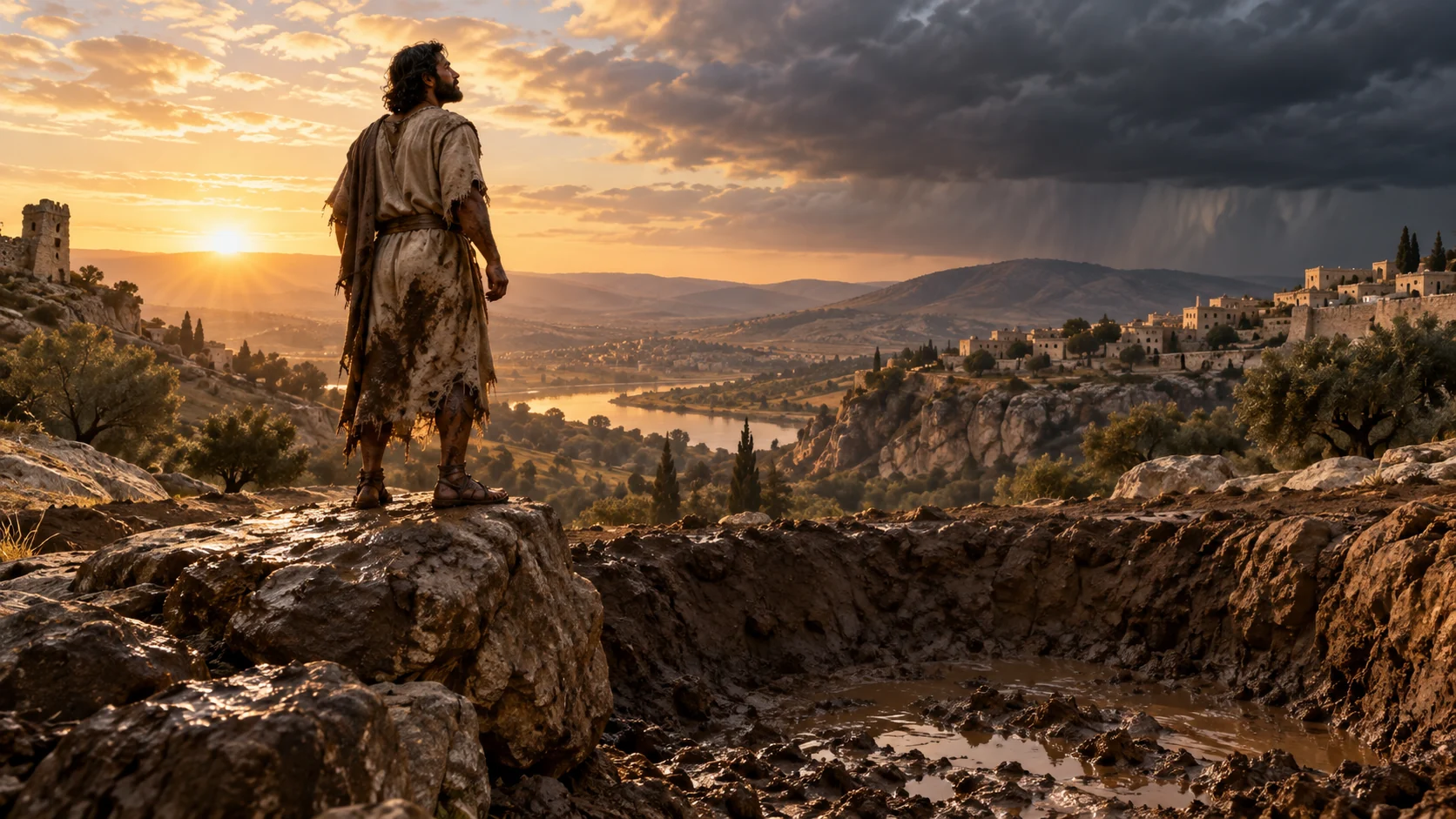
For people living through conflict, instability, or fear, the imagery rings true. A problem can return in waves. One crisis subsides, another gathers, and anxiety grows louder. Psalm 93 does not ask us to silence the noise by denying it. It invites us to hear a truer word above it.
3.4 Psalm 93:4 — The LORD on high is mightier
The response is concise: more majestic than the voice of many waters and the breakers of the sea is the LORD on high. The waves are mighty; he is mightier. The psalm does not need to describe a battle in detail to make its comparison.
“On high” locates the King beyond the reach of the tumult and emphasizes the difference between his reign and the struggles of the earth. This does not mean he is distant or indifferent. The world is stable precisely because the One on high is its sustainer. His transcendent majesty has practical consequences below.
The verse contains a small textual and syntactical question about how to arrange the comparison between the roar of the waters, the majestic breakers, and the LORD. Some translations make an explicit “mightier than” comparison; others preserve a more compact Hebrew sequence. The major point remains the same: the waters possess considerable power, but they do not surpass the LORD (Kidner 2014, 371, n. 22; Goldingay 2008, Psalm 93:4).
This claim should not be used to belittle people who have experienced flooding, displacement, or other disasters. It would be cruel to say that because God reigns, a grieving family should feel no fear. The psalm offers a horizon for trust amid real danger; it does not claim that faith abolishes the need for protection, warning systems, community action, or mourning.
What it offers is a changed comparison. The loudest thing in our lives is not necessarily the greatest thing in reality. The roar is real. It is not the throne.
3.5 Psalm 93:5 — God's word is trustworthy; holiness fits his house
The final verse surprises us. After majesty, strength, and the sea, we might expect another spectacular image. Instead, the poet speaks of God's testimonies as trustworthy and of holiness as fitting his house for all days.
The Hebrew word translated “testimonies” or “decrees” can describe God's authoritative declarations. Kidner hears the firmness of God's revealed assurances, promises, warnings, and commands. Goldingay stresses that, in the context of the creation imagery, these may especially be God's effective decrees establishing the limits of threatening forces. These are not mutually exclusive lessons: the divine word that orders creation must be reliable, and God's people are called to trust what he says (Kidner 2014, 371–72; Goldingay 2008, Psalm 93:5).
The second claim is just as important. Holiness befits God's house. There is some interpretive range in whether the house is understood primarily as God's heavenly dwelling or the earthly sanctuary where his people worship. Goldingay emphasizes the heavenly dwelling in this poem; Kidner draws out the implications for the holiness of worshipers in God's temple. The Psalm itself says that holiness belongs to the divine dwelling, not that impressive buildings automatically prove God's presence.
The final phrase extends the perspective across the years. As in verse 2, time is part of the song's assurance. The reign that precedes our crises also outlasts them. Holiness is not an optional decoration added to divine power. It reveals what kind of King holds the universe together.
05
4.0 Theological Reflection
4.1 The kingdom of God is more fundamental than human regimes
Psalm 89 ended amid the apparent collapse of the Davidic kingship. In Book Four, Psalm 90 remembered God as Israel's dwelling through generations; Psalm 93 now declares his throne secure. This literary movement does not make Israel's grief irrelevant. It refuses to let the collapse of a visible institution become the collapse of faith in the Creator.
The psalm is therefore a needed corrective whenever church communities depend too heavily on a leader, budget, building, political alliance, or period of success. Those things can serve good purposes, but none is the throne described here. Our security is grounded in God's kingship, not in our ability to keep our structures unchanged.
4.2 God's sovereignty does not mean the waters never rise
The psalm gives the floods three lines of rising sound. That is striking. God is king, and the waters roar. The Scriptures are not embarrassed by the coexistence of divine sovereignty and lived insecurity; Psalms 88 and 89 have already shown this painful tension.
We should therefore avoid two shortcuts. One claims that suffering proves God has lost control. The other claims that if God rules, believers should never need to grieve or seek help. Psalm 93 supports neither. It locates real danger inside a world that ultimately belongs to God, while leaving space for the laments and unanswered prayers surrounding it.
4.3 The power of God's word gives creation a trustworthy order
The sea's roar sounds overwhelming, but the last verse says God's declarations are firm. This recalls Genesis 1, where God's speech brings order, and Job 38:8–11, where the sea has boundaries. The world is not divine, self-sustaining, or ultimately sovereign. It is a gift under God's care.
That conviction can encourage gratitude and responsibility, not indifference. The Creator's governance does not absolve humans of caring for the lands and waters entrusted to them (Genesis 2:15; Psalm 24:1). It should make neglect and exploitation less acceptable, not more.
4.4 Holy character is not separate from rightful authority
Verse 5 prevents us from worshiping sheer force. The biblical God is not simply the strongest competitor in the universe. His reliable word and holy dwelling disclose a reign that deserves reverence and faithfulness. The One before whom oceans cannot boast is also the One whose people must not boast of power while living without integrity.
Thus holiness is not merely avoiding visible misconduct. It includes truthful speech, justice, fidelity, reverent worship, and attention to how our actions affect others. God's reign should be visible in the character of the community that calls him King.
06
5.0 Canonical and Christological Horizon
Psalm 93 belongs to the Bible's larger story of a Creator whose word orders the world. Genesis 1:6–10 describes the ordering of the waters; Job 38:8–11 imagines boundaries imposed on the sea; Exodus 15:1–18 celebrates deliverance through the sea and ends with the confession that the LORD will reign forever. Psalm 93 gathers the same elements—water, power, and kingship—into a short hymn.
The declaration also belongs with Isaiah 52:7, where good news reaches Zion in the announcement that Israel's God reigns. In the New Testament, Jesus announces the arrival of God's kingdom (Mark 1:14–15). His authority over the wind and sea (Mark 4:35–41) is not a simple quotation of Psalm 93, but it resonates deeply with the scriptural portrait of the LORD whose rule is greater than threatening waters.
Jesus reveals the character of this kingdom through more than control over nature. He serves those who have little standing, confronts injustice, and gives his life rather than using royal power for self-protection (Mark 10:42–45; John 18:36–37). The cross shows how human power can appear to triumph; the resurrection declares that death does not hold the last word (1 Corinthians 15:20–26).
The New Testament's vision is therefore not that believers escape all storms immediately. It is that God's reign, revealed in the crucified and risen Messiah, will finally renew creation. Hebrews 12:28 speaks of receiving a kingdom that cannot be shaken. Revelation 21–22 pictures God's dwelling with humanity, the end of death and tears, and life under God's enduring rule. These texts extend Psalm 93's hope; they should not be mistaken for details the ancient poet explicitly predicted.
A Christian reading also preserves the seriousness of verse 5: the reign of Jesus is not a triumph of raw power over weaker powers, but a holy and trustworthy reign that makes room for healing, worship, and renewed human life.
07
6.0 Life Application
- Name the waters without exaggerating or denying them. Write down one threat that feels loud in your life—uncertainty, conflict, illness, grief, financial strain, or fear. Ask what is known, what is not known, and what practical response is needed. Prayer need not replace responsible action.
- Distinguish God's throne from your own structures. Consider a role, institution, plan, or routine you have begun treating as indispensable. How might trusting God's enduring kingship free you to make necessary changes without panic?
- Make trust visible in the way you speak. Verse 5 honors reliable testimony. Keep a promise, correct a misleading statement, or speak truthfully when exaggeration would make you look more powerful.
- Let holiness shape your use of power. Examine how you make decisions at home, in ministry, at work, or in public life. Whose voice is least heard? What would change if reverence for God's character guided your leadership?
- Practice hope together. Read Psalm 93 aloud with others, then make room for someone to say where the waters are still rising. Share practical care and prayer without requiring the person to claim that the storm has ended.
08
7.0 Reflection Questions
- What changes when we hear “The LORD reigns” as a proclamation rather than a religious slogan?
- Why does Psalm 93 describe the waters so vividly if God's throne is already secure?
- In what ways have I confused the stability of God's kingdom with the stability of a human institution?
- How do God's reliable words and the holiness of his house qualify the kind of power celebrated earlier in the psalm?
- How can our worshiping community display the King's trustworthiness amid real social and personal turmoil?
09
8.0 Response Prayer
LORD who reigns above the waters, when the noise around us grows stronger, teach us neither to deny the danger nor to surrender our hope to it.
You established the world by your wisdom. You have not abandoned your creatures or placed your throne in human hands. Give courage to the fearful, shelter to those exposed to harm, and wise compassion to those who can help.
Make our words dependable. Make our worship truthful. Let holiness adorn the life of your people, so that we do not praise your power while neglecting justice and mercy.
Through Jesus Christ, our crucified and risen King, keep us faithful while the waves are loud, and lead all creation toward your lasting peace.
Amen.
10
9.0 Window into What Comes Next
Psalm 93 proclaims that God's throne is secure, his word reliable, and holiness fitting for his house. But the following psalm begins with a jarring appeal: “O LORD, God of vengeance, shine forth” (Psalm 94:1, sense). Why does injustice still seem to flourish if the LORD truly reigns?
That question is not an interruption of Psalm 93 but one of its necessary tests. Once the community confesses that the King is holy, it must ask what his reign means for people crushed by arrogance and exploitation. Psalm 94 moves from the unshaken throne to the urgent cry for a just judgment on earth. The King of the sea is also the Judge who hears the vulnerable.
11
10.0 Bibliography
- Scripture: Psalm 93; Genesis 1:6–10; 2:15; Exodus 14–15; Psalm 24; 29; 46; 89–94; 95–99; Job 38:8–11; Isaiah 17:12–13; 52:7; Mark 1:14–15; 4:35–41; 10:42–45; John 18:36–37; 1 Corinthians 15:20–26; Hebrews 12:28; Revelation 21–22.
- Goldingay, John. Psalms, Volume 3: Psalms 90–150. Baker Commentary on the Old Testament Wisdom and Psalms. Grand Rapids: Baker Academic, 2008. Commentary on Psalm 93, “Yhwh Began to Reign.”
- Kidner, Derek. Psalms 73–150. Original edition 1975; reprinted 2014. Commentary on Psalm 93, “The Throne above the Tumult,” pp. 369–72.
- BibleProject. The Book of Psalms: Study Notes. Project reference for the Psalter's five-book arrangement and the theological setting of Book Four.
Be the first to leave a comment.